import { T as ToneAudioNode, o as optionsFromArguments, P as Param, r as readOnly, g as getContext, _ as __awaiter, O as OfflineContext, s as setContext, c as ToneAudioBuffer, d as Source, e as assert, b as ToneBufferSource, V as Volume, f as isNumber, h as isDefined, j as connect, k as Signal, G as Gain, l as connectSeries, m as SignalOperator, n as Multiply, p as disconnect, q as Oscillator, A as AudioToGain, t as connectSignal, a as ToneAudioBuffers, u as noOp, v as Player, C as Clock, w as intervalToFrequencyRatio, x as assertRange, y as defaultArg, W as WaveShaper, z as ToneConstantSource, B as TransportTimeClass, D as Monophonic, E as Synth, H as omitFromObject, I as OmniOscillator, J as Envelope, K as writable, L as AmplitudeEnvelope, N as deepMerge, Q as FMOscillator, R as Instrument, U as getWorkletGlobalScope, X as workletName, Y as warn, Z as MidiClass, $ as isArray, a0 as ToneWithContext, a1 as StateTimeline, a2 as TicksClass, a3 as isBoolean, a4 as isObject, a5 as isUndef, a6 as clamp, i as isString, a7 as Panner, a8 as gainToDb, a9 as dbToGain, aa as workletName$1, ab as ToneOscillatorNode, ac as theWindow } from './common/index-b6fc655f.js';
export { aL as AMOscillator, L as AmplitudeEnvelope, A as AudioToGain, aB as BaseContext, as as Buffer, au as BufferSource, at as Buffers, aP as Channel, C as Clock, aA as Context, ak as Destination, ao as Draw, aH as Emitter, J as Envelope, Q as FMOscillator, aN as FatOscillator, F as Frequency, aC as FrequencyClass, G as Gain, aI as IntervalTimeline, am as Listener, al as Master, ae as MembraneSynth, M as Midi, Z as MidiClass, n as Multiply, O as OfflineContext, I as OmniOscillator, q as Oscillator, aO as PWMOscillator, aQ as PanVol, a7 as Panner, P as Param, v as Player, aM as PulseOscillator, S as Sampler, k as Signal, aR as Solo, a1 as StateTimeline, E as Synth, aF as Ticks, a2 as TicksClass, aE as Time, aD as TimeClass, aJ as Timeline, c as ToneAudioBuffer, a as ToneAudioBuffers, T as ToneAudioNode, b as ToneBufferSource, ab as ToneOscillatorNode, ai as Transport, aG as TransportTime, B as TransportTimeClass, V as Volume, W as WaveShaper, j as connect, l as connectSeries, t as connectSignal, aq as context, a9 as dbToGain, ax as debug, y as defaultArg, p as disconnect, ay as ftom, a8 as gainToDb, g as getContext, af as getDestination, ap as getDraw, an as getListener, aj as getTransport, ah as immediate, w as intervalToFrequencyRatio, $ as isArray, a3 as isBoolean, h as isDefined, aK as isFunction, ad as isNote, f as isNumber, a4 as isObject, i as isString, a5 as isUndef, ar as loaded, az as mtof, ag as now, o as optionsFromArguments, s as setContext, av as start, aw as supported, aS as version } from './common/index-b6fc655f.js';
/**
* Wrapper around Web Audio's native [DelayNode](http://webaudio.github.io/web-audio-api/#the-delaynode-interface).
* @category Core
* @example
* return Tone.Offline(() => {
* const delay = new Tone.Delay(0.1).toDestination();
* // connect the signal to both the delay and the destination
* const pulse = new Tone.PulseOscillator().connect(delay).toDestination();
* // start and stop the pulse
* pulse.start(0).stop(0.01);
* }, 0.5, 1);
*/
class Delay extends ToneAudioNode {
constructor() {
super(optionsFromArguments(Delay.getDefaults(), arguments, ["delayTime", "maxDelay"]));
this.name = "Delay";
const options = optionsFromArguments(Delay.getDefaults(), arguments, ["delayTime", "maxDelay"]);
const maxDelayInSeconds = this.toSeconds(options.maxDelay);
this._maxDelay = Math.max(maxDelayInSeconds, this.toSeconds(options.delayTime));
this._delayNode = this.input = this.output = this.context.createDelay(maxDelayInSeconds);
this.delayTime = new Param({
context: this.context,
param: this._delayNode.delayTime,
units: "time",
value: options.delayTime,
minValue: 0,
maxValue: this.maxDelay,
});
readOnly(this, "delayTime");
}
static getDefaults() {
return Object.assign(ToneAudioNode.getDefaults(), {
delayTime: 0,
maxDelay: 1,
});
}
/**
* The maximum delay time. This cannot be changed after
* the value is passed into the constructor.
*/
get maxDelay() {
return this._maxDelay;
}
/**
* Clean up.
*/
dispose() {
super.dispose();
this._delayNode.disconnect();
this.delayTime.dispose();
return this;
}
}
/**
* Generate a buffer by rendering all of the Tone.js code within the callback using the OfflineAudioContext.
* The OfflineAudioContext is capable of rendering much faster than real time in many cases.
* The callback function also passes in an offline instance of [[Context]] which can be used
* to schedule events along the Transport.
* @param callback All Tone.js nodes which are created and scheduled within this callback are recorded into the output Buffer.
* @param duration the amount of time to record for.
* @return The promise which is invoked with the ToneAudioBuffer of the recorded output.
* @example
* // render 2 seconds of the oscillator
* Tone.Offline(() => {
* // only nodes created in this callback will be recorded
* const oscillator = new Tone.Oscillator().toDestination().start(0);
* }, 2).then((buffer) => {
* // do something with the output buffer
* console.log(buffer);
* });
* @example
* // can also schedule events along the Transport
* // using the passed in Offline Transport
* Tone.Offline(({ transport }) => {
* const osc = new Tone.Oscillator().toDestination();
* transport.schedule(time => {
* osc.start(time).stop(time + 0.1);
* }, 1);
* // make sure to start the transport
* transport.start(0.2);
* }, 4).then((buffer) => {
* // do something with the output buffer
* console.log(buffer);
* });
* @category Core
*/
function Offline(callback, duration, channels = 2, sampleRate = getContext().sampleRate) {
return __awaiter(this, void 0, void 0, function* () {
// set the OfflineAudioContext based on the current context
const originalContext = getContext();
const context = new OfflineContext(channels, duration, sampleRate);
setContext(context);
// invoke the callback/scheduling
yield callback(context);
// then render the audio
const bufferPromise = context.render();
// return the original AudioContext
setContext(originalContext);
// await the rendering
const buffer = yield bufferPromise;
// return the audio
return new ToneAudioBuffer(buffer);
});
}
var Units = /*#__PURE__*/Object.freeze({
__proto__: null
});
/**
* Noise is a noise generator. It uses looped noise buffers to save on performance.
* Noise supports the noise types: "pink", "white", and "brown". Read more about
* colors of noise on [Wikipedia](https://en.wikipedia.org/wiki/Colors_of_noise).
*
* @example
* // initialize the noise and start
* const noise = new Tone.Noise("pink").start();
* // make an autofilter to shape the noise
* const autoFilter = new Tone.AutoFilter({
* frequency: "8n",
* baseFrequency: 200,
* octaves: 8
* }).toDestination().start();
* // connect the noise
* noise.connect(autoFilter);
* // start the autofilter LFO
* autoFilter.start();
* @category Source
*/
class Noise extends Source {
constructor() {
super(optionsFromArguments(Noise.getDefaults(), arguments, ["type"]));
this.name = "Noise";
/**
* Private reference to the source
*/
this._source = null;
const options = optionsFromArguments(Noise.getDefaults(), arguments, ["type"]);
this._playbackRate = options.playbackRate;
this.type = options.type;
this._fadeIn = options.fadeIn;
this._fadeOut = options.fadeOut;
}
static getDefaults() {
return Object.assign(Source.getDefaults(), {
fadeIn: 0,
fadeOut: 0,
playbackRate: 1,
type: "white",
});
}
/**
* The type of the noise. Can be "white", "brown", or "pink".
* @example
* const noise = new Tone.Noise().toDestination().start();
* noise.type = "brown";
*/
get type() {
return this._type;
}
set type(type) {
assert(type in _noiseBuffers, "Noise: invalid type: " + type);
if (this._type !== type) {
this._type = type;
// if it's playing, stop and restart it
if (this.state === "started") {
const now = this.now();
this._stop(now);
this._start(now);
}
}
}
/**
* The playback rate of the noise. Affects
* the "frequency" of the noise.
*/
get playbackRate() {
return this._playbackRate;
}
set playbackRate(rate) {
this._playbackRate = rate;
if (this._source) {
this._source.playbackRate.value = rate;
}
}
/**
* internal start method
*/
_start(time) {
const buffer = _noiseBuffers[this._type];
this._source = new ToneBufferSource({
url: buffer,
context: this.context,
fadeIn: this._fadeIn,
fadeOut: this._fadeOut,
loop: true,
onended: () => this.onstop(this),
playbackRate: this._playbackRate,
}).connect(this.output);
this._source.start(this.toSeconds(time), Math.random() * (buffer.duration - 0.001));
}
/**
* internal stop method
*/
_stop(time) {
if (this._source) {
this._source.stop(this.toSeconds(time));
this._source = null;
}
}
/**
* The fadeIn time of the amplitude envelope.
*/
get fadeIn() {
return this._fadeIn;
}
set fadeIn(time) {
this._fadeIn = time;
if (this._source) {
this._source.fadeIn = this._fadeIn;
}
}
/**
* The fadeOut time of the amplitude envelope.
*/
get fadeOut() {
return this._fadeOut;
}
set fadeOut(time) {
this._fadeOut = time;
if (this._source) {
this._source.fadeOut = this._fadeOut;
}
}
_restart(time) {
// TODO could be optimized by cancelling the buffer source 'stop'
this._stop(time);
this._start(time);
}
/**
* Clean up.
*/
dispose() {
super.dispose();
if (this._source) {
this._source.disconnect();
}
return this;
}
}
//--------------------
// THE NOISE BUFFERS
//--------------------
// Noise buffer stats
const BUFFER_LENGTH = 44100 * 5;
const NUM_CHANNELS = 2;
/**
* Cache the noise buffers
*/
const _noiseCache = {
brown: null,
pink: null,
white: null,
};
/**
* The noise arrays. Generated on initialization.
* borrowed heavily from https://github.com/zacharydenton/noise.js
* (c) 2013 Zach Denton (MIT)
*/
const _noiseBuffers = {
get brown() {
if (!_noiseCache.brown) {
const buffer = [];
for (let channelNum = 0; channelNum < NUM_CHANNELS; channelNum++) {
const channel = new Float32Array(BUFFER_LENGTH);
buffer[channelNum] = channel;
let lastOut = 0.0;
for (let i = 0; i < BUFFER_LENGTH; i++) {
const white = Math.random() * 2 - 1;
channel[i] = (lastOut + (0.02 * white)) / 1.02;
lastOut = channel[i];
channel[i] *= 3.5; // (roughly) compensate for gain
}
}
_noiseCache.brown = new ToneAudioBuffer().fromArray(buffer);
}
return _noiseCache.brown;
},
get pink() {
if (!_noiseCache.pink) {
const buffer = [];
for (let channelNum = 0; channelNum < NUM_CHANNELS; channelNum++) {
const channel = new Float32Array(BUFFER_LENGTH);
buffer[channelNum] = channel;
let b0, b1, b2, b3, b4, b5, b6;
b0 = b1 = b2 = b3 = b4 = b5 = b6 = 0.0;
for (let i = 0; i < BUFFER_LENGTH; i++) {
const white = Math.random() * 2 - 1;
b0 = 0.99886 * b0 + white * 0.0555179;
b1 = 0.99332 * b1 + white * 0.0750759;
b2 = 0.96900 * b2 + white * 0.1538520;
b3 = 0.86650 * b3 + white * 0.3104856;
b4 = 0.55000 * b4 + white * 0.5329522;
b5 = -0.7616 * b5 - white * 0.0168980;
channel[i] = b0 + b1 + b2 + b3 + b4 + b5 + b6 + white * 0.5362;
channel[i] *= 0.11; // (roughly) compensate for gain
b6 = white * 0.115926;
}
}
_noiseCache.pink = new ToneAudioBuffer().fromArray(buffer);
}
return _noiseCache.pink;
},
get white() {
if (!_noiseCache.white) {
const buffer = [];
for (let channelNum = 0; channelNum < NUM_CHANNELS; channelNum++) {
const channel = new Float32Array(BUFFER_LENGTH);
buffer[channelNum] = channel;
for (let i = 0; i < BUFFER_LENGTH; i++) {
channel[i] = Math.random() * 2 - 1;
}
}
_noiseCache.white = new ToneAudioBuffer().fromArray(buffer);
}
return _noiseCache.white;
},
};
/**
* UserMedia uses MediaDevices.getUserMedia to open up and external microphone or audio input.
* Check [MediaDevices API Support](https://developer.mozilla.org/en-US/docs/Web/API/MediaDevices/getUserMedia)
* to see which browsers are supported. Access to an external input
* is limited to secure (HTTPS) connections.
* @example
* const meter = new Tone.Meter();
* const mic = new Tone.UserMedia().connect(meter);
* mic.open().then(() => {
* // promise resolves when input is available
* console.log("mic open");
* // print the incoming mic levels in decibels
* setInterval(() => console.log(meter.getValue()), 100);
* }).catch(e => {
* // promise is rejected when the user doesn't have or allow mic access
* console.log("mic not open");
* });
* @category Source
*/
class UserMedia extends ToneAudioNode {
constructor() {
super(optionsFromArguments(UserMedia.getDefaults(), arguments, ["volume"]));
this.name = "UserMedia";
const options = optionsFromArguments(UserMedia.getDefaults(), arguments, ["volume"]);
this._volume = this.output = new Volume({
context: this.context,
volume: options.volume,
});
this.volume = this._volume.volume;
readOnly(this, "volume");
this.mute = options.mute;
}
static getDefaults() {
return Object.assign(ToneAudioNode.getDefaults(), {
mute: false,
volume: 0
});
}
/**
* Open the media stream. If a string is passed in, it is assumed
* to be the label or id of the stream, if a number is passed in,
* it is the input number of the stream.
* @param labelOrId The label or id of the audio input media device.
* With no argument, the default stream is opened.
* @return The promise is resolved when the stream is open.
*/
open(labelOrId) {
return __awaiter(this, void 0, void 0, function* () {
assert(UserMedia.supported, "UserMedia is not supported");
// close the previous stream
if (this.state === "started") {
this.close();
}
const devices = yield UserMedia.enumerateDevices();
if (isNumber(labelOrId)) {
this._device = devices[labelOrId];
}
else {
this._device = devices.find((device) => {
return device.label === labelOrId || device.deviceId === labelOrId;
});
// didn't find a matching device
if (!this._device && devices.length > 0) {
this._device = devices[0];
}
assert(isDefined(this._device), `No matching device ${labelOrId}`);
}
// do getUserMedia
const constraints = {
audio: {
echoCancellation: false,
sampleRate: this.context.sampleRate,
noiseSuppression: false,
mozNoiseSuppression: false,
}
};
if (this._device) {
// @ts-ignore
constraints.audio.deviceId = this._device.deviceId;
}
const stream = yield navigator.mediaDevices.getUserMedia(constraints);
// start a new source only if the previous one is closed
if (!this._stream) {
this._stream = stream;
// Wrap a MediaStreamSourceNode around the live input stream.
const mediaStreamNode = this.context.createMediaStreamSource(stream);
// Connect the MediaStreamSourceNode to a gate gain node
connect(mediaStreamNode, this.output);
this._mediaStream = mediaStreamNode;
}
return this;
});
}
/**
* Close the media stream
*/
close() {
if (this._stream && this._mediaStream) {
this._stream.getAudioTracks().forEach((track) => {
track.stop();
});
this._stream = undefined;
// remove the old media stream
this._mediaStream.disconnect();
this._mediaStream = undefined;
}
this._device = undefined;
return this;
}
/**
* Returns a promise which resolves with the list of audio input devices available.
* @return The promise that is resolved with the devices
* @example
* Tone.UserMedia.enumerateDevices().then((devices) => {
* // print the device labels
* console.log(devices.map(device => device.label));
* });
*/
static enumerateDevices() {
return __awaiter(this, void 0, void 0, function* () {
const allDevices = yield navigator.mediaDevices.enumerateDevices();
return allDevices.filter(device => {
return device.kind === "audioinput";
});
});
}
/**
* Returns the playback state of the source, "started" when the microphone is open
* and "stopped" when the mic is closed.
*/
get state() {
return this._stream && this._stream.active ? "started" : "stopped";
}
/**
* Returns an identifier for the represented device that is
* persisted across sessions. It is un-guessable by other applications and
* unique to the origin of the calling application. It is reset when the
* user clears cookies (for Private Browsing, a different identifier is
* used that is not persisted across sessions). Returns undefined when the
* device is not open.
*/
get deviceId() {
if (this._device) {
return this._device.deviceId;
}
else {
return undefined;
}
}
/**
* Returns a group identifier. Two devices have the
* same group identifier if they belong to the same physical device.
* Returns null when the device is not open.
*/
get groupId() {
if (this._device) {
return this._device.groupId;
}
else {
return undefined;
}
}
/**
* Returns a label describing this device (for example "Built-in Microphone").
* Returns undefined when the device is not open or label is not available
* because of permissions.
*/
get label() {
if (this._device) {
return this._device.label;
}
else {
return undefined;
}
}
/**
* Mute the output.
* @example
* const mic = new Tone.UserMedia();
* mic.open().then(() => {
* // promise resolves when input is available
* });
* // mute the output
* mic.mute = true;
*/
get mute() {
return this._volume.mute;
}
set mute(mute) {
this._volume.mute = mute;
}
dispose() {
super.dispose();
this.close();
this._volume.dispose();
this.volume.dispose();
return this;
}
/**
* If getUserMedia is supported by the browser.
*/
static get supported() {
return isDefined(navigator.mediaDevices) &&
isDefined(navigator.mediaDevices.getUserMedia);
}
}
/**
* Add a signal and a number or two signals. When no value is
* passed into the constructor, Tone.Add will sum input and `addend`
* If a value is passed into the constructor, the it will be added to the input.
*
* @example
* return Tone.Offline(() => {
* const add = new Tone.Add(2).toDestination();
* add.addend.setValueAtTime(1, 0.2);
* const signal = new Tone.Signal(2);
* // add a signal and a scalar
* signal.connect(add);
* signal.setValueAtTime(1, 0.1);
* }, 0.5, 1);
* @category Signal
*/
class Add extends Signal {
constructor() {
super(Object.assign(optionsFromArguments(Add.getDefaults(), arguments, ["value"])));
this.override = false;
this.name = "Add";
/**
* the summing node
*/
this._sum = new Gain({ context: this.context });
this.input = this._sum;
this.output = this._sum;
/**
* The value which is added to the input signal
*/
this.addend = this._param;
connectSeries(this._constantSource, this._sum);
}
static getDefaults() {
return Object.assign(Signal.getDefaults(), {
value: 0,
});
}
dispose() {
super.dispose();
this._sum.dispose();
return this;
}
}
/**
* Performs a linear scaling on an input signal.
* Scales a NormalRange input to between
* outputMin and outputMax.
*
* @example
* const scale = new Tone.Scale(50, 100);
* const signal = new Tone.Signal(0.5).connect(scale);
* // the output of scale equals 75
* @category Signal
*/
class Scale extends SignalOperator {
constructor() {
super(Object.assign(optionsFromArguments(Scale.getDefaults(), arguments, ["min", "max"])));
this.name = "Scale";
const options = optionsFromArguments(Scale.getDefaults(), arguments, ["min", "max"]);
this._mult = this.input = new Multiply({
context: this.context,
value: options.max - options.min,
});
this._add = this.output = new Add({
context: this.context,
value: options.min,
});
this._min = options.min;
this._max = options.max;
this.input.connect(this.output);
}
static getDefaults() {
return Object.assign(SignalOperator.getDefaults(), {
max: 1,
min: 0,
});
}
/**
* The minimum output value. This number is output when the value input value is 0.
*/
get min() {
return this._min;
}
set min(min) {
this._min = min;
this._setRange();
}
/**
* The maximum output value. This number is output when the value input value is 1.
*/
get max() {
return this._max;
}
set max(max) {
this._max = max;
this._setRange();
}
/**
* set the values
*/
_setRange() {
this._add.value = this._min;
this._mult.value = this._max - this._min;
}
dispose() {
super.dispose();
this._add.dispose();
this._mult.dispose();
return this;
}
}
/**
* Tone.Zero outputs 0's at audio-rate. The reason this has to be
* it's own class is that many browsers optimize out Tone.Signal
* with a value of 0 and will not process nodes further down the graph.
* @category Signal
*/
class Zero extends SignalOperator {
constructor() {
super(Object.assign(optionsFromArguments(Zero.getDefaults(), arguments)));
this.name = "Zero";
/**
* The gain node which connects the constant source to the output
*/
this._gain = new Gain({ context: this.context });
/**
* Only outputs 0
*/
this.output = this._gain;
/**
* no input node
*/
this.input = undefined;
connect(this.context.getConstant(0), this._gain);
}
/**
* clean up
*/
dispose() {
super.dispose();
disconnect(this.context.getConstant(0), this._gain);
return this;
}
}
/**
* LFO stands for low frequency oscillator. LFO produces an output signal
* which can be attached to an AudioParam or Tone.Signal
* in order to modulate that parameter with an oscillator. The LFO can
* also be synced to the transport to start/stop and change when the tempo changes.
* @example
* return Tone.Offline(() => {
* const lfo = new Tone.LFO("4n", 400, 4000).start().toDestination();
* }, 0.5, 1);
* @category Source
*/
class LFO extends ToneAudioNode {
constructor() {
super(optionsFromArguments(LFO.getDefaults(), arguments, ["frequency", "min", "max"]));
this.name = "LFO";
/**
* The value that the LFO outputs when it's stopped
*/
this._stoppedValue = 0;
/**
* A private placeholder for the units
*/
this._units = "number";
/**
* If the input value is converted using the [[units]]
*/
this.convert = true;
/**
* Private methods borrowed from Param
*/
// @ts-ignore
this._fromType = Param.prototype._fromType;
// @ts-ignore
this._toType = Param.prototype._toType;
// @ts-ignore
this._is = Param.prototype._is;
// @ts-ignore
this._clampValue = Param.prototype._clampValue;
const options = optionsFromArguments(LFO.getDefaults(), arguments, ["frequency", "min", "max"]);
this._oscillator = new Oscillator(options);
this.frequency = this._oscillator.frequency;
this._amplitudeGain = new Gain({
context: this.context,
gain: options.amplitude,
units: "normalRange",
});
this.amplitude = this._amplitudeGain.gain;
this._stoppedSignal = new Signal({
context: this.context,
units: "audioRange",
value: 0,
});
this._zeros = new Zero({ context: this.context });
this._a2g = new AudioToGain({ context: this.context });
this._scaler = this.output = new Scale({
context: this.context,
max: options.max,
min: options.min,
});
this.units = options.units;
this.min = options.min;
this.max = options.max;
// connect it up
this._oscillator.chain(this._amplitudeGain, this._a2g, this._scaler);
this._zeros.connect(this._a2g);
this._stoppedSignal.connect(this._a2g);
readOnly(this, ["amplitude", "frequency"]);
this.phase = options.phase;
}
static getDefaults() {
return Object.assign(Oscillator.getDefaults(), {
amplitude: 1,
frequency: "4n",
max: 1,
min: 0,
type: "sine",
units: "number",
});
}
/**
* Start the LFO.
* @param time The time the LFO will start
*/
start(time) {
time = this.toSeconds(time);
this._stoppedSignal.setValueAtTime(0, time);
this._oscillator.start(time);
return this;
}
/**
* Stop the LFO.
* @param time The time the LFO will stop
*/
stop(time) {
time = this.toSeconds(time);
this._stoppedSignal.setValueAtTime(this._stoppedValue, time);
this._oscillator.stop(time);
return this;
}
/**
* Sync the start/stop/pause to the transport
* and the frequency to the bpm of the transport
* @example
* const lfo = new Tone.LFO("8n");
* lfo.sync().start(0);
* // the rate of the LFO will always be an eighth note, even as the tempo changes
*/
sync() {
this._oscillator.sync();
this._oscillator.syncFrequency();
return this;
}
/**
* unsync the LFO from transport control
*/
unsync() {
this._oscillator.unsync();
this._oscillator.unsyncFrequency();
return this;
}
/**
* After the oscillator waveform is updated, reset the `_stoppedSignal` value to match the updated waveform
*/
_setStoppedValue() {
this._stoppedValue = this._oscillator.getInitialValue();
this._stoppedSignal.value = this._stoppedValue;
}
/**
* The minimum output of the LFO.
*/
get min() {
return this._toType(this._scaler.min);
}
set min(min) {
min = this._fromType(min);
this._scaler.min = min;
}
/**
* The maximum output of the LFO.
*/
get max() {
return this._toType(this._scaler.max);
}
set max(max) {
max = this._fromType(max);
this._scaler.max = max;
}
/**
* The type of the oscillator: See [[Oscillator.type]]
*/
get type() {
return this._oscillator.type;
}
set type(type) {
this._oscillator.type = type;
this._setStoppedValue();
}
/**
* The oscillator's partials array: See [[Oscillator.partials]]
*/
get partials() {
return this._oscillator.partials;
}
set partials(partials) {
this._oscillator.partials = partials;
this._setStoppedValue();
}
/**
* The phase of the LFO.
*/
get phase() {
return this._oscillator.phase;
}
set phase(phase) {
this._oscillator.phase = phase;
this._setStoppedValue();
}
/**
* The output units of the LFO.
*/
get units() {
return this._units;
}
set units(val) {
const currentMin = this.min;
const currentMax = this.max;
// convert the min and the max
this._units = val;
this.min = currentMin;
this.max = currentMax;
}
/**
* Returns the playback state of the source, either "started" or "stopped".
*/
get state() {
return this._oscillator.state;
}
/**
* @param node the destination to connect to
* @param outputNum the optional output number
* @param inputNum the input number
*/
connect(node, outputNum, inputNum) {
if (node instanceof Param || node instanceof Signal) {
this.convert = node.convert;
this.units = node.units;
}
connectSignal(this, node, outputNum, inputNum);
return this;
}
dispose() {
super.dispose();
this._oscillator.dispose();
this._stoppedSignal.dispose();
this._zeros.dispose();
this._scaler.dispose();
this._a2g.dispose();
this._amplitudeGain.dispose();
this.amplitude.dispose();
return this;
}
}
/**
* Players combines multiple [[Player]] objects.
* @category Source
*/
class Players extends ToneAudioNode {
constructor() {
super(optionsFromArguments(Players.getDefaults(), arguments, ["urls", "onload"], "urls"));
this.name = "Players";
/**
* Players has no input.
*/
this.input = undefined;
/**
* The container of all of the players
*/
this._players = new Map();
const options = optionsFromArguments(Players.getDefaults(), arguments, ["urls", "onload"], "urls");
/**
* The output volume node
*/
this._volume = this.output = new Volume({
context: this.context,
volume: options.volume,
});
this.volume = this._volume.volume;
readOnly(this, "volume");
this._buffers = new ToneAudioBuffers({
urls: options.urls,
onload: options.onload,
baseUrl: options.baseUrl,
onerror: options.onerror
});
// mute initially
this.mute = options.mute;
this._fadeIn = options.fadeIn;
this._fadeOut = options.fadeOut;
}
static getDefaults() {
return Object.assign(Source.getDefaults(), {
baseUrl: "",
fadeIn: 0,
fadeOut: 0,
mute: false,
onload: noOp,
onerror: noOp,
urls: {},
volume: 0,
});
}
/**
* Mute the output.
*/
get mute() {
return this._volume.mute;
}
set mute(mute) {
this._volume.mute = mute;
}
/**
* The fadeIn time of the envelope applied to the source.
*/
get fadeIn() {
return this._fadeIn;
}
set fadeIn(fadeIn) {
this._fadeIn = fadeIn;
this._players.forEach(player => {
player.fadeIn = fadeIn;
});
}
/**
* The fadeOut time of the each of the sources.
*/
get fadeOut() {
return this._fadeOut;
}
set fadeOut(fadeOut) {
this._fadeOut = fadeOut;
this._players.forEach(player => {
player.fadeOut = fadeOut;
});
}
/**
* The state of the players object. Returns "started" if any of the players are playing.
*/
get state() {
const playing = Array.from(this._players).some(([_, player]) => player.state === "started");
return playing ? "started" : "stopped";
}
/**
* True if the buffers object has a buffer by that name.
* @param name The key or index of the buffer.
*/
has(name) {
return this._buffers.has(name);
}
/**
* Get a player by name.
* @param name The players name as defined in the constructor object or `add` method.
*/
player(name) {
assert(this.has(name), `No Player with the name ${name} exists on this object`);
if (!this._players.has(name)) {
const player = new Player({
context: this.context,
fadeIn: this._fadeIn,
fadeOut: this._fadeOut,
url: this._buffers.get(name),
}).connect(this.output);
this._players.set(name, player);
}
return this._players.get(name);
}
/**
* If all the buffers are loaded or not
*/
get loaded() {
return this._buffers.loaded;
}
/**
* Add a player by name and url to the Players
* @param name A unique name to give the player
* @param url Either the url of the bufer or a buffer which will be added with the given name.
* @param callback The callback to invoke when the url is loaded.
*/
add(name, url, callback) {
assert(!this._buffers.has(name), "A buffer with that name already exists on this object");
this._buffers.add(name, url, callback);
return this;
}
/**
* Stop all of the players at the given time
* @param time The time to stop all of the players.
*/
stopAll(time) {
this._players.forEach(player => player.stop(time));
return this;
}
dispose() {
super.dispose();
this._volume.dispose();
this.volume.dispose();
this._players.forEach(player => player.dispose());
this._buffers.dispose();
return this;
}
}
/**
* GrainPlayer implements [granular synthesis](https://en.wikipedia.org/wiki/Granular_synthesis).
* Granular Synthesis enables you to adjust pitch and playback rate independently. The grainSize is the
* amount of time each small chunk of audio is played for and the overlap is the
* amount of crossfading transition time between successive grains.
* @category Source
*/
class GrainPlayer extends Source {
constructor() {
super(optionsFromArguments(GrainPlayer.getDefaults(), arguments, ["url", "onload"]));
this.name = "GrainPlayer";
/**
* Internal loopStart value
*/
this._loopStart = 0;
/**
* Internal loopStart value
*/
this._loopEnd = 0;
/**
* All of the currently playing BufferSources
*/
this._activeSources = [];
const options = optionsFromArguments(GrainPlayer.getDefaults(), arguments, ["url", "onload"]);
this.buffer = new ToneAudioBuffer({
onload: options.onload,
onerror: options.onerror,
reverse: options.reverse,
url: options.url,
});
this._clock = new Clock({
context: this.context,
callback: this._tick.bind(this),
frequency: 1 / options.grainSize
});
this._playbackRate = options.playbackRate;
this._grainSize = options.grainSize;
this._overlap = options.overlap;
this.detune = options.detune;
// setup
this.overlap = options.overlap;
this.loop = options.loop;
this.playbackRate = options.playbackRate;
this.grainSize = options.grainSize;
this.loopStart = options.loopStart;
this.loopEnd = options.loopEnd;
this.reverse = options.reverse;
this._clock.on("stop", this._onstop.bind(this));
}
static getDefaults() {
return Object.assign(Source.getDefaults(), {
onload: noOp,
onerror: noOp,
overlap: 0.1,
grainSize: 0.2,
playbackRate: 1,
detune: 0,
loop: false,
loopStart: 0,
loopEnd: 0,
reverse: false
});
}
/**
* Internal start method
*/
_start(time, offset, duration) {
offset = defaultArg(offset, 0);
offset = this.toSeconds(offset);
time = this.toSeconds(time);
const grainSize = 1 / this._clock.frequency.getValueAtTime(time);
this._clock.start(time, offset / grainSize);
if (duration) {
this.stop(time + this.toSeconds(duration));
}
}
/**
* Stop and then restart the player from the beginning (or offset)
* @param time When the player should start.
* @param offset The offset from the beginning of the sample to start at.
* @param duration How long the sample should play. If no duration is given,
* it will default to the full length of the sample (minus any offset)
*/
restart(time, offset, duration) {
super.restart(time, offset, duration);
return this;
}
_restart(time, offset, duration) {
this._stop(time);
this._start(time, offset, duration);
}
/**
* Internal stop method
*/
_stop(time) {
this._clock.stop(time);
}
/**
* Invoked when the clock is stopped
*/
_onstop(time) {
// stop the players
this._activeSources.forEach((source) => {
source.fadeOut = 0;
source.stop(time);
});
this.onstop(this);
}
/**
* Invoked on each clock tick. scheduled a new grain at this time.
*/
_tick(time) {
// check if it should stop looping
const ticks = this._clock.getTicksAtTime(time);
const offset = ticks * this._grainSize;
this.log("offset", offset);
if (!this.loop && offset > this.buffer.duration) {
this.stop(time);
return;
}
// at the beginning of the file, the fade in should be 0
const fadeIn = offset < this._overlap ? 0 : this._overlap;
// create a buffer source
const source = new ToneBufferSource({
context: this.context,
url: this.buffer,
fadeIn: fadeIn,
fadeOut: this._overlap,
loop: this.loop,
loopStart: this._loopStart,
loopEnd: this._loopEnd,
// compute the playbackRate based on the detune
playbackRate: intervalToFrequencyRatio(this.detune / 100)
}).connect(this.output);
source.start(time, this._grainSize * ticks);
source.stop(time + this._grainSize / this.playbackRate);
// add it to the active sources
this._activeSources.push(source);
// remove it when it's done
source.onended = () => {
const index = this._activeSources.indexOf(source);
if (index !== -1) {
this._activeSources.splice(index, 1);
}
};
}
/**
* The playback rate of the sample
*/
get playbackRate() {
return this._playbackRate;
}
set playbackRate(rate) {
assertRange(rate, 0.001);
this._playbackRate = rate;
this.grainSize = this._grainSize;
}
/**
* The loop start time.
*/
get loopStart() {
return this._loopStart;
}
set loopStart(time) {
if (this.buffer.loaded) {
assertRange(this.toSeconds(time), 0, this.buffer.duration);
}
this._loopStart = this.toSeconds(time);
}
/**
* The loop end time.
*/
get loopEnd() {
return this._loopEnd;
}
set loopEnd(time) {
if (this.buffer.loaded) {
assertRange(this.toSeconds(time), 0, this.buffer.duration);
}
this._loopEnd = this.toSeconds(time);
}
/**
* The direction the buffer should play in
*/
get reverse() {
return this.buffer.reverse;
}
set reverse(rev) {
this.buffer.reverse = rev;
}
/**
* The size of each chunk of audio that the
* buffer is chopped into and played back at.
*/
get grainSize() {
return this._grainSize;
}
set grainSize(size) {
this._grainSize = this.toSeconds(size);
this._clock.frequency.setValueAtTime(this._playbackRate / this._grainSize, this.now());
}
/**
* The duration of the cross-fade between successive grains.
*/
get overlap() {
return this._overlap;
}
set overlap(time) {
const computedTime = this.toSeconds(time);
assertRange(computedTime, 0);
this._overlap = computedTime;
}
/**
* If all the buffer is loaded
*/
get loaded() {
return this.buffer.loaded;
}
dispose() {
super.dispose();
this.buffer.dispose();
this._clock.dispose();
this._activeSources.forEach((source) => source.dispose());
return this;
}
}
/**
* Return the absolute value of an incoming signal.
*
* @example
* return Tone.Offline(() => {
* const abs = new Tone.Abs().toDestination();
* const signal = new Tone.Signal(1);
* signal.rampTo(-1, 0.5);
* signal.connect(abs);
* }, 0.5, 1);
* @category Signal
*/
class Abs extends SignalOperator {
constructor() {
super(...arguments);
this.name = "Abs";
/**
* The node which converts the audio ranges
*/
this._abs = new WaveShaper({
context: this.context,
mapping: val => {
if (Math.abs(val) < 0.001) {
return 0;
}
else {
return Math.abs(val);
}
},
});
/**
* The AudioRange input [-1, 1]
*/
this.input = this._abs;
/**
* The output range [0, 1]
*/
this.output = this._abs;
}
/**
* clean up
*/
dispose() {
super.dispose();
this._abs.dispose();
return this;
}
}
/**
* GainToAudio converts an input in NormalRange [0,1] to AudioRange [-1,1].
* See [[AudioToGain]].
* @category Signal
*/
class GainToAudio extends SignalOperator {
constructor() {
super(...arguments);
this.name = "GainToAudio";
/**
* The node which converts the audio ranges
*/
this._norm = new WaveShaper({
context: this.context,
mapping: x => Math.abs(x) * 2 - 1,
});
/**
* The NormalRange input [0, 1]
*/
this.input = this._norm;
/**
* The AudioRange output [-1, 1]
*/
this.output = this._norm;
}
/**
* clean up
*/
dispose() {
super.dispose();
this._norm.dispose();
return this;
}
}
/**
* Negate the incoming signal. i.e. an input signal of 10 will output -10
*
* @example
* const neg = new Tone.Negate();
* const sig = new Tone.Signal(-2).connect(neg);
* // output of neg is positive 2.
* @category Signal
*/
class Negate extends SignalOperator {
constructor() {
super(...arguments);
this.name = "Negate";
/**
* negation is done by multiplying by -1
*/
this._multiply = new Multiply({
context: this.context,
value: -1,
});
/**
* The input and output are equal to the multiply node
*/
this.input = this._multiply;
this.output = this._multiply;
}
/**
* clean up
* @returns {Negate} this
*/
dispose() {
super.dispose();
this._multiply.dispose();
return this;
}
}
/**
* Subtract the signal connected to the input is subtracted from the signal connected
* The subtrahend.
*
* @example
* // subtract a scalar from a signal
* const sub = new Tone.Subtract(1);
* const sig = new Tone.Signal(4).connect(sub);
* // the output of sub is 3.
* @example
* // subtract two signals
* const sub = new Tone.Subtract();
* const sigA = new Tone.Signal(10);
* const sigB = new Tone.Signal(2.5);
* sigA.connect(sub);
* sigB.connect(sub.subtrahend);
* // output of sub is 7.5
* @category Signal
*/
class Subtract extends Signal {
constructor() {
super(Object.assign(optionsFromArguments(Subtract.getDefaults(), arguments, ["value"])));
this.override = false;
this.name = "Subtract";
/**
* the summing node
*/
this._sum = new Gain({ context: this.context });
this.input = this._sum;
this.output = this._sum;
/**
* Negate the input of the second input before connecting it to the summing node.
*/
this._neg = new Negate({ context: this.context });
/**
* The value which is subtracted from the main signal
*/
this.subtrahend = this._param;
connectSeries(this._constantSource, this._neg, this._sum);
}
static getDefaults() {
return Object.assign(Signal.getDefaults(), {
value: 0,
});
}
dispose() {
super.dispose();
this._neg.dispose();
this._sum.dispose();
return this;
}
}
/**
* GreaterThanZero outputs 1 when the input is strictly greater than zero
* @example
* return Tone.Offline(() => {
* const gt0 = new Tone.GreaterThanZero().toDestination();
* const sig = new Tone.Signal(0.5).connect(gt0);
* sig.setValueAtTime(-1, 0.05);
* }, 0.1, 1);
* @category Signal
*/
class GreaterThanZero extends SignalOperator {
constructor() {
super(Object.assign(optionsFromArguments(GreaterThanZero.getDefaults(), arguments)));
this.name = "GreaterThanZero";
this._thresh = this.output = new WaveShaper({
context: this.context,
length: 127,
mapping: (val) => {
if (val <= 0) {
return 0;
}
else {
return 1;
}
},
});
this._scale = this.input = new Multiply({
context: this.context,
value: 10000
});
// connections
this._scale.connect(this._thresh);
}
dispose() {
super.dispose();
this._scale.dispose();
this._thresh.dispose();
return this;
}
}
/**
* Output 1 if the signal is greater than the value, otherwise outputs 0.
* can compare two signals or a signal and a number.
*
* @example
* return Tone.Offline(() => {
* const gt = new Tone.GreaterThan(2).toDestination();
* const sig = new Tone.Signal(4).connect(gt);
* }, 0.1, 1);
* @category Signal
*/
class GreaterThan extends Signal {
constructor() {
super(Object.assign(optionsFromArguments(GreaterThan.getDefaults(), arguments, ["value"])));
this.name = "GreaterThan";
this.override = false;
const options = optionsFromArguments(GreaterThan.getDefaults(), arguments, ["value"]);
this._subtract = this.input = new Subtract({
context: this.context,
value: options.value
});
this._gtz = this.output = new GreaterThanZero({ context: this.context });
this.comparator = this._param = this._subtract.subtrahend;
readOnly(this, "comparator");
// connect
this._subtract.connect(this._gtz);
}
static getDefaults() {
return Object.assign(Signal.getDefaults(), {
value: 0,
});
}
dispose() {
super.dispose();
this._gtz.dispose();
this._subtract.dispose();
this.comparator.dispose();
return this;
}
}
/**
* Pow applies an exponent to the incoming signal. The incoming signal must be AudioRange [-1, 1]
*
* @example
* const pow = new Tone.Pow(2);
* const sig = new Tone.Signal(0.5).connect(pow);
* // output of pow is 0.25.
* @category Signal
*/
class Pow extends SignalOperator {
constructor() {
super(Object.assign(optionsFromArguments(Pow.getDefaults(), arguments, ["value"])));
this.name = "Pow";
const options = optionsFromArguments(Pow.getDefaults(), arguments, ["value"]);
this._exponentScaler = this.input = this.output = new WaveShaper({
context: this.context,
mapping: this._expFunc(options.value),
length: 8192,
});
this._exponent = options.value;
}
static getDefaults() {
return Object.assign(SignalOperator.getDefaults(), {
value: 1,
});
}
/**
* the function which maps the waveshaper
* @param exponent exponent value
*/
_expFunc(exponent) {
return (val) => {
return Math.pow(Math.abs(val), exponent);
};
}
/**
* The value of the exponent.
*/
get value() {
return this._exponent;
}
set value(exponent) {
this._exponent = exponent;
this._exponentScaler.setMap(this._expFunc(this._exponent));
}
/**
* Clean up.
*/
dispose() {
super.dispose();
this._exponentScaler.dispose();
return this;
}
}
/**
* Performs an exponential scaling on an input signal.
* Scales a NormalRange value [0,1] exponentially
* to the output range of outputMin to outputMax.
* @example
* const scaleExp = new Tone.ScaleExp(0, 100, 2);
* const signal = new Tone.Signal(0.5).connect(scaleExp);
* @category Signal
*/
class ScaleExp extends Scale {
constructor() {
super(Object.assign(optionsFromArguments(ScaleExp.getDefaults(), arguments, ["min", "max", "exponent"])));
this.name = "ScaleExp";
const options = optionsFromArguments(ScaleExp.getDefaults(), arguments, ["min", "max", "exponent"]);
this.input = this._exp = new Pow({
context: this.context,
value: options.exponent,
});
this._exp.connect(this._mult);
}
static getDefaults() {
return Object.assign(Scale.getDefaults(), {
exponent: 1,
});
}
/**
* Instead of interpolating linearly between the [[min]] and
* [[max]] values, setting the exponent will interpolate between
* the two values with an exponential curve.
*/
get exponent() {
return this._exp.value;
}
set exponent(exp) {
this._exp.value = exp;
}
dispose() {
super.dispose();
this._exp.dispose();
return this;
}
}
/**
* Adds the ability to synchronize the signal to the [[Transport]]
*/
class SyncedSignal extends Signal {
constructor() {
super(optionsFromArguments(Signal.getDefaults(), arguments, ["value", "units"]));
this.name = "SyncedSignal";
/**
* Don't override when something is connected to the input
*/
this.override = false;
const options = optionsFromArguments(Signal.getDefaults(), arguments, ["value", "units"]);
this._lastVal = options.value;
this._synced = this.context.transport.scheduleRepeat(this._onTick.bind(this), "1i");
this._syncedCallback = this._anchorValue.bind(this);
this.context.transport.on("start", this._syncedCallback);
this.context.transport.on("pause", this._syncedCallback);
this.context.transport.on("stop", this._syncedCallback);
// disconnect the constant source from the output and replace it with another one
this._constantSource.disconnect();
this._constantSource.stop(0);
// create a new one
this._constantSource = this.output = new ToneConstantSource({
context: this.context,
offset: options.value,
units: options.units,
}).start(0);
this.setValueAtTime(options.value, 0);
}
/**
* Callback which is invoked every tick.
*/
_onTick(time) {
const val = super.getValueAtTime(this.context.transport.seconds);
// approximate ramp curves with linear ramps
if (this._lastVal !== val) {
this._lastVal = val;
this._constantSource.offset.setValueAtTime(val, time);
}
}
/**
* Anchor the value at the start and stop of the Transport
*/
_anchorValue(time) {
const val = super.getValueAtTime(this.context.transport.seconds);
this._lastVal = val;
this._constantSource.offset.cancelAndHoldAtTime(time);
this._constantSource.offset.setValueAtTime(val, time);
}
getValueAtTime(time) {
const computedTime = new TransportTimeClass(this.context, time).toSeconds();
return super.getValueAtTime(computedTime);
}
setValueAtTime(value, time) {
const computedTime = new TransportTimeClass(this.context, time).toSeconds();
super.setValueAtTime(value, computedTime);
return this;
}
linearRampToValueAtTime(value, time) {
const computedTime = new TransportTimeClass(this.context, time).toSeconds();
super.linearRampToValueAtTime(value, computedTime);
return this;
}
exponentialRampToValueAtTime(value, time) {
const computedTime = new TransportTimeClass(this.context, time).toSeconds();
super.exponentialRampToValueAtTime(value, computedTime);
return this;
}
setTargetAtTime(value, startTime, timeConstant) {
const computedTime = new TransportTimeClass(this.context, startTime).toSeconds();
super.setTargetAtTime(value, computedTime, timeConstant);
return this;
}
cancelScheduledValues(startTime) {
const computedTime = new TransportTimeClass(this.context, startTime).toSeconds();
super.cancelScheduledValues(computedTime);
return this;
}
setValueCurveAtTime(values, startTime, duration, scaling) {
const computedTime = new TransportTimeClass(this.context, startTime).toSeconds();
duration = this.toSeconds(duration);
super.setValueCurveAtTime(values, computedTime, duration, scaling);
return this;
}
cancelAndHoldAtTime(time) {
const computedTime = new TransportTimeClass(this.context, time).toSeconds();
super.cancelAndHoldAtTime(computedTime);
return this;
}
setRampPoint(time) {
const computedTime = new TransportTimeClass(this.context, time).toSeconds();
super.setRampPoint(computedTime);
return this;
}
exponentialRampTo(value, rampTime, startTime) {
const computedTime = new TransportTimeClass(this.context, startTime).toSeconds();
super.exponentialRampTo(value, rampTime, computedTime);
return this;
}
linearRampTo(value, rampTime, startTime) {
const computedTime = new TransportTimeClass(this.context, startTime).toSeconds();
super.linearRampTo(value, rampTime, computedTime);
return this;
}
targetRampTo(value, rampTime, startTime) {
const computedTime = new TransportTimeClass(this.context, startTime).toSeconds();
super.targetRampTo(value, rampTime, computedTime);
return this;
}
dispose() {
super.dispose();
this.context.transport.clear(this._synced);
this.context.transport.off("start", this._syncedCallback);
this.context.transport.off("pause", this._syncedCallback);
this.context.transport.off("stop", this._syncedCallback);
this._constantSource.dispose();
return this;
}
}
/**
* Base class for both AM and FM synths
*/
class ModulationSynth extends Monophonic {
constructor() {
super(optionsFromArguments(ModulationSynth.getDefaults(), arguments));
this.name = "ModulationSynth";
const options = optionsFromArguments(ModulationSynth.getDefaults(), arguments);
this._carrier = new Synth({
context: this.context,
oscillator: options.oscillator,
envelope: options.envelope,
onsilence: () => this.onsilence(this),
volume: -10,
});
this._modulator = new Synth({
context: this.context,
oscillator: options.modulation,
envelope: options.modulationEnvelope,
volume: -10,
});
this.oscillator = this._carrier.oscillator;
this.envelope = this._carrier.envelope;
this.modulation = this._modulator.oscillator;
this.modulationEnvelope = this._modulator.envelope;
this.frequency = new Signal({
context: this.context,
units: "frequency",
});
this.detune = new Signal({
context: this.context,
value: options.detune,
units: "cents"
});
this.harmonicity = new Multiply({
context: this.context,
value: options.harmonicity,
minValue: 0,
});
this._modulationNode = new Gain({
context: this.context,
gain: 0,
});
readOnly(this, ["frequency", "harmonicity", "oscillator", "envelope", "modulation", "modulationEnvelope", "detune"]);
}
static getDefaults() {
return Object.assign(Monophonic.getDefaults(), {
harmonicity: 3,
oscillator: Object.assign(omitFromObject(OmniOscillator.getDefaults(), [
...Object.keys(Source.getDefaults()),
"frequency",
"detune"
]), {
type: "sine"
}),
envelope: Object.assign(omitFromObject(Envelope.getDefaults(), Object.keys(ToneAudioNode.getDefaults())), {
attack: 0.01,
decay: 0.01,
sustain: 1,
release: 0.5
}),
modulation: Object.assign(omitFromObject(OmniOscillator.getDefaults(), [
...Object.keys(Source.getDefaults()),
"frequency",
"detune"
]), {
type: "square"
}),
modulationEnvelope: Object.assign(omitFromObject(Envelope.getDefaults(), Object.keys(ToneAudioNode.getDefaults())), {
attack: 0.5,
decay: 0.0,
sustain: 1,
release: 0.5
})
});
}
/**
* Trigger the attack portion of the note
*/
_triggerEnvelopeAttack(time, velocity) {
// @ts-ignore
this._carrier._triggerEnvelopeAttack(time, velocity);
// @ts-ignore
this._modulator._triggerEnvelopeAttack(time, velocity);
}
/**
* Trigger the release portion of the note
*/
_triggerEnvelopeRelease(time) {
// @ts-ignore
this._carrier._triggerEnvelopeRelease(time);
// @ts-ignore
this._modulator._triggerEnvelopeRelease(time);
return this;
}
getLevelAtTime(time) {
time = this.toSeconds(time);
return this.envelope.getValueAtTime(time);
}
dispose() {
super.dispose();
this._carrier.dispose();
this._modulator.dispose();
this.frequency.dispose();
this.detune.dispose();
this.harmonicity.dispose();
this._modulationNode.dispose();
return this;
}
}
/**
* AMSynth uses the output of one Tone.Synth to modulate the
* amplitude of another Tone.Synth. The harmonicity (the ratio between
* the two signals) affects the timbre of the output signal greatly.
* Read more about Amplitude Modulation Synthesis on
* [SoundOnSound](https://web.archive.org/web/20160404103653/http://www.soundonsound.com:80/sos/mar00/articles/synthsecrets.htm).
*
* @example
* const synth = new Tone.AMSynth().toDestination();
* synth.triggerAttackRelease("C4", "4n");
*
* @category Instrument
*/
class AMSynth extends ModulationSynth {
constructor() {
super(optionsFromArguments(AMSynth.getDefaults(), arguments));
this.name = "AMSynth";
this._modulationScale = new AudioToGain({
context: this.context,
});
// control the two voices frequency
this.frequency.connect(this._carrier.frequency);
this.frequency.chain(this.harmonicity, this._modulator.frequency);
this.detune.fan(this._carrier.detune, this._modulator.detune);
this._modulator.chain(this._modulationScale, this._modulationNode.gain);
this._carrier.chain(this._modulationNode, this.output);
}
dispose() {
super.dispose();
this._modulationScale.dispose();
return this;
}
}
/**
* Thin wrapper around the native Web Audio [BiquadFilterNode](https://webaudio.github.io/web-audio-api/#biquadfilternode).
* BiquadFilter is similar to [[Filter]] but doesn't have the option to set the "rolloff" value.
* @category Component
*/
class BiquadFilter extends ToneAudioNode {
constructor() {
super(optionsFromArguments(BiquadFilter.getDefaults(), arguments, ["frequency", "type"]));
this.name = "BiquadFilter";
const options = optionsFromArguments(BiquadFilter.getDefaults(), arguments, ["frequency", "type"]);
this._filter = this.context.createBiquadFilter();
this.input = this.output = this._filter;
this.Q = new Param({
context: this.context,
units: "number",
value: options.Q,
param: this._filter.Q,
});
this.frequency = new Param({
context: this.context,
units: "frequency",
value: options.frequency,
param: this._filter.frequency,
});
this.detune = new Param({
context: this.context,
units: "cents",
value: options.detune,
param: this._filter.detune,
});
this.gain = new Param({
context: this.context,
units: "decibels",
convert: false,
value: options.gain,
param: this._filter.gain,
});
this.type = options.type;
}
static getDefaults() {
return Object.assign(ToneAudioNode.getDefaults(), {
Q: 1,
type: "lowpass",
frequency: 350,
detune: 0,
gain: 0,
});
}
/**
* The type of this BiquadFilterNode. For a complete list of types and their attributes, see the
* [Web Audio API](https://webaudio.github.io/web-audio-api/#dom-biquadfiltertype-lowpass)
*/
get type() {
return this._filter.type;
}
set type(type) {
const types = ["lowpass", "highpass", "bandpass",
"lowshelf", "highshelf", "notch", "allpass", "peaking"];
assert(types.indexOf(type) !== -1, `Invalid filter type: ${type}`);
this._filter.type = type;
}
/**
* Get the frequency response curve. This curve represents how the filter
* responses to frequencies between 20hz-20khz.
* @param len The number of values to return
* @return The frequency response curve between 20-20kHz
*/
getFrequencyResponse(len = 128) {
// start with all 1s
const freqValues = new Float32Array(len);
for (let i = 0; i < len; i++) {
const norm = Math.pow(i / len, 2);
const freq = norm * (20000 - 20) + 20;
freqValues[i] = freq;
}
const magValues = new Float32Array(len);
const phaseValues = new Float32Array(len);
// clone the filter to remove any connections which may be changing the value
const filterClone = this.context.createBiquadFilter();
filterClone.type = this.type;
filterClone.Q.value = this.Q.value;
filterClone.frequency.value = this.frequency.value;
filterClone.gain.value = this.gain.value;
filterClone.getFrequencyResponse(freqValues, magValues, phaseValues);
return magValues;
}
dispose() {
super.dispose();
this._filter.disconnect();
this.Q.dispose();
this.frequency.dispose();
this.gain.dispose();
this.detune.dispose();
return this;
}
}
/**
* Tone.Filter is a filter which allows for all of the same native methods
* as the [BiquadFilterNode](http://webaudio.github.io/web-audio-api/#the-biquadfilternode-interface).
* Tone.Filter has the added ability to set the filter rolloff at -12
* (default), -24 and -48.
* @example
* const filter = new Tone.Filter(1500, "highpass").toDestination();
* filter.frequency.rampTo(20000, 10);
* const noise = new Tone.Noise().connect(filter).start();
* @category Component
*/
class Filter extends ToneAudioNode {
constructor() {
super(optionsFromArguments(Filter.getDefaults(), arguments, ["frequency", "type", "rolloff"]));
this.name = "Filter";
this.input = new Gain({ context: this.context });
this.output = new Gain({ context: this.context });
this._filters = [];
const options = optionsFromArguments(Filter.getDefaults(), arguments, ["frequency", "type", "rolloff"]);
this._filters = [];
this.Q = new Signal({
context: this.context,
units: "positive",
value: options.Q,
});
this.frequency = new Signal({
context: this.context,
units: "frequency",
value: options.frequency,
});
this.detune = new Signal({
context: this.context,
units: "cents",
value: options.detune,
});
this.gain = new Signal({
context: this.context,
units: "decibels",
convert: false,
value: options.gain,
});
this._type = options.type;
this.rolloff = options.rolloff;
readOnly(this, ["detune", "frequency", "gain", "Q"]);
}
static getDefaults() {
return Object.assign(ToneAudioNode.getDefaults(), {
Q: 1,
detune: 0,
frequency: 350,
gain: 0,
rolloff: -12,
type: "lowpass",
});
}
/**
* The type of the filter. Types: "lowpass", "highpass",
* "bandpass", "lowshelf", "highshelf", "notch", "allpass", or "peaking".
*/
get type() {
return this._type;
}
set type(type) {
const types = ["lowpass", "highpass", "bandpass",
"lowshelf", "highshelf", "notch", "allpass", "peaking"];
assert(types.indexOf(type) !== -1, `Invalid filter type: ${type}`);
this._type = type;
this._filters.forEach(filter => filter.type = type);
}
/**
* The rolloff of the filter which is the drop in db
* per octave. Implemented internally by cascading filters.
* Only accepts the values -12, -24, -48 and -96.
*/
get rolloff() {
return this._rolloff;
}
set rolloff(rolloff) {
const rolloffNum = isNumber(rolloff) ? rolloff : parseInt(rolloff, 10);
const possibilities = [-12, -24, -48, -96];
let cascadingCount = possibilities.indexOf(rolloffNum);
// check the rolloff is valid
assert(cascadingCount !== -1, `rolloff can only be ${possibilities.join(", ")}`);
cascadingCount += 1;
this._rolloff = rolloffNum;
this.input.disconnect();
this._filters.forEach(filter => filter.disconnect());
this._filters = new Array(cascadingCount);
for (let count = 0; count < cascadingCount; count++) {
const filter = new BiquadFilter({
context: this.context,
});
filter.type = this._type;
this.frequency.connect(filter.frequency);
this.detune.connect(filter.detune);
this.Q.connect(filter.Q);
this.gain.connect(filter.gain);
this._filters[count] = filter;
}
this._internalChannels = this._filters;
connectSeries(this.input, ...this._internalChannels, this.output);
}
/**
* Get the frequency response curve. This curve represents how the filter
* responses to frequencies between 20hz-20khz.
* @param len The number of values to return
* @return The frequency response curve between 20-20kHz
*/
getFrequencyResponse(len = 128) {
const filterClone = new BiquadFilter({
frequency: this.frequency.value,
gain: this.gain.value,
Q: this.Q.value,
type: this._type,
detune: this.detune.value,
});
// start with all 1s
const totalResponse = new Float32Array(len).map(() => 1);
this._filters.forEach(() => {
const response = filterClone.getFrequencyResponse(len);
response.forEach((val, i) => totalResponse[i] *= val);
});
filterClone.dispose();
return totalResponse;
}
/**
* Clean up.
*/
dispose() {
super.dispose();
this._filters.forEach(filter => {
filter.dispose();
});
writable(this, ["detune", "frequency", "gain", "Q"]);
this.frequency.dispose();
this.Q.dispose();
this.detune.dispose();
this.gain.dispose();
return this;
}
}
/**
* FrequencyEnvelope is an [[Envelope]] which ramps between [[baseFrequency]]
* and [[octaves]]. It can also have an optional [[exponent]] to adjust the curve
* which it ramps.
* @example
* const oscillator = new Tone.Oscillator().toDestination().start();
* const freqEnv = new Tone.FrequencyEnvelope({
* attack: 0.2,
* baseFrequency: "C2",
* octaves: 4
* });
* freqEnv.connect(oscillator.frequency);
* freqEnv.triggerAttack();
* @category Component
*/
class FrequencyEnvelope extends Envelope {
constructor() {
super(optionsFromArguments(FrequencyEnvelope.getDefaults(), arguments, ["attack", "decay", "sustain", "release"]));
this.name = "FrequencyEnvelope";
const options = optionsFromArguments(FrequencyEnvelope.getDefaults(), arguments, ["attack", "decay", "sustain", "release"]);
this._octaves = options.octaves;
this._baseFrequency = this.toFrequency(options.baseFrequency);
this._exponent = this.input = new Pow({
context: this.context,
value: options.exponent
});
this._scale = this.output = new Scale({
context: this.context,
min: this._baseFrequency,
max: this._baseFrequency * Math.pow(2, this._octaves),
});
this._sig.chain(this._exponent, this._scale);
}
static getDefaults() {
return Object.assign(Envelope.getDefaults(), {
baseFrequency: 200,
exponent: 1,
octaves: 4,
});
}
/**
* The envelope's minimum output value. This is the value which it
* starts at.
*/
get baseFrequency() {
return this._baseFrequency;
}
set baseFrequency(min) {
const freq = this.toFrequency(min);
assertRange(freq, 0);
this._baseFrequency = freq;
this._scale.min = this._baseFrequency;
// update the max value when the min changes
this.octaves = this._octaves;
}
/**
* The number of octaves above the baseFrequency that the
* envelope will scale to.
*/
get octaves() {
return this._octaves;
}
set octaves(octaves) {
this._octaves = octaves;
this._scale.max = this._baseFrequency * Math.pow(2, octaves);
}
/**
* The envelope's exponent value.
*/
get exponent() {
return this._exponent.value;
}
set exponent(exponent) {
this._exponent.value = exponent;
}
/**
* Clean up
*/
dispose() {
super.dispose();
this._exponent.dispose();
this._scale.dispose();
return this;
}
}
/**
* MonoSynth is composed of one `oscillator`, one `filter`, and two `envelopes`.
* The amplitude of the Oscillator and the cutoff frequency of the
* Filter are controlled by Envelopes.
* 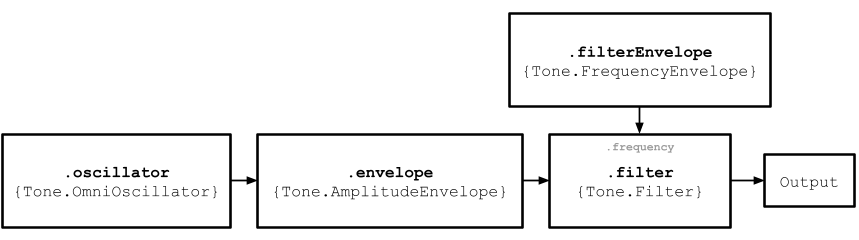 * @example
* const synth = new Tone.MonoSynth({
* oscillator: {
* type: "square"
* },
* envelope: {
* attack: 0.1
* }
* }).toDestination();
* synth.triggerAttackRelease("C4", "8n");
* @category Instrument
*/
class MonoSynth extends Monophonic {
constructor() {
super(optionsFromArguments(MonoSynth.getDefaults(), arguments));
this.name = "MonoSynth";
const options = optionsFromArguments(MonoSynth.getDefaults(), arguments);
this.oscillator = new OmniOscillator(Object.assign(options.oscillator, {
context: this.context,
detune: options.detune,
onstop: () => this.onsilence(this),
}));
this.frequency = this.oscillator.frequency;
this.detune = this.oscillator.detune;
this.filter = new Filter(Object.assign(options.filter, { context: this.context }));
this.filterEnvelope = new FrequencyEnvelope(Object.assign(options.filterEnvelope, { context: this.context }));
this.envelope = new AmplitudeEnvelope(Object.assign(options.envelope, { context: this.context }));
// connect the oscillators to the output
this.oscillator.chain(this.filter, this.envelope, this.output);
// connect the filter envelope
this.filterEnvelope.connect(this.filter.frequency);
readOnly(this, ["oscillator", "frequency", "detune", "filter", "filterEnvelope", "envelope"]);
}
static getDefaults() {
return Object.assign(Monophonic.getDefaults(), {
envelope: Object.assign(omitFromObject(Envelope.getDefaults(), Object.keys(ToneAudioNode.getDefaults())), {
attack: 0.005,
decay: 0.1,
release: 1,
sustain: 0.9,
}),
filter: Object.assign(omitFromObject(Filter.getDefaults(), Object.keys(ToneAudioNode.getDefaults())), {
Q: 1,
rolloff: -12,
type: "lowpass",
}),
filterEnvelope: Object.assign(omitFromObject(FrequencyEnvelope.getDefaults(), Object.keys(ToneAudioNode.getDefaults())), {
attack: 0.6,
baseFrequency: 200,
decay: 0.2,
exponent: 2,
octaves: 3,
release: 2,
sustain: 0.5,
}),
oscillator: Object.assign(omitFromObject(OmniOscillator.getDefaults(), Object.keys(Source.getDefaults())), {
type: "sawtooth",
}),
});
}
/**
* start the attack portion of the envelope
* @param time the time the attack should start
* @param velocity the velocity of the note (0-1)
*/
_triggerEnvelopeAttack(time, velocity = 1) {
this.envelope.triggerAttack(time, velocity);
this.filterEnvelope.triggerAttack(time);
this.oscillator.start(time);
if (this.envelope.sustain === 0) {
const computedAttack = this.toSeconds(this.envelope.attack);
const computedDecay = this.toSeconds(this.envelope.decay);
this.oscillator.stop(time + computedAttack + computedDecay);
}
}
/**
* start the release portion of the envelope
* @param time the time the release should start
*/
_triggerEnvelopeRelease(time) {
this.envelope.triggerRelease(time);
this.filterEnvelope.triggerRelease(time);
this.oscillator.stop(time + this.toSeconds(this.envelope.release));
}
getLevelAtTime(time) {
time = this.toSeconds(time);
return this.envelope.getValueAtTime(time);
}
dispose() {
super.dispose();
this.oscillator.dispose();
this.envelope.dispose();
this.filterEnvelope.dispose();
this.filter.dispose();
return this;
}
}
/**
* DuoSynth is a monophonic synth composed of two [[MonoSynths]] run in parallel with control over the
* frequency ratio between the two voices and vibrato effect.
* @example
* const duoSynth = new Tone.DuoSynth().toDestination();
* duoSynth.triggerAttackRelease("C4", "2n");
* @category Instrument
*/
class DuoSynth extends Monophonic {
constructor() {
super(optionsFromArguments(DuoSynth.getDefaults(), arguments));
this.name = "DuoSynth";
const options = optionsFromArguments(DuoSynth.getDefaults(), arguments);
this.voice0 = new MonoSynth(Object.assign(options.voice0, {
context: this.context,
onsilence: () => this.onsilence(this)
}));
this.voice1 = new MonoSynth(Object.assign(options.voice1, {
context: this.context,
}));
this.harmonicity = new Multiply({
context: this.context,
units: "positive",
value: options.harmonicity,
});
this._vibrato = new LFO({
frequency: options.vibratoRate,
context: this.context,
min: -50,
max: 50
});
// start the vibrato immediately
this._vibrato.start();
this.vibratoRate = this._vibrato.frequency;
this._vibratoGain = new Gain({
context: this.context,
units: "normalRange",
gain: options.vibratoAmount
});
this.vibratoAmount = this._vibratoGain.gain;
this.frequency = new Signal({
context: this.context,
units: "frequency",
value: 440
});
this.detune = new Signal({
context: this.context,
units: "cents",
value: options.detune
});
// control the two voices frequency
this.frequency.connect(this.voice0.frequency);
this.frequency.chain(this.harmonicity, this.voice1.frequency);
this._vibrato.connect(this._vibratoGain);
this._vibratoGain.fan(this.voice0.detune, this.voice1.detune);
this.detune.fan(this.voice0.detune, this.voice1.detune);
this.voice0.connect(this.output);
this.voice1.connect(this.output);
readOnly(this, ["voice0", "voice1", "frequency", "vibratoAmount", "vibratoRate"]);
}
getLevelAtTime(time) {
time = this.toSeconds(time);
return this.voice0.envelope.getValueAtTime(time) + this.voice1.envelope.getValueAtTime(time);
}
static getDefaults() {
return deepMerge(Monophonic.getDefaults(), {
vibratoAmount: 0.5,
vibratoRate: 5,
harmonicity: 1.5,
voice0: deepMerge(omitFromObject(MonoSynth.getDefaults(), Object.keys(Monophonic.getDefaults())), {
filterEnvelope: {
attack: 0.01,
decay: 0.0,
sustain: 1,
release: 0.5
},
envelope: {
attack: 0.01,
decay: 0.0,
sustain: 1,
release: 0.5
}
}),
voice1: deepMerge(omitFromObject(MonoSynth.getDefaults(), Object.keys(Monophonic.getDefaults())), {
filterEnvelope: {
attack: 0.01,
decay: 0.0,
sustain: 1,
release: 0.5
},
envelope: {
attack: 0.01,
decay: 0.0,
sustain: 1,
release: 0.5
}
}),
});
}
/**
* Trigger the attack portion of the note
*/
_triggerEnvelopeAttack(time, velocity) {
// @ts-ignore
this.voice0._triggerEnvelopeAttack(time, velocity);
// @ts-ignore
this.voice1._triggerEnvelopeAttack(time, velocity);
}
/**
* Trigger the release portion of the note
*/
_triggerEnvelopeRelease(time) {
// @ts-ignore
this.voice0._triggerEnvelopeRelease(time);
// @ts-ignore
this.voice1._triggerEnvelopeRelease(time);
return this;
}
dispose() {
super.dispose();
this.voice0.dispose();
this.voice1.dispose();
this.frequency.dispose();
this.detune.dispose();
this._vibrato.dispose();
this.vibratoRate.dispose();
this._vibratoGain.dispose();
this.harmonicity.dispose();
return this;
}
}
/**
* FMSynth is composed of two Tone.Synths where one Tone.Synth modulates
* the frequency of a second Tone.Synth. A lot of spectral content
* can be explored using the modulationIndex parameter. Read more about
* frequency modulation synthesis on Sound On Sound: [Part 1](https://web.archive.org/web/20160403123704/http://www.soundonsound.com/sos/apr00/articles/synthsecrets.htm), [Part 2](https://web.archive.org/web/20160403115835/http://www.soundonsound.com/sos/may00/articles/synth.htm).
*
* @example
* const fmSynth = new Tone.FMSynth().toDestination();
* fmSynth.triggerAttackRelease("C5", "4n");
*
* @category Instrument
*/
class FMSynth extends ModulationSynth {
constructor() {
super(optionsFromArguments(FMSynth.getDefaults(), arguments));
this.name = "FMSynth";
const options = optionsFromArguments(FMSynth.getDefaults(), arguments);
this.modulationIndex = new Multiply({
context: this.context,
value: options.modulationIndex,
});
// control the two voices frequency
this.frequency.connect(this._carrier.frequency);
this.frequency.chain(this.harmonicity, this._modulator.frequency);
this.frequency.chain(this.modulationIndex, this._modulationNode);
this.detune.fan(this._carrier.detune, this._modulator.detune);
this._modulator.connect(this._modulationNode.gain);
this._modulationNode.connect(this._carrier.frequency);
this._carrier.connect(this.output);
}
static getDefaults() {
return Object.assign(ModulationSynth.getDefaults(), {
modulationIndex: 10,
});
}
dispose() {
super.dispose();
this.modulationIndex.dispose();
return this;
}
}
/**
* Inharmonic ratio of frequencies based on the Roland TR-808
* Taken from https://ccrma.stanford.edu/papers/tr-808-cymbal-physically-informed-circuit-bendable-digital-model
*/
const inharmRatios = [1.0, 1.483, 1.932, 2.546, 2.630, 3.897];
/**
* A highly inharmonic and spectrally complex source with a highpass filter
* and amplitude envelope which is good for making metallophone sounds.
* Based on CymbalSynth by [@polyrhythmatic](https://github.com/polyrhythmatic).
* Inspiration from [Sound on Sound](https://shorturl.at/rSZ12).
* @category Instrument
*/
class MetalSynth extends Monophonic {
constructor() {
super(optionsFromArguments(MetalSynth.getDefaults(), arguments));
this.name = "MetalSynth";
/**
* The array of FMOscillators
*/
this._oscillators = [];
/**
* The frequency multipliers
*/
this._freqMultipliers = [];
const options = optionsFromArguments(MetalSynth.getDefaults(), arguments);
this.detune = new Signal({
context: this.context,
units: "cents",
value: options.detune,
});
this.frequency = new Signal({
context: this.context,
units: "frequency",
});
this._amplitude = new Gain({
context: this.context,
gain: 0,
}).connect(this.output);
this._highpass = new Filter({
// Q: -3.0102999566398125,
Q: 0,
context: this.context,
type: "highpass",
}).connect(this._amplitude);
for (let i = 0; i < inharmRatios.length; i++) {
const osc = new FMOscillator({
context: this.context,
harmonicity: options.harmonicity,
modulationIndex: options.modulationIndex,
modulationType: "square",
onstop: i === 0 ? () => this.onsilence(this) : noOp,
type: "square",
});
osc.connect(this._highpass);
this._oscillators[i] = osc;
const mult = new Multiply({
context: this.context,
value: inharmRatios[i],
});
this._freqMultipliers[i] = mult;
this.frequency.chain(mult, osc.frequency);
this.detune.connect(osc.detune);
}
this._filterFreqScaler = new Scale({
context: this.context,
max: 7000,
min: this.toFrequency(options.resonance),
});
this.envelope = new Envelope({
attack: options.envelope.attack,
attackCurve: "linear",
context: this.context,
decay: options.envelope.decay,
release: options.envelope.release,
sustain: 0,
});
this.envelope.chain(this._filterFreqScaler, this._highpass.frequency);
this.envelope.connect(this._amplitude.gain);
// set the octaves
this._octaves = options.octaves;
this.octaves = options.octaves;
}
static getDefaults() {
return deepMerge(Monophonic.getDefaults(), {
envelope: Object.assign(omitFromObject(Envelope.getDefaults(), Object.keys(ToneAudioNode.getDefaults())), {
attack: 0.001,
decay: 1.4,
release: 0.2,
}),
harmonicity: 5.1,
modulationIndex: 32,
octaves: 1.5,
resonance: 4000,
});
}
/**
* Trigger the attack.
* @param time When the attack should be triggered.
* @param velocity The velocity that the envelope should be triggered at.
*/
_triggerEnvelopeAttack(time, velocity = 1) {
this.envelope.triggerAttack(time, velocity);
this._oscillators.forEach(osc => osc.start(time));
if (this.envelope.sustain === 0) {
this._oscillators.forEach(osc => {
osc.stop(time + this.toSeconds(this.envelope.attack) + this.toSeconds(this.envelope.decay));
});
}
return this;
}
/**
* Trigger the release of the envelope.
* @param time When the release should be triggered.
*/
_triggerEnvelopeRelease(time) {
this.envelope.triggerRelease(time);
this._oscillators.forEach(osc => osc.stop(time + this.toSeconds(this.envelope.release)));
return this;
}
getLevelAtTime(time) {
time = this.toSeconds(time);
return this.envelope.getValueAtTime(time);
}
/**
* The modulationIndex of the oscillators which make up the source.
* see [[FMOscillator.modulationIndex]]
* @min 1
* @max 100
*/
get modulationIndex() {
return this._oscillators[0].modulationIndex.value;
}
set modulationIndex(val) {
this._oscillators.forEach(osc => (osc.modulationIndex.value = val));
}
/**
* The harmonicity of the oscillators which make up the source.
* see Tone.FMOscillator.harmonicity
* @min 0.1
* @max 10
*/
get harmonicity() {
return this._oscillators[0].harmonicity.value;
}
set harmonicity(val) {
this._oscillators.forEach(osc => (osc.harmonicity.value = val));
}
/**
* The lower level of the highpass filter which is attached to the envelope.
* This value should be between [0, 7000]
* @min 0
* @max 7000
*/
get resonance() {
return this._filterFreqScaler.min;
}
set resonance(val) {
this._filterFreqScaler.min = this.toFrequency(val);
this.octaves = this._octaves;
}
/**
* The number of octaves above the "resonance" frequency
* that the filter ramps during the attack/decay envelope
* @min 0
* @max 8
*/
get octaves() {
return this._octaves;
}
set octaves(val) {
this._octaves = val;
this._filterFreqScaler.max = this._filterFreqScaler.min * Math.pow(2, val);
}
dispose() {
super.dispose();
this._oscillators.forEach(osc => osc.dispose());
this._freqMultipliers.forEach(freqMult => freqMult.dispose());
this.frequency.dispose();
this.detune.dispose();
this._filterFreqScaler.dispose();
this._amplitude.dispose();
this.envelope.dispose();
this._highpass.dispose();
return this;
}
}
/**
* Tone.NoiseSynth is composed of [[Noise]] through an [[AmplitudeEnvelope]].
* ```
* +-------+ +-------------------+
* | Noise +>--> AmplitudeEnvelope +>--> Output
* +-------+ +-------------------+
* ```
* @example
* const noiseSynth = new Tone.NoiseSynth().toDestination();
* noiseSynth.triggerAttackRelease("8n", 0.05);
* @category Instrument
*/
class NoiseSynth extends Instrument {
constructor() {
super(optionsFromArguments(NoiseSynth.getDefaults(), arguments));
this.name = "NoiseSynth";
const options = optionsFromArguments(NoiseSynth.getDefaults(), arguments);
this.noise = new Noise(Object.assign({
context: this.context,
}, options.noise));
this.envelope = new AmplitudeEnvelope(Object.assign({
context: this.context,
}, options.envelope));
// connect the noise to the output
this.noise.chain(this.envelope, this.output);
}
static getDefaults() {
return Object.assign(Instrument.getDefaults(), {
envelope: Object.assign(omitFromObject(Envelope.getDefaults(), Object.keys(ToneAudioNode.getDefaults())), {
decay: 0.1,
sustain: 0.0,
}),
noise: Object.assign(omitFromObject(Noise.getDefaults(), Object.keys(Source.getDefaults())), {
type: "white",
}),
});
}
/**
* Start the attack portion of the envelopes. Unlike other
* instruments, Tone.NoiseSynth doesn't have a note.
* @example
* const noiseSynth = new Tone.NoiseSynth().toDestination();
* noiseSynth.triggerAttack();
*/
triggerAttack(time, velocity = 1) {
time = this.toSeconds(time);
// the envelopes
this.envelope.triggerAttack(time, velocity);
// start the noise
this.noise.start(time);
if (this.envelope.sustain === 0) {
this.noise.stop(time + this.toSeconds(this.envelope.attack) + this.toSeconds(this.envelope.decay));
}
return this;
}
/**
* Start the release portion of the envelopes.
*/
triggerRelease(time) {
time = this.toSeconds(time);
this.envelope.triggerRelease(time);
this.noise.stop(time + this.toSeconds(this.envelope.release));
return this;
}
sync() {
if (this._syncState()) {
this._syncMethod("triggerAttack", 0);
this._syncMethod("triggerRelease", 0);
}
return this;
}
triggerAttackRelease(duration, time, velocity = 1) {
time = this.toSeconds(time);
duration = this.toSeconds(duration);
this.triggerAttack(time, velocity);
this.triggerRelease(time + duration);
return this;
}
dispose() {
super.dispose();
this.noise.dispose();
this.envelope.dispose();
return this;
}
}
class ToneAudioWorklet extends ToneAudioNode {
constructor(options) {
super(options);
this.name = "ToneAudioWorklet";
/**
* The constructor options for the node
*/
this.workletOptions = {};
/**
* Callback which is invoked when there is an error in the processing
*/
this.onprocessorerror = noOp;
const blobUrl = URL.createObjectURL(new Blob([getWorkletGlobalScope()], { type: "text/javascript" }));
const name = this._audioWorkletName();
this._dummyGain = this.context.createGain();
this._dummyParam = this._dummyGain.gain;
// Register the processor
this.context.addAudioWorkletModule(blobUrl, name).then(() => {
// create the worklet when it's read
if (!this.disposed) {
this._worklet = this.context.createAudioWorkletNode(name, this.workletOptions);
this._worklet.onprocessorerror = this.onprocessorerror.bind(this);
this.onReady(this._worklet);
}
});
}
dispose() {
super.dispose();
this._dummyGain.disconnect();
if (this._worklet) {
this._worklet.port.postMessage("dispose");
this._worklet.disconnect();
}
return this;
}
}
/**
* Comb filters are basic building blocks for physical modeling. Read more
* about comb filters on [CCRMA's website](https://ccrma.stanford.edu/~jos/pasp/Feedback_Comb_Filters.html).
*
* This comb filter is implemented with the AudioWorkletNode which allows it to have feedback delays less than the
* Web Audio processing block of 128 samples. There is a polyfill for browsers that don't yet support the
* AudioWorkletNode, but it will add some latency and have slower performance than the AudioWorkletNode.
* @category Component
*/
class FeedbackCombFilter extends ToneAudioWorklet {
constructor() {
super(optionsFromArguments(FeedbackCombFilter.getDefaults(), arguments, ["delayTime", "resonance"]));
this.name = "FeedbackCombFilter";
const options = optionsFromArguments(FeedbackCombFilter.getDefaults(), arguments, ["delayTime", "resonance"]);
this.input = new Gain({ context: this.context });
this.output = new Gain({ context: this.context });
this.delayTime = new Param({
context: this.context,
value: options.delayTime,
units: "time",
minValue: 0,
maxValue: 1,
param: this._dummyParam,
swappable: true,
});
this.resonance = new Param({
context: this.context,
value: options.resonance,
units: "normalRange",
param: this._dummyParam,
swappable: true,
});
readOnly(this, ["resonance", "delayTime"]);
}
_audioWorkletName() {
return workletName;
}
/**
* The default parameters
*/
static getDefaults() {
return Object.assign(ToneAudioNode.getDefaults(), {
delayTime: 0.1,
resonance: 0.5,
});
}
onReady(node) {
connectSeries(this.input, node, this.output);
const delayTime = node.parameters.get("delayTime");
this.delayTime.setParam(delayTime);
const feedback = node.parameters.get("feedback");
this.resonance.setParam(feedback);
}
dispose() {
super.dispose();
this.input.dispose();
this.output.dispose();
this.delayTime.dispose();
this.resonance.dispose();
return this;
}
}
/**
* A one pole filter with 6db-per-octave rolloff. Either "highpass" or "lowpass".
* Note that changing the type or frequency may result in a discontinuity which
* can sound like a click or pop.
* References:
* * http://www.earlevel.com/main/2012/12/15/a-one-pole-filter/
* * http://www.dspguide.com/ch19/2.htm
* * https://github.com/vitaliy-bobrov/js-rocks/blob/master/src/app/audio/effects/one-pole-filters.ts
* @category Component
*/
class OnePoleFilter extends ToneAudioNode {
constructor() {
super(optionsFromArguments(OnePoleFilter.getDefaults(), arguments, ["frequency", "type"]));
this.name = "OnePoleFilter";
const options = optionsFromArguments(OnePoleFilter.getDefaults(), arguments, ["frequency", "type"]);
this._frequency = options.frequency;
this._type = options.type;
this.input = new Gain({ context: this.context });
this.output = new Gain({ context: this.context });
this._createFilter();
}
static getDefaults() {
return Object.assign(ToneAudioNode.getDefaults(), {
frequency: 880,
type: "lowpass"
});
}
/**
* Create a filter and dispose the old one
*/
_createFilter() {
const oldFilter = this._filter;
const freq = this.toFrequency(this._frequency);
const t = 1 / (2 * Math.PI * freq);
if (this._type === "lowpass") {
const a0 = 1 / (t * this.context.sampleRate);
const b1 = a0 - 1;
this._filter = this.context.createIIRFilter([a0, 0], [1, b1]);
}
else {
const b1 = 1 / (t * this.context.sampleRate) - 1;
this._filter = this.context.createIIRFilter([1, -1], [1, b1]);
}
this.input.chain(this._filter, this.output);
if (oldFilter) {
// dispose it on the next block
this.context.setTimeout(() => {
if (!this.disposed) {
this.input.disconnect(oldFilter);
oldFilter.disconnect();
}
}, this.blockTime);
}
}
/**
* The frequency value.
*/
get frequency() {
return this._frequency;
}
set frequency(fq) {
this._frequency = fq;
this._createFilter();
}
/**
* The OnePole Filter type, either "highpass" or "lowpass"
*/
get type() {
return this._type;
}
set type(t) {
this._type = t;
this._createFilter();
}
/**
* Get the frequency response curve. This curve represents how the filter
* responses to frequencies between 20hz-20khz.
* @param len The number of values to return
* @return The frequency response curve between 20-20kHz
*/
getFrequencyResponse(len = 128) {
const freqValues = new Float32Array(len);
for (let i = 0; i < len; i++) {
const norm = Math.pow(i / len, 2);
const freq = norm * (20000 - 20) + 20;
freqValues[i] = freq;
}
const magValues = new Float32Array(len);
const phaseValues = new Float32Array(len);
this._filter.getFrequencyResponse(freqValues, magValues, phaseValues);
return magValues;
}
dispose() {
super.dispose();
this.input.dispose();
this.output.dispose();
this._filter.disconnect();
return this;
}
}
/**
* A lowpass feedback comb filter. It is similar to
* [[FeedbackCombFilter]], but includes a lowpass filter.
* @category Component
*/
class LowpassCombFilter extends ToneAudioNode {
constructor() {
super(optionsFromArguments(LowpassCombFilter.getDefaults(), arguments, ["delayTime", "resonance", "dampening"]));
this.name = "LowpassCombFilter";
const options = optionsFromArguments(LowpassCombFilter.getDefaults(), arguments, ["delayTime", "resonance", "dampening"]);
this._combFilter = this.output = new FeedbackCombFilter({
context: this.context,
delayTime: options.delayTime,
resonance: options.resonance,
});
this.delayTime = this._combFilter.delayTime;
this.resonance = this._combFilter.resonance;
this._lowpass = this.input = new OnePoleFilter({
context: this.context,
frequency: options.dampening,
type: "lowpass",
});
// connections
this._lowpass.connect(this._combFilter);
}
static getDefaults() {
return Object.assign(ToneAudioNode.getDefaults(), {
dampening: 3000,
delayTime: 0.1,
resonance: 0.5,
});
}
/**
* The dampening control of the feedback
*/
get dampening() {
return this._lowpass.frequency;
}
set dampening(fq) {
this._lowpass.frequency = fq;
}
dispose() {
super.dispose();
this._combFilter.dispose();
this._lowpass.dispose();
return this;
}
}
/**
* Karplus-String string synthesis.
* @example
* const plucky = new Tone.PluckSynth().toDestination();
* plucky.triggerAttack("C4", "+0.5");
* plucky.triggerAttack("C3", "+1");
* plucky.triggerAttack("C2", "+1.5");
* plucky.triggerAttack("C1", "+2");
* @category Instrument
*/
class PluckSynth extends Instrument {
constructor() {
super(optionsFromArguments(PluckSynth.getDefaults(), arguments));
this.name = "PluckSynth";
const options = optionsFromArguments(PluckSynth.getDefaults(), arguments);
this._noise = new Noise({
context: this.context,
type: "pink"
});
this.attackNoise = options.attackNoise;
this._lfcf = new LowpassCombFilter({
context: this.context,
dampening: options.dampening,
resonance: options.resonance,
});
this.resonance = options.resonance;
this.release = options.release;
this._noise.connect(this._lfcf);
this._lfcf.connect(this.output);
}
static getDefaults() {
return deepMerge(Instrument.getDefaults(), {
attackNoise: 1,
dampening: 4000,
resonance: 0.7,
release: 1,
});
}
/**
* The dampening control. i.e. the lowpass filter frequency of the comb filter
* @min 0
* @max 7000
*/
get dampening() {
return this._lfcf.dampening;
}
set dampening(fq) {
this._lfcf.dampening = fq;
}
triggerAttack(note, time) {
const freq = this.toFrequency(note);
time = this.toSeconds(time);
const delayAmount = 1 / freq;
this._lfcf.delayTime.setValueAtTime(delayAmount, time);
this._noise.start(time);
this._noise.stop(time + delayAmount * this.attackNoise);
this._lfcf.resonance.cancelScheduledValues(time);
this._lfcf.resonance.setValueAtTime(this.resonance, time);
return this;
}
/**
* Ramp down the [[resonance]] to 0 over the duration of the release time.
*/
triggerRelease(time) {
this._lfcf.resonance.linearRampTo(0, this.release, time);
return this;
}
dispose() {
super.dispose();
this._noise.dispose();
this._lfcf.dispose();
return this;
}
}
/**
* PolySynth handles voice creation and allocation for any
* instruments passed in as the second paramter. PolySynth is
* not a synthesizer by itself, it merely manages voices of
* one of the other types of synths, allowing any of the
* monophonic synthesizers to be polyphonic.
*
* @example
* const synth = new Tone.PolySynth().toDestination();
* // set the attributes across all the voices using 'set'
* synth.set({ detune: -1200 });
* // play a chord
* synth.triggerAttackRelease(["C4", "E4", "A4"], 1);
* @category Instrument
*/
class PolySynth extends Instrument {
constructor() {
super(optionsFromArguments(PolySynth.getDefaults(), arguments, ["voice", "options"]));
this.name = "PolySynth";
/**
* The voices which are not currently in use
*/
this._availableVoices = [];
/**
* The currently active voices
*/
this._activeVoices = [];
/**
* All of the allocated voices for this synth.
*/
this._voices = [];
/**
* The GC timeout. Held so that it could be cancelled when the node is disposed.
*/
this._gcTimeout = -1;
/**
* A moving average of the number of active voices
*/
this._averageActiveVoices = 0;
const options = optionsFromArguments(PolySynth.getDefaults(), arguments, ["voice", "options"]);
// check against the old API (pre 14.3.0)
assert(!isNumber(options.voice), "DEPRECATED: The polyphony count is no longer the first argument.");
const defaults = options.voice.getDefaults();
this.options = Object.assign(defaults, options.options);
this.voice = options.voice;
this.maxPolyphony = options.maxPolyphony;
// create the first voice
this._dummyVoice = this._getNextAvailableVoice();
// remove it from the voices list
const index = this._voices.indexOf(this._dummyVoice);
this._voices.splice(index, 1);
// kick off the GC interval
this._gcTimeout = this.context.setInterval(this._collectGarbage.bind(this), 1);
}
static getDefaults() {
return Object.assign(Instrument.getDefaults(), {
maxPolyphony: 32,
options: {},
voice: Synth,
});
}
/**
* The number of active voices.
*/
get activeVoices() {
return this._activeVoices.length;
}
/**
* Invoked when the source is done making sound, so that it can be
* readded to the pool of available voices
*/
_makeVoiceAvailable(voice) {
this._availableVoices.push(voice);
// remove the midi note from 'active voices'
const activeVoiceIndex = this._activeVoices.findIndex((e) => e.voice === voice);
this._activeVoices.splice(activeVoiceIndex, 1);
}
/**
* Get an available voice from the pool of available voices.
* If one is not available and the maxPolyphony limit is reached,
* steal a voice, otherwise return null.
*/
_getNextAvailableVoice() {
// if there are available voices, return the first one
if (this._availableVoices.length) {
return this._availableVoices.shift();
}
else if (this._voices.length < this.maxPolyphony) {
// otherwise if there is still more maxPolyphony, make a new voice
const voice = new this.voice(Object.assign(this.options, {
context: this.context,
onsilence: this._makeVoiceAvailable.bind(this),
}));
voice.connect(this.output);
this._voices.push(voice);
return voice;
}
else {
warn("Max polyphony exceeded. Note dropped.");
}
}
/**
* Occasionally check if there are any allocated voices which can be cleaned up.
*/
_collectGarbage() {
this._averageActiveVoices = Math.max(this._averageActiveVoices * 0.95, this.activeVoices);
if (this._availableVoices.length && this._voices.length > Math.ceil(this._averageActiveVoices + 1)) {
// take off an available note
const firstAvail = this._availableVoices.shift();
const index = this._voices.indexOf(firstAvail);
this._voices.splice(index, 1);
if (!this.context.isOffline) {
firstAvail.dispose();
}
}
}
/**
* Internal method which triggers the attack
*/
_triggerAttack(notes, time, velocity) {
notes.forEach(note => {
const midiNote = new MidiClass(this.context, note).toMidi();
const voice = this._getNextAvailableVoice();
if (voice) {
voice.triggerAttack(note, time, velocity);
this._activeVoices.push({
midi: midiNote, voice, released: false,
});
this.log("triggerAttack", note, time);
}
});
}
/**
* Internal method which triggers the release
*/
_triggerRelease(notes, time) {
notes.forEach(note => {
const midiNote = new MidiClass(this.context, note).toMidi();
const event = this._activeVoices.find(({ midi, released }) => midi === midiNote && !released);
if (event) {
// trigger release on that note
event.voice.triggerRelease(time);
// mark it as released
event.released = true;
this.log("triggerRelease", note, time);
}
});
}
/**
* Schedule the attack/release events. If the time is in the future, then it should set a timeout
* to wait for just-in-time scheduling
*/
_scheduleEvent(type, notes, time, velocity) {
assert(!this.disposed, "Synth was already disposed");
// if the notes are greater than this amount of time in the future, they should be scheduled with setTimeout
if (time <= this.now()) {
// do it immediately
if (type === "attack") {
this._triggerAttack(notes, time, velocity);
}
else {
this._triggerRelease(notes, time);
}
}
else {
// schedule it to start in the future
this.context.setTimeout(() => {
this._scheduleEvent(type, notes, time, velocity);
}, time - this.now());
}
}
/**
* Trigger the attack portion of the note
* @param notes The notes to play. Accepts a single Frequency or an array of frequencies.
* @param time The start time of the note.
* @param velocity The velocity of the note.
* @example
* const synth = new Tone.PolySynth(Tone.FMSynth).toDestination();
* // trigger a chord immediately with a velocity of 0.2
* synth.triggerAttack(["Ab3", "C4", "F5"], Tone.now(), 0.2);
*/
triggerAttack(notes, time, velocity) {
if (!Array.isArray(notes)) {
notes = [notes];
}
const computedTime = this.toSeconds(time);
this._scheduleEvent("attack", notes, computedTime, velocity);
return this;
}
/**
* Trigger the release of the note. Unlike monophonic instruments,
* a note (or array of notes) needs to be passed in as the first argument.
* @param notes The notes to play. Accepts a single Frequency or an array of frequencies.
* @param time When the release will be triggered.
* @example
* @example
* const poly = new Tone.PolySynth(Tone.AMSynth).toDestination();
* poly.triggerAttack(["Ab3", "C4", "F5"]);
* // trigger the release of the given notes.
* poly.triggerRelease(["Ab3", "C4"], "+1");
* poly.triggerRelease("F5", "+3");
*/
triggerRelease(notes, time) {
if (!Array.isArray(notes)) {
notes = [notes];
}
const computedTime = this.toSeconds(time);
this._scheduleEvent("release", notes, computedTime);
return this;
}
/**
* Trigger the attack and release after the specified duration
* @param notes The notes to play. Accepts a single Frequency or an array of frequencies.
* @param duration the duration of the note
* @param time if no time is given, defaults to now
* @param velocity the velocity of the attack (0-1)
* @example
* const poly = new Tone.PolySynth(Tone.AMSynth).toDestination();
* // can pass in an array of durations as well
* poly.triggerAttackRelease(["Eb3", "G4", "Bb4", "D5"], [4, 3, 2, 1]);
*/
triggerAttackRelease(notes, duration, time, velocity) {
const computedTime = this.toSeconds(time);
this.triggerAttack(notes, computedTime, velocity);
if (isArray(duration)) {
assert(isArray(notes), "If the duration is an array, the notes must also be an array");
notes = notes;
for (let i = 0; i < notes.length; i++) {
const d = duration[Math.min(i, duration.length - 1)];
const durationSeconds = this.toSeconds(d);
assert(durationSeconds > 0, "The duration must be greater than 0");
this.triggerRelease(notes[i], computedTime + durationSeconds);
}
}
else {
const durationSeconds = this.toSeconds(duration);
assert(durationSeconds > 0, "The duration must be greater than 0");
this.triggerRelease(notes, computedTime + durationSeconds);
}
return this;
}
sync() {
if (this._syncState()) {
this._syncMethod("triggerAttack", 1);
this._syncMethod("triggerRelease", 1);
}
return this;
}
/**
* Set a member/attribute of the voices
* @example
* const poly = new Tone.PolySynth().toDestination();
* // set all of the voices using an options object for the synth type
* poly.set({
* envelope: {
* attack: 0.25
* }
* });
* poly.triggerAttackRelease("Bb3", 0.2);
*/
set(options) {
// remove options which are controlled by the PolySynth
const sanitizedOptions = omitFromObject(options, ["onsilence", "context"]);
// store all of the options
this.options = deepMerge(this.options, sanitizedOptions);
this._voices.forEach(voice => voice.set(sanitizedOptions));
this._dummyVoice.set(sanitizedOptions);
return this;
}
get() {
return this._dummyVoice.get();
}
/**
* Trigger the release portion of all the currently active voices immediately.
* Useful for silencing the synth.
*/
releaseAll(time) {
const computedTime = this.toSeconds(time);
this._activeVoices.forEach(({ voice }) => {
voice.triggerRelease(computedTime);
});
return this;
}
dispose() {
super.dispose();
this._dummyVoice.dispose();
this._voices.forEach(v => v.dispose());
this._activeVoices = [];
this._availableVoices = [];
this.context.clearInterval(this._gcTimeout);
return this;
}
}
/**
* ToneEvent abstracts away this.context.transport.schedule and provides a schedulable
* callback for a single or repeatable events along the timeline.
*
* @example
* const synth = new Tone.PolySynth().toDestination();
* const chordEvent = new Tone.ToneEvent(((time, chord) => {
* // the chord as well as the exact time of the event
* // are passed in as arguments to the callback function
* synth.triggerAttackRelease(chord, 0.5, time);
* }), ["D4", "E4", "F4"]);
* // start the chord at the beginning of the transport timeline
* chordEvent.start();
* // loop it every measure for 8 measures
* chordEvent.loop = 8;
* chordEvent.loopEnd = "1m";
* @category Event
*/
class ToneEvent extends ToneWithContext {
constructor() {
super(optionsFromArguments(ToneEvent.getDefaults(), arguments, ["callback", "value"]));
this.name = "ToneEvent";
/**
* Tracks the scheduled events
*/
this._state = new StateTimeline("stopped");
/**
* A delay time from when the event is scheduled to start
*/
this._startOffset = 0;
const options = optionsFromArguments(ToneEvent.getDefaults(), arguments, ["callback", "value"]);
this._loop = options.loop;
this.callback = options.callback;
this.value = options.value;
this._loopStart = this.toTicks(options.loopStart);
this._loopEnd = this.toTicks(options.loopEnd);
this._playbackRate = options.playbackRate;
this._probability = options.probability;
this._humanize = options.humanize;
this.mute = options.mute;
this._playbackRate = options.playbackRate;
this._state.increasing = true;
// schedule the events for the first time
this._rescheduleEvents();
}
static getDefaults() {
return Object.assign(ToneWithContext.getDefaults(), {
callback: noOp,
humanize: false,
loop: false,
loopEnd: "1m",
loopStart: 0,
mute: false,
playbackRate: 1,
probability: 1,
value: null,
});
}
/**
* Reschedule all of the events along the timeline
* with the updated values.
* @param after Only reschedules events after the given time.
*/
_rescheduleEvents(after = -1) {
// if no argument is given, schedules all of the events
this._state.forEachFrom(after, event => {
let duration;
if (event.state === "started") {
if (event.id !== -1) {
this.context.transport.clear(event.id);
}
const startTick = event.time + Math.round(this.startOffset / this._playbackRate);
if (this._loop === true || isNumber(this._loop) && this._loop > 1) {
duration = Infinity;
if (isNumber(this._loop)) {
duration = (this._loop) * this._getLoopDuration();
}
const nextEvent = this._state.getAfter(startTick);
if (nextEvent !== null) {
duration = Math.min(duration, nextEvent.time - startTick);
}
if (duration !== Infinity) {
// schedule a stop since it's finite duration
this._state.setStateAtTime("stopped", startTick + duration + 1, { id: -1 });
duration = new TicksClass(this.context, duration);
}
const interval = new TicksClass(this.context, this._getLoopDuration());
event.id = this.context.transport.scheduleRepeat(this._tick.bind(this), interval, new TicksClass(this.context, startTick), duration);
}
else {
event.id = this.context.transport.schedule(this._tick.bind(this), new TicksClass(this.context, startTick));
}
}
});
}
/**
* Returns the playback state of the note, either "started" or "stopped".
*/
get state() {
return this._state.getValueAtTime(this.context.transport.ticks);
}
/**
* The start from the scheduled start time.
*/
get startOffset() {
return this._startOffset;
}
set startOffset(offset) {
this._startOffset = offset;
}
/**
* The probability of the notes being triggered.
*/
get probability() {
return this._probability;
}
set probability(prob) {
this._probability = prob;
}
/**
* If set to true, will apply small random variation
* to the callback time. If the value is given as a time, it will randomize
* by that amount.
* @example
* const event = new Tone.ToneEvent();
* event.humanize = true;
*/
get humanize() {
return this._humanize;
}
set humanize(variation) {
this._humanize = variation;
}
/**
* Start the note at the given time.
* @param time When the event should start.
*/
start(time) {
const ticks = this.toTicks(time);
if (this._state.getValueAtTime(ticks) === "stopped") {
this._state.add({
id: -1,
state: "started",
time: ticks,
});
this._rescheduleEvents(ticks);
}
return this;
}
/**
* Stop the Event at the given time.
* @param time When the event should stop.
*/
stop(time) {
this.cancel(time);
const ticks = this.toTicks(time);
if (this._state.getValueAtTime(ticks) === "started") {
this._state.setStateAtTime("stopped", ticks, { id: -1 });
const previousEvent = this._state.getBefore(ticks);
let reschedulTime = ticks;
if (previousEvent !== null) {
reschedulTime = previousEvent.time;
}
this._rescheduleEvents(reschedulTime);
}
return this;
}
/**
* Cancel all scheduled events greater than or equal to the given time
* @param time The time after which events will be cancel.
*/
cancel(time) {
time = defaultArg(time, -Infinity);
const ticks = this.toTicks(time);
this._state.forEachFrom(ticks, event => {
this.context.transport.clear(event.id);
});
this._state.cancel(ticks);
return this;
}
/**
* The callback function invoker. Also
* checks if the Event is done playing
* @param time The time of the event in seconds
*/
_tick(time) {
const ticks = this.context.transport.getTicksAtTime(time);
if (!this.mute && this._state.getValueAtTime(ticks) === "started") {
if (this.probability < 1 && Math.random() > this.probability) {
return;
}
if (this.humanize) {
let variation = 0.02;
if (!isBoolean(this.humanize)) {
variation = this.toSeconds(this.humanize);
}
time += (Math.random() * 2 - 1) * variation;
}
this.callback(time, this.value);
}
}
/**
* Get the duration of the loop.
*/
_getLoopDuration() {
return Math.round((this._loopEnd - this._loopStart) / this._playbackRate);
}
/**
* If the note should loop or not
* between ToneEvent.loopStart and
* ToneEvent.loopEnd. If set to true,
* the event will loop indefinitely,
* if set to a number greater than 1
* it will play a specific number of
* times, if set to false, 0 or 1, the
* part will only play once.
*/
get loop() {
return this._loop;
}
set loop(loop) {
this._loop = loop;
this._rescheduleEvents();
}
/**
* The playback rate of the note. Defaults to 1.
* @example
* const note = new Tone.ToneEvent();
* note.loop = true;
* // repeat the note twice as fast
* note.playbackRate = 2;
*/
get playbackRate() {
return this._playbackRate;
}
set playbackRate(rate) {
this._playbackRate = rate;
this._rescheduleEvents();
}
/**
* The loopEnd point is the time the event will loop
* if ToneEvent.loop is true.
*/
get loopEnd() {
return new TicksClass(this.context, this._loopEnd).toSeconds();
}
set loopEnd(loopEnd) {
this._loopEnd = this.toTicks(loopEnd);
if (this._loop) {
this._rescheduleEvents();
}
}
/**
* The time when the loop should start.
*/
get loopStart() {
return new TicksClass(this.context, this._loopStart).toSeconds();
}
set loopStart(loopStart) {
this._loopStart = this.toTicks(loopStart);
if (this._loop) {
this._rescheduleEvents();
}
}
/**
* The current progress of the loop interval.
* Returns 0 if the event is not started yet or
* it is not set to loop.
*/
get progress() {
if (this._loop) {
const ticks = this.context.transport.ticks;
const lastEvent = this._state.get(ticks);
if (lastEvent !== null && lastEvent.state === "started") {
const loopDuration = this._getLoopDuration();
const progress = (ticks - lastEvent.time) % loopDuration;
return progress / loopDuration;
}
else {
return 0;
}
}
else {
return 0;
}
}
dispose() {
super.dispose();
this.cancel();
this._state.dispose();
return this;
}
}
/**
* Loop creates a looped callback at the
* specified interval. The callback can be
* started, stopped and scheduled along
* the Transport's timeline.
* @example
* const loop = new Tone.Loop((time) => {
* // triggered every eighth note.
* console.log(time);
* }, "8n").start(0);
* Tone.Transport.start();
* @category Event
*/
class Loop extends ToneWithContext {
constructor() {
super(optionsFromArguments(Loop.getDefaults(), arguments, ["callback", "interval"]));
this.name = "Loop";
const options = optionsFromArguments(Loop.getDefaults(), arguments, ["callback", "interval"]);
this._event = new ToneEvent({
context: this.context,
callback: this._tick.bind(this),
loop: true,
loopEnd: options.interval,
playbackRate: options.playbackRate,
probability: options.probability
});
this.callback = options.callback;
// set the iterations
this.iterations = options.iterations;
}
static getDefaults() {
return Object.assign(ToneWithContext.getDefaults(), {
interval: "4n",
callback: noOp,
playbackRate: 1,
iterations: Infinity,
probability: 1,
mute: false,
humanize: false
});
}
/**
* Start the loop at the specified time along the Transport's timeline.
* @param time When to start the Loop.
*/
start(time) {
this._event.start(time);
return this;
}
/**
* Stop the loop at the given time.
* @param time When to stop the Loop.
*/
stop(time) {
this._event.stop(time);
return this;
}
/**
* Cancel all scheduled events greater than or equal to the given time
* @param time The time after which events will be cancel.
*/
cancel(time) {
this._event.cancel(time);
return this;
}
/**
* Internal function called when the notes should be called
* @param time The time the event occurs
*/
_tick(time) {
this.callback(time);
}
/**
* The state of the Loop, either started or stopped.
*/
get state() {
return this._event.state;
}
/**
* The progress of the loop as a value between 0-1. 0, when the loop is stopped or done iterating.
*/
get progress() {
return this._event.progress;
}
/**
* The time between successive callbacks.
* @example
* const loop = new Tone.Loop();
* loop.interval = "8n"; // loop every 8n
*/
get interval() {
return this._event.loopEnd;
}
set interval(interval) {
this._event.loopEnd = interval;
}
/**
* The playback rate of the loop. The normal playback rate is 1 (no change).
* A `playbackRate` of 2 would be twice as fast.
*/
get playbackRate() {
return this._event.playbackRate;
}
set playbackRate(rate) {
this._event.playbackRate = rate;
}
/**
* Random variation +/-0.01s to the scheduled time.
* Or give it a time value which it will randomize by.
*/
get humanize() {
return this._event.humanize;
}
set humanize(variation) {
this._event.humanize = variation;
}
/**
* The probably of the callback being invoked.
*/
get probability() {
return this._event.probability;
}
set probability(prob) {
this._event.probability = prob;
}
/**
* Muting the Loop means that no callbacks are invoked.
*/
get mute() {
return this._event.mute;
}
set mute(mute) {
this._event.mute = mute;
}
/**
* The number of iterations of the loop. The default value is `Infinity` (loop forever).
*/
get iterations() {
if (this._event.loop === true) {
return Infinity;
}
else {
return this._event.loop;
}
}
set iterations(iters) {
if (iters === Infinity) {
this._event.loop = true;
}
else {
this._event.loop = iters;
}
}
dispose() {
super.dispose();
this._event.dispose();
return this;
}
}
/**
* Part is a collection ToneEvents which can be started/stopped and looped as a single unit.
*
* @example
* const synth = new Tone.Synth().toDestination();
* const part = new Tone.Part(((time, note) => {
* // the notes given as the second element in the array
* // will be passed in as the second argument
* synth.triggerAttackRelease(note, "8n", time);
* }), [[0, "C2"], ["0:2", "C3"], ["0:3:2", "G2"]]);
* Tone.Transport.start();
* @example
* const synth = new Tone.Synth().toDestination();
* // use an array of objects as long as the object has a "time" attribute
* const part = new Tone.Part(((time, value) => {
* // the value is an object which contains both the note and the velocity
* synth.triggerAttackRelease(value.note, "8n", time, value.velocity);
* }), [{ time: 0, note: "C3", velocity: 0.9 },
* { time: "0:2", note: "C4", velocity: 0.5 }
* ]).start(0);
* Tone.Transport.start();
* @category Event
*/
class Part extends ToneEvent {
constructor() {
super(optionsFromArguments(Part.getDefaults(), arguments, ["callback", "events"]));
this.name = "Part";
/**
* Tracks the scheduled events
*/
this._state = new StateTimeline("stopped");
/**
* The events that belong to this part
*/
this._events = new Set();
const options = optionsFromArguments(Part.getDefaults(), arguments, ["callback", "events"]);
// make sure things are assigned in the right order
this._state.increasing = true;
// add the events
options.events.forEach(event => {
if (isArray(event)) {
this.add(event[0], event[1]);
}
else {
this.add(event);
}
});
}
static getDefaults() {
return Object.assign(ToneEvent.getDefaults(), {
events: [],
});
}
/**
* Start the part at the given time.
* @param time When to start the part.
* @param offset The offset from the start of the part to begin playing at.
*/
start(time, offset) {
const ticks = this.toTicks(time);
if (this._state.getValueAtTime(ticks) !== "started") {
offset = defaultArg(offset, this._loop ? this._loopStart : 0);
if (this._loop) {
offset = defaultArg(offset, this._loopStart);
}
else {
offset = defaultArg(offset, 0);
}
const computedOffset = this.toTicks(offset);
this._state.add({
id: -1,
offset: computedOffset,
state: "started",
time: ticks,
});
this._forEach(event => {
this._startNote(event, ticks, computedOffset);
});
}
return this;
}
/**
* Start the event in the given event at the correct time given
* the ticks and offset and looping.
* @param event
* @param ticks
* @param offset
*/
_startNote(event, ticks, offset) {
ticks -= offset;
if (this._loop) {
if (event.startOffset >= this._loopStart && event.startOffset < this._loopEnd) {
if (event.startOffset < offset) {
// start it on the next loop
ticks += this._getLoopDuration();
}
event.start(new TicksClass(this.context, ticks));
}
else if (event.startOffset < this._loopStart && event.startOffset >= offset) {
event.loop = false;
event.start(new TicksClass(this.context, ticks));
}
}
else if (event.startOffset >= offset) {
event.start(new TicksClass(this.context, ticks));
}
}
get startOffset() {
return this._startOffset;
}
set startOffset(offset) {
this._startOffset = offset;
this._forEach(event => {
event.startOffset += this._startOffset;
});
}
/**
* Stop the part at the given time.
* @param time When to stop the part.
*/
stop(time) {
const ticks = this.toTicks(time);
this._state.cancel(ticks);
this._state.setStateAtTime("stopped", ticks);
this._forEach(event => {
event.stop(time);
});
return this;
}
/**
* Get/Set an Event's value at the given time.
* If a value is passed in and no event exists at
* the given time, one will be created with that value.
* If two events are at the same time, the first one will
* be returned.
* @example
* const part = new Tone.Part();
* part.at("1m"); // returns the part at the first measure
* part.at("2m", "C2"); // set the value at "2m" to C2.
* // if an event didn't exist at that time, it will be created.
* @param time The time of the event to get or set.
* @param value If a value is passed in, the value of the event at the given time will be set to it.
*/
at(time, value) {
const timeInTicks = new TransportTimeClass(this.context, time).toTicks();
const tickTime = new TicksClass(this.context, 1).toSeconds();
const iterator = this._events.values();
let result = iterator.next();
while (!result.done) {
const event = result.value;
if (Math.abs(timeInTicks - event.startOffset) < tickTime) {
if (isDefined(value)) {
event.value = value;
}
return event;
}
result = iterator.next();
}
// if there was no event at that time, create one
if (isDefined(value)) {
this.add(time, value);
// return the new event
return this.at(time);
}
else {
return null;
}
}
add(time, value) {
// extract the parameters
if (time instanceof Object && Reflect.has(time, "time")) {
value = time;
time = value.time;
}
const ticks = this.toTicks(time);
let event;
if (value instanceof ToneEvent) {
event = value;
event.callback = this._tick.bind(this);
}
else {
event = new ToneEvent({
callback: this._tick.bind(this),
context: this.context,
value,
});
}
// the start offset
event.startOffset = ticks;
// initialize the values
event.set({
humanize: this.humanize,
loop: this.loop,
loopEnd: this.loopEnd,
loopStart: this.loopStart,
playbackRate: this.playbackRate,
probability: this.probability,
});
this._events.add(event);
// start the note if it should be played right now
this._restartEvent(event);
return this;
}
/**
* Restart the given event
*/
_restartEvent(event) {
this._state.forEach((stateEvent) => {
if (stateEvent.state === "started") {
this._startNote(event, stateEvent.time, stateEvent.offset);
}
else {
// stop the note
event.stop(new TicksClass(this.context, stateEvent.time));
}
});
}
remove(time, value) {
// extract the parameters
if (isObject(time) && time.hasOwnProperty("time")) {
value = time;
time = value.time;
}
time = this.toTicks(time);
this._events.forEach(event => {
if (event.startOffset === time) {
if (isUndef(value) || (isDefined(value) && event.value === value)) {
this._events.delete(event);
event.dispose();
}
}
});
return this;
}
/**
* Remove all of the notes from the group.
*/
clear() {
this._forEach(event => event.dispose());
this._events.clear();
return this;
}
/**
* Cancel scheduled state change events: i.e. "start" and "stop".
* @param after The time after which to cancel the scheduled events.
*/
cancel(after) {
this._forEach(event => event.cancel(after));
this._state.cancel(this.toTicks(after));
return this;
}
/**
* Iterate over all of the events
*/
_forEach(callback) {
if (this._events) {
this._events.forEach(event => {
if (event instanceof Part) {
event._forEach(callback);
}
else {
callback(event);
}
});
}
return this;
}
/**
* Set the attribute of all of the events
* @param attr the attribute to set
* @param value The value to set it to
*/
_setAll(attr, value) {
this._forEach(event => {
event[attr] = value;
});
}
/**
* Internal tick method
* @param time The time of the event in seconds
*/
_tick(time, value) {
if (!this.mute) {
this.callback(time, value);
}
}
/**
* Determine if the event should be currently looping
* given the loop boundries of this Part.
* @param event The event to test
*/
_testLoopBoundries(event) {
if (this._loop && (event.startOffset < this._loopStart || event.startOffset >= this._loopEnd)) {
event.cancel(0);
}
else if (event.state === "stopped") {
// reschedule it if it's stopped
this._restartEvent(event);
}
}
get probability() {
return this._probability;
}
set probability(prob) {
this._probability = prob;
this._setAll("probability", prob);
}
get humanize() {
return this._humanize;
}
set humanize(variation) {
this._humanize = variation;
this._setAll("humanize", variation);
}
/**
* If the part should loop or not
* between Part.loopStart and
* Part.loopEnd. If set to true,
* the part will loop indefinitely,
* if set to a number greater than 1
* it will play a specific number of
* times, if set to false, 0 or 1, the
* part will only play once.
* @example
* const part = new Tone.Part();
* // loop the part 8 times
* part.loop = 8;
*/
get loop() {
return this._loop;
}
set loop(loop) {
this._loop = loop;
this._forEach(event => {
event.loopStart = this.loopStart;
event.loopEnd = this.loopEnd;
event.loop = loop;
this._testLoopBoundries(event);
});
}
/**
* The loopEnd point determines when it will
* loop if Part.loop is true.
*/
get loopEnd() {
return new TicksClass(this.context, this._loopEnd).toSeconds();
}
set loopEnd(loopEnd) {
this._loopEnd = this.toTicks(loopEnd);
if (this._loop) {
this._forEach(event => {
event.loopEnd = loopEnd;
this._testLoopBoundries(event);
});
}
}
/**
* The loopStart point determines when it will
* loop if Part.loop is true.
*/
get loopStart() {
return new TicksClass(this.context, this._loopStart).toSeconds();
}
set loopStart(loopStart) {
this._loopStart = this.toTicks(loopStart);
if (this._loop) {
this._forEach(event => {
event.loopStart = this.loopStart;
this._testLoopBoundries(event);
});
}
}
/**
* The playback rate of the part
*/
get playbackRate() {
return this._playbackRate;
}
set playbackRate(rate) {
this._playbackRate = rate;
this._setAll("playbackRate", rate);
}
/**
* The number of scheduled notes in the part.
*/
get length() {
return this._events.size;
}
dispose() {
super.dispose();
this.clear();
return this;
}
}
/**
* Start at the first value and go up to the last
*/
function* upPatternGen(values) {
let index = 0;
while (index < values.length) {
index = clampToArraySize(index, values);
yield values[index];
index++;
}
}
/**
* Start at the last value and go down to 0
*/
function* downPatternGen(values) {
let index = values.length - 1;
while (index >= 0) {
index = clampToArraySize(index, values);
yield values[index];
index--;
}
}
/**
* Infinitely yield the generator
*/
function* infiniteGen(values, gen) {
while (true) {
yield* gen(values);
}
}
/**
* Make sure that the index is in the given range
*/
function clampToArraySize(index, values) {
return clamp(index, 0, values.length - 1);
}
/**
* Alternate between two generators
*/
function* alternatingGenerator(values, directionUp) {
let index = directionUp ? 0 : values.length - 1;
while (true) {
index = clampToArraySize(index, values);
yield values[index];
if (directionUp) {
index++;
if (index >= values.length - 1) {
directionUp = false;
}
}
else {
index--;
if (index <= 0) {
directionUp = true;
}
}
}
}
/**
* Starting from the bottom move up 2, down 1
*/
function* jumpUp(values) {
let index = 0;
let stepIndex = 0;
while (index < values.length) {
index = clampToArraySize(index, values);
yield values[index];
stepIndex++;
index += (stepIndex % 2 ? 2 : -1);
}
}
/**
* Starting from the top move down 2, up 1
*/
function* jumpDown(values) {
let index = values.length - 1;
let stepIndex = 0;
while (index >= 0) {
index = clampToArraySize(index, values);
yield values[index];
stepIndex++;
index += (stepIndex % 2 ? -2 : 1);
}
}
/**
* Choose a random index each time
*/
function* randomGen(values) {
while (true) {
const randomIndex = Math.floor(Math.random() * values.length);
yield values[randomIndex];
}
}
/**
* Randomly go through all of the values once before choosing a new random order
*/
function* randomOnce(values) {
// create an array of indices
const copy = [];
for (let i = 0; i < values.length; i++) {
copy.push(i);
}
while (copy.length > 0) {
// random choose an index, and then remove it so it's not chosen again
const randVal = copy.splice(Math.floor(copy.length * Math.random()), 1);
const index = clampToArraySize(randVal[0], values);
yield values[index];
}
}
/**
* Randomly choose to walk up or down 1 index in the values array
*/
function* randomWalk(values) {
// randomly choose a starting index in the values array
let index = Math.floor(Math.random() * values.length);
while (true) {
if (index === 0) {
index++; // at bottom of array, so force upward step
}
else if (index === values.length - 1) {
index--; // at top of array, so force downward step
}
else if (Math.random() < 0.5) { // else choose random downward or upward step
index--;
}
else {
index++;
}
yield values[index];
}
}
/**
* PatternGenerator returns a generator which will iterate over the given array
* of values and yield the items according to the passed in pattern
* @param values An array of values to iterate over
* @param pattern The name of the pattern use when iterating over
* @param index Where to start in the offset of the values array
*/
function* PatternGenerator(values, pattern = "up", index = 0) {
// safeguards
assert(values.length > 0, "The array must have more than one value in it");
switch (pattern) {
case "up":
yield* infiniteGen(values, upPatternGen);
case "down":
yield* infiniteGen(values, downPatternGen);
case "upDown":
yield* alternatingGenerator(values, true);
case "downUp":
yield* alternatingGenerator(values, false);
case "alternateUp":
yield* infiniteGen(values, jumpUp);
case "alternateDown":
yield* infiniteGen(values, jumpDown);
case "random":
yield* randomGen(values);
case "randomOnce":
yield* infiniteGen(values, randomOnce);
case "randomWalk":
yield* randomWalk(values);
}
}
/**
* Pattern arpeggiates between the given notes
* in a number of patterns.
* @example
* const pattern = new Tone.Pattern((time, note) => {
* // the order of the notes passed in depends on the pattern
* }, ["C2", "D4", "E5", "A6"], "upDown");
* @category Event
*/
class Pattern extends Loop {
constructor() {
super(optionsFromArguments(Pattern.getDefaults(), arguments, ["callback", "values", "pattern"]));
this.name = "Pattern";
const options = optionsFromArguments(Pattern.getDefaults(), arguments, ["callback", "values", "pattern"]);
this.callback = options.callback;
this._values = options.values;
this._pattern = PatternGenerator(options.values, options.pattern);
this._type = options.pattern;
}
static getDefaults() {
return Object.assign(Loop.getDefaults(), {
pattern: "up",
values: [],
callback: noOp,
});
}
/**
* Internal function called when the notes should be called
*/
_tick(time) {
const value = this._pattern.next();
this._value = value.value;
this.callback(time, this._value);
}
/**
* The array of events.
*/
get values() {
return this._values;
}
set values(val) {
this._values = val;
// reset the pattern
this.pattern = this._type;
}
/**
* The current value of the pattern.
*/
get value() {
return this._value;
}
/**
* The pattern type. See Tone.CtrlPattern for the full list of patterns.
*/
get pattern() {
return this._type;
}
set pattern(pattern) {
this._type = pattern;
this._pattern = PatternGenerator(this._values, this._type);
}
}
/**
* A sequence is an alternate notation of a part. Instead
* of passing in an array of [time, event] pairs, pass
* in an array of events which will be spaced at the
* given subdivision. Sub-arrays will subdivide that beat
* by the number of items are in the array.
* Sequence notation inspiration from [Tidal](http://yaxu.org/tidal/)
* @example
* const synth = new Tone.Synth().toDestination();
* const seq = new Tone.Sequence((time, note) => {
* synth.triggerAttackRelease(note, 0.1, time);
* // subdivisions are given as subarrays
* }, ["C4", ["E4", "D4", "E4"], "G4", ["A4", "G4"]]).start(0);
* Tone.Transport.start();
* @category Event
*/
class Sequence extends ToneEvent {
constructor() {
super(optionsFromArguments(Sequence.getDefaults(), arguments, ["callback", "events", "subdivision"]));
this.name = "Sequence";
/**
* The object responsible for scheduling all of the events
*/
this._part = new Part({
callback: this._seqCallback.bind(this),
context: this.context,
});
/**
* private reference to all of the sequence proxies
*/
this._events = [];
/**
* The proxied array
*/
this._eventsArray = [];
const options = optionsFromArguments(Sequence.getDefaults(), arguments, ["callback", "events", "subdivision"]);
this._subdivision = this.toTicks(options.subdivision);
this.events = options.events;
// set all of the values
this.loop = options.loop;
this.loopStart = options.loopStart;
this.loopEnd = options.loopEnd;
this.playbackRate = options.playbackRate;
this.probability = options.probability;
this.humanize = options.humanize;
this.mute = options.mute;
this.playbackRate = options.playbackRate;
}
static getDefaults() {
return Object.assign(omitFromObject(ToneEvent.getDefaults(), ["value"]), {
events: [],
loop: true,
loopEnd: 0,
loopStart: 0,
subdivision: "8n",
});
}
/**
* The internal callback for when an event is invoked
*/
_seqCallback(time, value) {
if (value !== null) {
this.callback(time, value);
}
}
/**
* The sequence
*/
get events() {
return this._events;
}
set events(s) {
this.clear();
this._eventsArray = s;
this._events = this._createSequence(this._eventsArray);
this._eventsUpdated();
}
/**
* Start the part at the given time.
* @param time When to start the part.
* @param offset The offset index to start at
*/
start(time, offset) {
this._part.start(time, offset ? this._indexTime(offset) : offset);
return this;
}
/**
* Stop the part at the given time.
* @param time When to stop the part.
*/
stop(time) {
this._part.stop(time);
return this;
}
/**
* The subdivision of the sequence. This can only be
* set in the constructor. The subdivision is the
* interval between successive steps.
*/
get subdivision() {
return new TicksClass(this.context, this._subdivision).toSeconds();
}
/**
* Create a sequence proxy which can be monitored to create subsequences
*/
_createSequence(array) {
return new Proxy(array, {
get: (target, property) => {
// property is index in this case
return target[property];
},
set: (target, property, value) => {
if (isString(property) && isFinite(parseInt(property, 10))) {
if (isArray(value)) {
target[property] = this._createSequence(value);
}
else {
target[property] = value;
}
}
else {
target[property] = value;
}
this._eventsUpdated();
// return true to accept the changes
return true;
},
});
}
/**
* When the sequence has changed, all of the events need to be recreated
*/
_eventsUpdated() {
this._part.clear();
this._rescheduleSequence(this._eventsArray, this._subdivision, this.startOffset);
// update the loopEnd
this.loopEnd = this.loopEnd;
}
/**
* reschedule all of the events that need to be rescheduled
*/
_rescheduleSequence(sequence, subdivision, startOffset) {
sequence.forEach((value, index) => {
const eventOffset = index * (subdivision) + startOffset;
if (isArray(value)) {
this._rescheduleSequence(value, subdivision / value.length, eventOffset);
}
else {
const startTime = new TicksClass(this.context, eventOffset, "i").toSeconds();
this._part.add(startTime, value);
}
});
}
/**
* Get the time of the index given the Sequence's subdivision
* @param index
* @return The time of that index
*/
_indexTime(index) {
return new TicksClass(this.context, index * (this._subdivision) + this.startOffset).toSeconds();
}
/**
* Clear all of the events
*/
clear() {
this._part.clear();
return this;
}
dispose() {
super.dispose();
this._part.dispose();
return this;
}
//-------------------------------------
// PROXY CALLS
//-------------------------------------
get loop() {
return this._part.loop;
}
set loop(l) {
this._part.loop = l;
}
/**
* The index at which the sequence should start looping
*/
get loopStart() {
return this._loopStart;
}
set loopStart(index) {
this._loopStart = index;
this._part.loopStart = this._indexTime(index);
}
/**
* The index at which the sequence should end looping
*/
get loopEnd() {
return this._loopEnd;
}
set loopEnd(index) {
this._loopEnd = index;
if (index === 0) {
this._part.loopEnd = this._indexTime(this._eventsArray.length);
}
else {
this._part.loopEnd = this._indexTime(index);
}
}
get startOffset() {
return this._part.startOffset;
}
set startOffset(start) {
this._part.startOffset = start;
}
get playbackRate() {
return this._part.playbackRate;
}
set playbackRate(rate) {
this._part.playbackRate = rate;
}
get probability() {
return this._part.probability;
}
set probability(prob) {
this._part.probability = prob;
}
get progress() {
return this._part.progress;
}
get humanize() {
return this._part.humanize;
}
set humanize(variation) {
this._part.humanize = variation;
}
/**
* The number of scheduled events
*/
get length() {
return this._part.length;
}
}
/**
* Tone.Crossfade provides equal power fading between two inputs.
* More on crossfading technique [here](https://en.wikipedia.org/wiki/Fade_(audio_engineering)#Crossfading).
* ```
* +---------+
* +> input a +>--+
* +-----------+ +---------------------+ | | |
* | 1s signal +>--> stereoPannerNode L +>----> gain | |
* +-----------+ | | +---------+ |
* +-> pan R +>-+ | +--------+
* | +---------------------+ | +---> output +>
* +------+ | | +---------+ | +--------+
* | fade +>----+ | +> input b +>--+
* +------+ | | |
* +--> gain |
* +---------+
* ```
* @example
* const crossFade = new Tone.CrossFade().toDestination();
* // connect two inputs Tone.to a/b
* const inputA = new Tone.Oscillator(440, "square").connect(crossFade.a).start();
* const inputB = new Tone.Oscillator(440, "sine").connect(crossFade.b).start();
* // use the fade to control the mix between the two
* crossFade.fade.value = 0.5;
* @category Component
*/
class CrossFade extends ToneAudioNode {
constructor() {
super(Object.assign(optionsFromArguments(CrossFade.getDefaults(), arguments, ["fade"])));
this.name = "CrossFade";
/**
* The crossfading is done by a StereoPannerNode
*/
this._panner = this.context.createStereoPanner();
/**
* Split the output of the panner node into two values used to control the gains.
*/
this._split = this.context.createChannelSplitter(2);
/**
* Convert the fade value into an audio range value so it can be connected
* to the panner.pan AudioParam
*/
this._g2a = new GainToAudio({ context: this.context });
/**
* The input which is at full level when fade = 0
*/
this.a = new Gain({
context: this.context,
gain: 0,
});
/**
* The input which is at full level when fade = 1
*/
this.b = new Gain({
context: this.context,
gain: 0,
});
/**
* The output is a mix between `a` and `b` at the ratio of `fade`
*/
this.output = new Gain({ context: this.context });
this._internalChannels = [this.a, this.b];
const options = optionsFromArguments(CrossFade.getDefaults(), arguments, ["fade"]);
this.fade = new Signal({
context: this.context,
units: "normalRange",
value: options.fade,
});
readOnly(this, "fade");
this.context.getConstant(1).connect(this._panner);
this._panner.connect(this._split);
// this is necessary for standardized-audio-context
// doesn't make any difference for the native AudioContext
// https://github.com/chrisguttandin/standardized-audio-context/issues/647
this._panner.channelCount = 1;
this._panner.channelCountMode = "explicit";
connect(this._split, this.a.gain, 0);
connect(this._split, this.b.gain, 1);
this.fade.chain(this._g2a, this._panner.pan);
this.a.connect(this.output);
this.b.connect(this.output);
}
static getDefaults() {
return Object.assign(ToneAudioNode.getDefaults(), {
fade: 0.5,
});
}
dispose() {
super.dispose();
this.a.dispose();
this.b.dispose();
this.output.dispose();
this.fade.dispose();
this._g2a.dispose();
this._panner.disconnect();
this._split.disconnect();
return this;
}
}
/**
* Effect is the base class for effects. Connect the effect between
* the effectSend and effectReturn GainNodes, then control the amount of
* effect which goes to the output using the wet control.
*/
class Effect extends ToneAudioNode {
constructor(options) {
super(options);
this.name = "Effect";
/**
* the drywet knob to control the amount of effect
*/
this._dryWet = new CrossFade({ context: this.context });
/**
* The wet control is how much of the effected
* will pass through to the output. 1 = 100% effected
* signal, 0 = 100% dry signal.
*/
this.wet = this._dryWet.fade;
/**
* connect the effectSend to the input of hte effect
*/
this.effectSend = new Gain({ context: this.context });
/**
* connect the output of the effect to the effectReturn
*/
this.effectReturn = new Gain({ context: this.context });
/**
* The effect input node
*/
this.input = new Gain({ context: this.context });
/**
* The effect output
*/
this.output = this._dryWet;
// connections
this.input.fan(this._dryWet.a, this.effectSend);
this.effectReturn.connect(this._dryWet.b);
this.wet.setValueAtTime(options.wet, 0);
this._internalChannels = [this.effectReturn, this.effectSend];
readOnly(this, "wet");
}
static getDefaults() {
return Object.assign(ToneAudioNode.getDefaults(), {
wet: 1,
});
}
/**
* chains the effect in between the effectSend and effectReturn
*/
connectEffect(effect) {
// add it to the internal channels
this._internalChannels.push(effect);
this.effectSend.chain(effect, this.effectReturn);
return this;
}
dispose() {
super.dispose();
this._dryWet.dispose();
this.effectSend.dispose();
this.effectReturn.dispose();
this.wet.dispose();
return this;
}
}
/**
* Base class for LFO-based effects.
*/
class LFOEffect extends Effect {
constructor(options) {
super(options);
this.name = "LFOEffect";
this._lfo = new LFO({
context: this.context,
frequency: options.frequency,
amplitude: options.depth,
});
this.depth = this._lfo.amplitude;
this.frequency = this._lfo.frequency;
this.type = options.type;
readOnly(this, ["frequency", "depth"]);
}
static getDefaults() {
return Object.assign(Effect.getDefaults(), {
frequency: 1,
type: "sine",
depth: 1,
});
}
/**
* Start the effect.
*/
start(time) {
this._lfo.start(time);
return this;
}
/**
* Stop the lfo
*/
stop(time) {
this._lfo.stop(time);
return this;
}
/**
* Sync the filter to the transport. See [[LFO.sync]]
*/
sync() {
this._lfo.sync();
return this;
}
/**
* Unsync the filter from the transport.
*/
unsync() {
this._lfo.unsync();
return this;
}
/**
* The type of the LFO's oscillator: See [[Oscillator.type]]
* @example
* const autoFilter = new Tone.AutoFilter().start().toDestination();
* const noise = new Tone.Noise().start().connect(autoFilter);
* autoFilter.type = "square";
*/
get type() {
return this._lfo.type;
}
set type(type) {
this._lfo.type = type;
}
dispose() {
super.dispose();
this._lfo.dispose();
this.frequency.dispose();
this.depth.dispose();
return this;
}
}
/**
* AutoFilter is a Tone.Filter with a Tone.LFO connected to the filter cutoff frequency.
* Setting the LFO rate and depth allows for control over the filter modulation rate
* and depth.
*
* @example
* // create an autofilter and start it's LFO
* const autoFilter = new Tone.AutoFilter("4n").toDestination().start();
* // route an oscillator through the filter and start it
* const oscillator = new Tone.Oscillator().connect(autoFilter).start();
* @category Effect
*/
class AutoFilter extends LFOEffect {
constructor() {
super(optionsFromArguments(AutoFilter.getDefaults(), arguments, ["frequency", "baseFrequency", "octaves"]));
this.name = "AutoFilter";
const options = optionsFromArguments(AutoFilter.getDefaults(), arguments, ["frequency", "baseFrequency", "octaves"]);
this.filter = new Filter(Object.assign(options.filter, {
context: this.context,
}));
// connections
this.connectEffect(this.filter);
this._lfo.connect(this.filter.frequency);
this.octaves = options.octaves;
this.baseFrequency = options.baseFrequency;
}
static getDefaults() {
return Object.assign(LFOEffect.getDefaults(), {
baseFrequency: 200,
octaves: 2.6,
filter: {
type: "lowpass",
rolloff: -12,
Q: 1,
}
});
}
/**
* The minimum value of the filter's cutoff frequency.
*/
get baseFrequency() {
return this._lfo.min;
}
set baseFrequency(freq) {
this._lfo.min = this.toFrequency(freq);
// and set the max
this.octaves = this._octaves;
}
/**
* The maximum value of the filter's cutoff frequency.
*/
get octaves() {
return this._octaves;
}
set octaves(oct) {
this._octaves = oct;
this._lfo.max = this._lfo.min * Math.pow(2, oct);
}
dispose() {
super.dispose();
this.filter.dispose();
return this;
}
}
/**
* AutoPanner is a [[Panner]] with an [[LFO]] connected to the pan amount.
* [Related Reading](https://www.ableton.com/en/blog/autopan-chopper-effect-and-more-liveschool/).
*
* @example
* // create an autopanner and start it
* const autoPanner = new Tone.AutoPanner("4n").toDestination().start();
* // route an oscillator through the panner and start it
* const oscillator = new Tone.Oscillator().connect(autoPanner).start();
* @category Effect
*/
class AutoPanner extends LFOEffect {
constructor() {
super(optionsFromArguments(AutoPanner.getDefaults(), arguments, ["frequency"]));
this.name = "AutoPanner";
const options = optionsFromArguments(AutoPanner.getDefaults(), arguments, ["frequency"]);
this._panner = new Panner({
context: this.context,
channelCount: options.channelCount
});
// connections
this.connectEffect(this._panner);
this._lfo.connect(this._panner.pan);
this._lfo.min = -1;
this._lfo.max = 1;
}
static getDefaults() {
return Object.assign(LFOEffect.getDefaults(), {
channelCount: 1
});
}
dispose() {
super.dispose();
this._panner.dispose();
return this;
}
}
/**
* Follower is a simple envelope follower.
* It's implemented by applying a lowpass filter to the absolute value of the incoming signal.
* ```
* +-----+ +---------------+
* Input +--> Abs +----> OnePoleFilter +--> Output
* +-----+ +---------------+
* ```
* @category Component
*/
class Follower extends ToneAudioNode {
constructor() {
super(optionsFromArguments(Follower.getDefaults(), arguments, ["smoothing"]));
this.name = "Follower";
const options = optionsFromArguments(Follower.getDefaults(), arguments, ["smoothing"]);
this._abs = this.input = new Abs({ context: this.context });
this._lowpass = this.output = new OnePoleFilter({
context: this.context,
frequency: 1 / this.toSeconds(options.smoothing),
type: "lowpass"
});
this._abs.connect(this._lowpass);
this._smoothing = options.smoothing;
}
static getDefaults() {
return Object.assign(ToneAudioNode.getDefaults(), {
smoothing: 0.05
});
}
/**
* The amount of time it takes a value change to arrive at the updated value.
*/
get smoothing() {
return this._smoothing;
}
set smoothing(smoothing) {
this._smoothing = smoothing;
this._lowpass.frequency = 1 / this.toSeconds(this.smoothing);
}
dispose() {
super.dispose();
this._abs.dispose();
this._lowpass.dispose();
return this;
}
}
/**
* AutoWah connects a [[Follower]] to a [[Filter]].
* The frequency of the filter, follows the input amplitude curve.
* Inspiration from [Tuna.js](https://github.com/Dinahmoe/tuna).
*
* @example
* const autoWah = new Tone.AutoWah(50, 6, -30).toDestination();
* // initialize the synth and connect to autowah
* const synth = new Tone.Synth().connect(autoWah);
* // Q value influences the effect of the wah - default is 2
* autoWah.Q.value = 6;
* // more audible on higher notes
* synth.triggerAttackRelease("C4", "8n");
* @category Effect
*/
class AutoWah extends Effect {
constructor() {
super(optionsFromArguments(AutoWah.getDefaults(), arguments, ["baseFrequency", "octaves", "sensitivity"]));
this.name = "AutoWah";
const options = optionsFromArguments(AutoWah.getDefaults(), arguments, ["baseFrequency", "octaves", "sensitivity"]);
this._follower = new Follower({
context: this.context,
smoothing: options.follower,
});
this._sweepRange = new ScaleExp({
context: this.context,
min: 0,
max: 1,
exponent: 0.5,
});
this._baseFrequency = this.toFrequency(options.baseFrequency);
this._octaves = options.octaves;
this._inputBoost = new Gain({ context: this.context });
this._bandpass = new Filter({
context: this.context,
rolloff: -48,
frequency: 0,
Q: options.Q,
});
this._peaking = new Filter({
context: this.context,
type: "peaking"
});
this._peaking.gain.value = options.gain;
this.gain = this._peaking.gain;
this.Q = this._bandpass.Q;
// the control signal path
this.effectSend.chain(this._inputBoost, this._follower, this._sweepRange);
this._sweepRange.connect(this._bandpass.frequency);
this._sweepRange.connect(this._peaking.frequency);
// the filtered path
this.effectSend.chain(this._bandpass, this._peaking, this.effectReturn);
// set the initial value
this._setSweepRange();
this.sensitivity = options.sensitivity;
readOnly(this, ["gain", "Q"]);
}
static getDefaults() {
return Object.assign(Effect.getDefaults(), {
baseFrequency: 100,
octaves: 6,
sensitivity: 0,
Q: 2,
gain: 2,
follower: 0.2,
});
}
/**
* The number of octaves that the filter will sweep above the baseFrequency.
*/
get octaves() {
return this._octaves;
}
set octaves(octaves) {
this._octaves = octaves;
this._setSweepRange();
}
/**
* The follower's smoothing time
*/
get follower() {
return this._follower.smoothing;
}
set follower(follower) {
this._follower.smoothing = follower;
}
/**
* The base frequency from which the sweep will start from.
*/
get baseFrequency() {
return this._baseFrequency;
}
set baseFrequency(baseFreq) {
this._baseFrequency = this.toFrequency(baseFreq);
this._setSweepRange();
}
/**
* The sensitivity to control how responsive to the input signal the filter is.
*/
get sensitivity() {
return gainToDb(1 / this._inputBoost.gain.value);
}
set sensitivity(sensitivity) {
this._inputBoost.gain.value = 1 / dbToGain(sensitivity);
}
/**
* sets the sweep range of the scaler
*/
_setSweepRange() {
this._sweepRange.min = this._baseFrequency;
this._sweepRange.max = Math.min(this._baseFrequency * Math.pow(2, this._octaves), this.context.sampleRate / 2);
}
dispose() {
super.dispose();
this._follower.dispose();
this._sweepRange.dispose();
this._bandpass.dispose();
this._peaking.dispose();
this._inputBoost.dispose();
return this;
}
}
/**
* BitCrusher down-samples the incoming signal to a different bit depth.
* Lowering the bit depth of the signal creates distortion. Read more about BitCrushing
* on [Wikipedia](https://en.wikipedia.org/wiki/Bitcrusher).
* @example
* // initialize crusher and route a synth through it
* const crusher = new Tone.BitCrusher(4).toDestination();
* const synth = new Tone.Synth().connect(crusher);
* synth.triggerAttackRelease("C2", 2);
*
* @category Effect
*/
class BitCrusher extends Effect {
constructor() {
super(optionsFromArguments(BitCrusher.getDefaults(), arguments, ["bits"]));
this.name = "BitCrusher";
const options = optionsFromArguments(BitCrusher.getDefaults(), arguments, ["bits"]);
this._bitCrusherWorklet = new BitCrusherWorklet({
context: this.context,
bits: options.bits,
});
// connect it up
this.connectEffect(this._bitCrusherWorklet);
this.bits = this._bitCrusherWorklet.bits;
}
static getDefaults() {
return Object.assign(Effect.getDefaults(), {
bits: 4,
});
}
dispose() {
super.dispose();
this._bitCrusherWorklet.dispose();
return this;
}
}
/**
* Internal class which creates an AudioWorklet to do the bit crushing
*/
class BitCrusherWorklet extends ToneAudioWorklet {
constructor() {
super(optionsFromArguments(BitCrusherWorklet.getDefaults(), arguments));
this.name = "BitCrusherWorklet";
const options = optionsFromArguments(BitCrusherWorklet.getDefaults(), arguments);
this.input = new Gain({ context: this.context });
this.output = new Gain({ context: this.context });
this.bits = new Param({
context: this.context,
value: options.bits,
units: "positive",
minValue: 1,
maxValue: 16,
param: this._dummyParam,
swappable: true,
});
}
static getDefaults() {
return Object.assign(ToneAudioWorklet.getDefaults(), {
bits: 12,
});
}
_audioWorkletName() {
return workletName$1;
}
onReady(node) {
connectSeries(this.input, node, this.output);
const bits = node.parameters.get("bits");
this.bits.setParam(bits);
}
dispose() {
super.dispose();
this.input.dispose();
this.output.dispose();
this.bits.dispose();
return this;
}
}
/**
* Chebyshev is a waveshaper which is good
* for making different types of distortion sounds.
* Note that odd orders sound very different from even ones,
* and order = 1 is no change.
* Read more at [music.columbia.edu](http://music.columbia.edu/cmc/musicandcomputers/chapter4/04_06.php).
* @example
* // create a new cheby
* const cheby = new Tone.Chebyshev(50).toDestination();
* // create a monosynth connected to our cheby
* const synth = new Tone.MonoSynth().connect(cheby);
* synth.triggerAttackRelease("C2", 0.4);
* @category Effect
*/
class Chebyshev extends Effect {
constructor() {
super(optionsFromArguments(Chebyshev.getDefaults(), arguments, ["order"]));
this.name = "Chebyshev";
const options = optionsFromArguments(Chebyshev.getDefaults(), arguments, ["order"]);
this._shaper = new WaveShaper({
context: this.context,
length: 4096
});
this._order = options.order;
this.connectEffect(this._shaper);
this.order = options.order;
this.oversample = options.oversample;
}
static getDefaults() {
return Object.assign(Effect.getDefaults(), {
order: 1,
oversample: "none"
});
}
/**
* get the coefficient for that degree
* @param x the x value
* @param degree
* @param memo memoize the computed value. this speeds up computation greatly.
*/
_getCoefficient(x, degree, memo) {
if (memo.has(degree)) {
return memo.get(degree);
}
else if (degree === 0) {
memo.set(degree, 0);
}
else if (degree === 1) {
memo.set(degree, x);
}
else {
memo.set(degree, 2 * x * this._getCoefficient(x, degree - 1, memo) - this._getCoefficient(x, degree - 2, memo));
}
return memo.get(degree);
}
/**
* The order of the Chebyshev polynomial which creates the equation which is applied to the incoming
* signal through a Tone.WaveShaper. The equations are in the form:
* ```
* order 2: 2x^2 + 1
* order 3: 4x^3 + 3x
* ```
* @min 1
* @max 100
*/
get order() {
return this._order;
}
set order(order) {
this._order = order;
this._shaper.setMap((x => {
return this._getCoefficient(x, order, new Map());
}));
}
/**
* The oversampling of the effect. Can either be "none", "2x" or "4x".
*/
get oversample() {
return this._shaper.oversample;
}
set oversample(oversampling) {
this._shaper.oversample = oversampling;
}
dispose() {
super.dispose();
this._shaper.dispose();
return this;
}
}
/**
* Split splits an incoming signal into the number of given channels.
*
* @example
* const split = new Tone.Split();
* // stereoSignal.connect(split);
* @category Component
*/
class Split extends ToneAudioNode {
constructor() {
super(optionsFromArguments(Split.getDefaults(), arguments, ["channels"]));
this.name = "Split";
const options = optionsFromArguments(Split.getDefaults(), arguments, ["channels"]);
this._splitter = this.input = this.output = this.context.createChannelSplitter(options.channels);
this._internalChannels = [this._splitter];
}
static getDefaults() {
return Object.assign(ToneAudioNode.getDefaults(), {
channels: 2,
});
}
dispose() {
super.dispose();
this._splitter.disconnect();
return this;
}
}
/**
* Merge brings multiple mono input channels into a single multichannel output channel.
*
* @example
* const merge = new Tone.Merge().toDestination();
* // routing a sine tone in the left channel
* const osc = new Tone.Oscillator().connect(merge, 0, 0).start();
* // and noise in the right channel
* const noise = new Tone.Noise().connect(merge, 0, 1).start();;
* @category Component
*/
class Merge extends ToneAudioNode {
constructor() {
super(optionsFromArguments(Merge.getDefaults(), arguments, ["channels"]));
this.name = "Merge";
const options = optionsFromArguments(Merge.getDefaults(), arguments, ["channels"]);
this._merger = this.output = this.input = this.context.createChannelMerger(options.channels);
}
static getDefaults() {
return Object.assign(ToneAudioNode.getDefaults(), {
channels: 2,
});
}
dispose() {
super.dispose();
this._merger.disconnect();
return this;
}
}
/**
* Base class for Stereo effects.
*/
class StereoEffect extends ToneAudioNode {
constructor(options) {
super(options);
this.name = "StereoEffect";
this.input = new Gain({ context: this.context });
// force mono sources to be stereo
this.input.channelCount = 2;
this.input.channelCountMode = "explicit";
this._dryWet = this.output = new CrossFade({
context: this.context,
fade: options.wet
});
this.wet = this._dryWet.fade;
this._split = new Split({ context: this.context, channels: 2 });
this._merge = new Merge({ context: this.context, channels: 2 });
// connections
this.input.connect(this._split);
// dry wet connections
this.input.connect(this._dryWet.a);
this._merge.connect(this._dryWet.b);
readOnly(this, ["wet"]);
}
/**
* Connect the left part of the effect
*/
connectEffectLeft(...nodes) {
this._split.connect(nodes[0], 0, 0);
connectSeries(...nodes);
connect(nodes[nodes.length - 1], this._merge, 0, 0);
}
/**
* Connect the right part of the effect
*/
connectEffectRight(...nodes) {
this._split.connect(nodes[0], 1, 0);
connectSeries(...nodes);
connect(nodes[nodes.length - 1], this._merge, 0, 1);
}
static getDefaults() {
return Object.assign(ToneAudioNode.getDefaults(), {
wet: 1,
});
}
dispose() {
super.dispose();
this._dryWet.dispose();
this._split.dispose();
this._merge.dispose();
return this;
}
}
/**
* Base class for stereo feedback effects where the effectReturn is fed back into the same channel.
*/
class StereoFeedbackEffect extends StereoEffect {
constructor(options) {
super(options);
this.feedback = new Signal({
context: this.context,
value: options.feedback,
units: "normalRange"
});
this._feedbackL = new Gain({ context: this.context });
this._feedbackR = new Gain({ context: this.context });
this._feedbackSplit = new Split({ context: this.context, channels: 2 });
this._feedbackMerge = new Merge({ context: this.context, channels: 2 });
this._merge.connect(this._feedbackSplit);
this._feedbackMerge.connect(this._split);
// the left output connected to the left input
this._feedbackSplit.connect(this._feedbackL, 0, 0);
this._feedbackL.connect(this._feedbackMerge, 0, 0);
// the right output connected to the right input
this._feedbackSplit.connect(this._feedbackR, 1, 0);
this._feedbackR.connect(this._feedbackMerge, 0, 1);
// the feedback control
this.feedback.fan(this._feedbackL.gain, this._feedbackR.gain);
readOnly(this, ["feedback"]);
}
static getDefaults() {
return Object.assign(StereoEffect.getDefaults(), {
feedback: 0.5,
});
}
dispose() {
super.dispose();
this.feedback.dispose();
this._feedbackL.dispose();
this._feedbackR.dispose();
this._feedbackSplit.dispose();
this._feedbackMerge.dispose();
return this;
}
}
/**
* Chorus is a stereo chorus effect composed of a left and right delay with an [[LFO]] applied to the delayTime of each channel.
* When [[feedback]] is set to a value larger than 0, you also get Flanger-type effects.
* Inspiration from [Tuna.js](https://github.com/Dinahmoe/tuna/blob/master/tuna.js).
* Read more on the chorus effect on [SoundOnSound](http://www.soundonsound.com/sos/jun04/articles/synthsecrets.htm).
*
* @example
* const chorus = new Tone.Chorus(4, 2.5, 0.5).toDestination().start();
* const synth = new Tone.PolySynth().connect(chorus);
* synth.triggerAttackRelease(["C3", "E3", "G3"], "8n");
*
* @category Effect
*/
class Chorus extends StereoFeedbackEffect {
constructor() {
super(optionsFromArguments(Chorus.getDefaults(), arguments, ["frequency", "delayTime", "depth"]));
this.name = "Chorus";
const options = optionsFromArguments(Chorus.getDefaults(), arguments, ["frequency", "delayTime", "depth"]);
this._depth = options.depth;
this._delayTime = options.delayTime / 1000;
this._lfoL = new LFO({
context: this.context,
frequency: options.frequency,
min: 0,
max: 1,
});
this._lfoR = new LFO({
context: this.context,
frequency: options.frequency,
min: 0,
max: 1,
phase: 180
});
this._delayNodeL = new Delay({ context: this.context });
this._delayNodeR = new Delay({ context: this.context });
this.frequency = this._lfoL.frequency;
readOnly(this, ["frequency"]);
// have one LFO frequency control the other
this._lfoL.frequency.connect(this._lfoR.frequency);
// connections
this.connectEffectLeft(this._delayNodeL);
this.connectEffectRight(this._delayNodeR);
// lfo setup
this._lfoL.connect(this._delayNodeL.delayTime);
this._lfoR.connect(this._delayNodeR.delayTime);
// set the initial values
this.depth = this._depth;
this.type = options.type;
this.spread = options.spread;
}
static getDefaults() {
return Object.assign(StereoFeedbackEffect.getDefaults(), {
frequency: 1.5,
delayTime: 3.5,
depth: 0.7,
type: "sine",
spread: 180,
feedback: 0,
wet: 0.5,
});
}
/**
* The depth of the effect. A depth of 1 makes the delayTime
* modulate between 0 and 2*delayTime (centered around the delayTime).
*/
get depth() {
return this._depth;
}
set depth(depth) {
this._depth = depth;
const deviation = this._delayTime * depth;
this._lfoL.min = Math.max(this._delayTime - deviation, 0);
this._lfoL.max = this._delayTime + deviation;
this._lfoR.min = Math.max(this._delayTime - deviation, 0);
this._lfoR.max = this._delayTime + deviation;
}
/**
* The delayTime in milliseconds of the chorus. A larger delayTime
* will give a more pronounced effect. Nominal range a delayTime
* is between 2 and 20ms.
*/
get delayTime() {
return this._delayTime * 1000;
}
set delayTime(delayTime) {
this._delayTime = delayTime / 1000;
this.depth = this._depth;
}
/**
* The oscillator type of the LFO.
*/
get type() {
return this._lfoL.type;
}
set type(type) {
this._lfoL.type = type;
this._lfoR.type = type;
}
/**
* Amount of stereo spread. When set to 0, both LFO's will be panned centrally.
* When set to 180, LFO's will be panned hard left and right respectively.
*/
get spread() {
return this._lfoR.phase - this._lfoL.phase;
}
set spread(spread) {
this._lfoL.phase = 90 - (spread / 2);
this._lfoR.phase = (spread / 2) + 90;
}
/**
* Start the effect.
*/
start(time) {
this._lfoL.start(time);
this._lfoR.start(time);
return this;
}
/**
* Stop the lfo
*/
stop(time) {
this._lfoL.stop(time);
this._lfoR.stop(time);
return this;
}
/**
* Sync the filter to the transport. See [[LFO.sync]]
*/
sync() {
this._lfoL.sync();
this._lfoR.sync();
return this;
}
/**
* Unsync the filter from the transport.
*/
unsync() {
this._lfoL.unsync();
this._lfoR.unsync();
return this;
}
dispose() {
super.dispose();
this._lfoL.dispose();
this._lfoR.dispose();
this._delayNodeL.dispose();
this._delayNodeR.dispose();
this.frequency.dispose();
return this;
}
}
/**
* A simple distortion effect using Tone.WaveShaper.
* Algorithm from [this stackoverflow answer](http://stackoverflow.com/a/22313408).
*
* @example
* const dist = new Tone.Distortion(0.8).toDestination();
* const fm = new Tone.FMSynth().connect(dist);
* fm.triggerAttackRelease("A1", "8n");
* @category Effect
*/
class Distortion extends Effect {
constructor() {
super(optionsFromArguments(Distortion.getDefaults(), arguments, ["distortion"]));
this.name = "Distortion";
const options = optionsFromArguments(Distortion.getDefaults(), arguments, ["distortion"]);
this._shaper = new WaveShaper({
context: this.context,
length: 4096,
});
this._distortion = options.distortion;
this.connectEffect(this._shaper);
this.distortion = options.distortion;
this.oversample = options.oversample;
}
static getDefaults() {
return Object.assign(Effect.getDefaults(), {
distortion: 0.4,
oversample: "none",
});
}
/**
* The amount of distortion. Nominal range is between 0 and 1.
*/
get distortion() {
return this._distortion;
}
set distortion(amount) {
this._distortion = amount;
const k = amount * 100;
const deg = Math.PI / 180;
this._shaper.setMap((x) => {
if (Math.abs(x) < 0.001) {
// should output 0 when input is 0
return 0;
}
else {
return (3 + k) * x * 20 * deg / (Math.PI + k * Math.abs(x));
}
});
}
/**
* The oversampling of the effect. Can either be "none", "2x" or "4x".
*/
get oversample() {
return this._shaper.oversample;
}
set oversample(oversampling) {
this._shaper.oversample = oversampling;
}
dispose() {
super.dispose();
this._shaper.dispose();
return this;
}
}
/**
* FeedbackEffect provides a loop between an audio source and its own output.
* This is a base-class for feedback effects.
*/
class FeedbackEffect extends Effect {
constructor(options) {
super(options);
this.name = "FeedbackEffect";
this._feedbackGain = new Gain({
context: this.context,
gain: options.feedback,
units: "normalRange",
});
this.feedback = this._feedbackGain.gain;
readOnly(this, "feedback");
// the feedback loop
this.effectReturn.chain(this._feedbackGain, this.effectSend);
}
static getDefaults() {
return Object.assign(Effect.getDefaults(), {
feedback: 0.125,
});
}
dispose() {
super.dispose();
this._feedbackGain.dispose();
this.feedback.dispose();
return this;
}
}
/**
* FeedbackDelay is a DelayNode in which part of output signal is fed back into the delay.
*
* @param delayTime The delay applied to the incoming signal.
* @param feedback The amount of the effected signal which is fed back through the delay.
* @example
* const feedbackDelay = new Tone.FeedbackDelay("8n", 0.5).toDestination();
* const tom = new Tone.MembraneSynth({
* octaves: 4,
* pitchDecay: 0.1
* }).connect(feedbackDelay);
* tom.triggerAttackRelease("A2", "32n");
* @category Effect
*/
class FeedbackDelay extends FeedbackEffect {
constructor() {
super(optionsFromArguments(FeedbackDelay.getDefaults(), arguments, ["delayTime", "feedback"]));
this.name = "FeedbackDelay";
const options = optionsFromArguments(FeedbackDelay.getDefaults(), arguments, ["delayTime", "feedback"]);
this._delayNode = new Delay({
context: this.context,
delayTime: options.delayTime,
maxDelay: options.maxDelay,
});
this.delayTime = this._delayNode.delayTime;
// connect it up
this.connectEffect(this._delayNode);
readOnly(this, "delayTime");
}
static getDefaults() {
return Object.assign(FeedbackEffect.getDefaults(), {
delayTime: 0.25,
maxDelay: 1,
});
}
dispose() {
super.dispose();
this._delayNode.dispose();
this.delayTime.dispose();
return this;
}
}
/**
* PhaseShiftAllpass is an very efficient implementation of a Hilbert Transform
* using two Allpass filter banks whose outputs have a phase difference of 90°.
* Here the `offset90` phase is offset by +90° in relation to `output`.
* Coefficients and structure was developed by Olli Niemitalo.
* For more details see: http://yehar.com/blog/?p=368
* @category Component
*/
class PhaseShiftAllpass extends ToneAudioNode {
constructor(options) {
super(options);
this.name = "PhaseShiftAllpass";
this.input = new Gain({ context: this.context });
/**
* The phase shifted output
*/
this.output = new Gain({ context: this.context });
/**
* The PhaseShifted allpass output
*/
this.offset90 = new Gain({ context: this.context });
const allpassBank1Values = [0.6923878, 0.9360654322959, 0.9882295226860, 0.9987488452737];
const allpassBank2Values = [0.4021921162426, 0.8561710882420, 0.9722909545651, 0.9952884791278];
this._bank0 = this._createAllPassFilterBank(allpassBank1Values);
this._bank1 = this._createAllPassFilterBank(allpassBank2Values);
this._oneSampleDelay = this.context.createIIRFilter([0.0, 1.0], [1.0, 0.0]);
// connect Allpass filter banks
connectSeries(this.input, ...this._bank0, this._oneSampleDelay, this.output);
connectSeries(this.input, ...this._bank1, this.offset90);
}
/**
* Create all of the IIR filters from an array of values using the coefficient calculation.
*/
_createAllPassFilterBank(bankValues) {
const nodes = bankValues.map(value => {
const coefficients = [[value * value, 0, -1], [1, 0, -(value * value)]];
return this.context.createIIRFilter(coefficients[0], coefficients[1]);
});
return nodes;
}
dispose() {
super.dispose();
this.input.dispose();
this.output.dispose();
this.offset90.dispose();
this._bank0.forEach(f => f.disconnect());
this._bank1.forEach(f => f.disconnect());
this._oneSampleDelay.disconnect();
return this;
}
}
/**
* FrequencyShifter can be used to shift all frequencies of a signal by a fixed amount.
* The amount can be changed at audio rate and the effect is applied in real time.
* The frequency shifting is implemented with a technique called single side band modulation using a ring modulator.
* Note: Contrary to pitch shifting, all frequencies are shifted by the same amount,
* destroying the harmonic relationship between them. This leads to the classic ring modulator timbre distortion.
* The algorithm will produces some aliasing towards the high end, especially if your source material
* contains a lot of high frequencies. Unfortunatelly the webaudio API does not support resampling
* buffers in real time, so it is not possible to fix it properly. Depending on the use case it might
* be an option to low pass filter your input before frequency shifting it to get ride of the aliasing.
* You can find a very detailed description of the algorithm here: https://larzeitlin.github.io/RMFS/
*
* @example
* const input = new Tone.Oscillator(230, "sawtooth").start();
* const shift = new Tone.FrequencyShifter(42).toDestination();
* input.connect(shift);
* @category Effect
*/
class FrequencyShifter extends Effect {
constructor() {
super(optionsFromArguments(FrequencyShifter.getDefaults(), arguments, ["frequency"]));
this.name = "FrequencyShifter";
const options = optionsFromArguments(FrequencyShifter.getDefaults(), arguments, ["frequency"]);
this.frequency = new Signal({
context: this.context,
units: "frequency",
value: options.frequency,
minValue: -this.context.sampleRate / 2,
maxValue: this.context.sampleRate / 2,
});
this._sine = new ToneOscillatorNode({
context: this.context,
type: "sine",
});
this._cosine = new Oscillator({
context: this.context,
phase: -90,
type: "sine",
});
this._sineMultiply = new Multiply({ context: this.context });
this._cosineMultiply = new Multiply({ context: this.context });
this._negate = new Negate({ context: this.context });
this._add = new Add({ context: this.context });
this._phaseShifter = new PhaseShiftAllpass({ context: this.context });
this.effectSend.connect(this._phaseShifter);
// connect the carrier frequency signal to the two oscillators
this.frequency.fan(this._sine.frequency, this._cosine.frequency);
this._phaseShifter.offset90.connect(this._cosineMultiply);
this._cosine.connect(this._cosineMultiply.factor);
this._phaseShifter.connect(this._sineMultiply);
this._sine.connect(this._sineMultiply.factor);
this._sineMultiply.connect(this._negate);
this._cosineMultiply.connect(this._add);
this._negate.connect(this._add.addend);
this._add.connect(this.effectReturn);
// start the oscillators at the same time
const now = this.immediate();
this._sine.start(now);
this._cosine.start(now);
}
static getDefaults() {
return Object.assign(Effect.getDefaults(), {
frequency: 0,
});
}
dispose() {
super.dispose();
this.frequency.dispose();
this._add.dispose();
this._cosine.dispose();
this._cosineMultiply.dispose();
this._negate.dispose();
this._phaseShifter.dispose();
this._sine.dispose();
this._sineMultiply.dispose();
return this;
}
}
/**
* An array of comb filter delay values from Freeverb implementation
*/
const combFilterTunings = [1557 / 44100, 1617 / 44100, 1491 / 44100, 1422 / 44100, 1277 / 44100, 1356 / 44100, 1188 / 44100, 1116 / 44100];
/**
* An array of allpass filter frequency values from Freeverb implementation
*/
const allpassFilterFrequencies = [225, 556, 441, 341];
/**
* Freeverb is a reverb based on [Freeverb](https://ccrma.stanford.edu/~jos/pasp/Freeverb.html).
* Read more on reverb on [Sound On Sound](https://web.archive.org/web/20160404083902/http://www.soundonsound.com:80/sos/feb01/articles/synthsecrets.asp).
* Freeverb is now implemented with an AudioWorkletNode which may result on performance degradation on some platforms. Consider using [[Reverb]].
* @example
* const freeverb = new Tone.Freeverb().toDestination();
* freeverb.dampening = 1000;
* // routing synth through the reverb
* const synth = new Tone.NoiseSynth().connect(freeverb);
* synth.triggerAttackRelease(0.05);
* @category Effect
*/
class Freeverb extends StereoEffect {
constructor() {
super(optionsFromArguments(Freeverb.getDefaults(), arguments, ["roomSize", "dampening"]));
this.name = "Freeverb";
/**
* the comb filters
*/
this._combFilters = [];
/**
* the allpass filters on the left
*/
this._allpassFiltersL = [];
/**
* the allpass filters on the right
*/
this._allpassFiltersR = [];
const options = optionsFromArguments(Freeverb.getDefaults(), arguments, ["roomSize", "dampening"]);
this.roomSize = new Signal({
context: this.context,
value: options.roomSize,
units: "normalRange",
});
// make the allpass filters on the right
this._allpassFiltersL = allpassFilterFrequencies.map(freq => {
const allpassL = this.context.createBiquadFilter();
allpassL.type = "allpass";
allpassL.frequency.value = freq;
return allpassL;
});
// make the allpass filters on the left
this._allpassFiltersR = allpassFilterFrequencies.map(freq => {
const allpassR = this.context.createBiquadFilter();
allpassR.type = "allpass";
allpassR.frequency.value = freq;
return allpassR;
});
// make the comb filters
this._combFilters = combFilterTunings.map((delayTime, index) => {
const lfpf = new LowpassCombFilter({
context: this.context,
dampening: options.dampening,
delayTime,
});
if (index < combFilterTunings.length / 2) {
this.connectEffectLeft(lfpf, ...this._allpassFiltersL);
}
else {
this.connectEffectRight(lfpf, ...this._allpassFiltersR);
}
this.roomSize.connect(lfpf.resonance);
return lfpf;
});
readOnly(this, ["roomSize"]);
}
static getDefaults() {
return Object.assign(StereoEffect.getDefaults(), {
roomSize: 0.7,
dampening: 3000
});
}
/**
* The amount of dampening of the reverberant signal.
*/
get dampening() {
return this._combFilters[0].dampening;
}
set dampening(d) {
this._combFilters.forEach(c => c.dampening = d);
}
dispose() {
super.dispose();
this._allpassFiltersL.forEach(al => al.disconnect());
this._allpassFiltersR.forEach(ar => ar.disconnect());
this._combFilters.forEach(cf => cf.dispose());
this.roomSize.dispose();
return this;
}
}
/**
* an array of the comb filter delay time values
*/
const combFilterDelayTimes = [1687 / 25000, 1601 / 25000, 2053 / 25000, 2251 / 25000];
/**
* the resonances of each of the comb filters
*/
const combFilterResonances = [0.773, 0.802, 0.753, 0.733];
/**
* the allpass filter frequencies
*/
const allpassFilterFreqs = [347, 113, 37];
/**
* JCReverb is a simple [Schroeder Reverberator](https://ccrma.stanford.edu/~jos/pasp/Schroeder_Reverberators.html)
* tuned by John Chowning in 1970.
* It is made up of three allpass filters and four [[FeedbackCombFilter]].
* JCReverb is now implemented with an AudioWorkletNode which may result on performance degradation on some platforms. Consider using [[Reverb]].
* @example
* const reverb = new Tone.JCReverb(0.4).toDestination();
* const delay = new Tone.FeedbackDelay(0.5);
* // connecting the synth to reverb through delay
* const synth = new Tone.DuoSynth().chain(delay, reverb);
* synth.triggerAttackRelease("A4", "8n");
*
* @category Effect
*/
class JCReverb extends StereoEffect {
constructor() {
super(optionsFromArguments(JCReverb.getDefaults(), arguments, ["roomSize"]));
this.name = "JCReverb";
/**
* a series of allpass filters
*/
this._allpassFilters = [];
/**
* parallel feedback comb filters
*/
this._feedbackCombFilters = [];
const options = optionsFromArguments(JCReverb.getDefaults(), arguments, ["roomSize"]);
this.roomSize = new Signal({
context: this.context,
value: options.roomSize,
units: "normalRange",
});
this._scaleRoomSize = new Scale({
context: this.context,
min: -0.733,
max: 0.197,
});
// make the allpass filters
this._allpassFilters = allpassFilterFreqs.map(freq => {
const allpass = this.context.createBiquadFilter();
allpass.type = "allpass";
allpass.frequency.value = freq;
return allpass;
});
// and the comb filters
this._feedbackCombFilters = combFilterDelayTimes.map((delayTime, index) => {
const fbcf = new FeedbackCombFilter({
context: this.context,
delayTime,
});
this._scaleRoomSize.connect(fbcf.resonance);
fbcf.resonance.value = combFilterResonances[index];
if (index < combFilterDelayTimes.length / 2) {
this.connectEffectLeft(...this._allpassFilters, fbcf);
}
else {
this.connectEffectRight(...this._allpassFilters, fbcf);
}
return fbcf;
});
// chain the allpass filters together
this.roomSize.connect(this._scaleRoomSize);
readOnly(this, ["roomSize"]);
}
static getDefaults() {
return Object.assign(StereoEffect.getDefaults(), {
roomSize: 0.5,
});
}
dispose() {
super.dispose();
this._allpassFilters.forEach(apf => apf.disconnect());
this._feedbackCombFilters.forEach(fbcf => fbcf.dispose());
this.roomSize.dispose();
this._scaleRoomSize.dispose();
return this;
}
}
/**
* Just like a [[StereoFeedbackEffect]], but the feedback is routed from left to right
* and right to left instead of on the same channel.
* ```
* +--------------------------------+ feedbackL <-----------------------------------+
* | |
* +--> +-----> +----> +-----+
* feedbackMerge +--> split (EFFECT) merge +--> feedbackSplit | |
* +--> +-----> +----> +---+ |
* | |
* +--------------------------------+ feedbackR <-------------------------------------+
* ```
*/
class StereoXFeedbackEffect extends StereoFeedbackEffect {
constructor(options) {
super(options);
// the left output connected to the right input
this._feedbackL.disconnect();
this._feedbackL.connect(this._feedbackMerge, 0, 1);
// the left output connected to the right input
this._feedbackR.disconnect();
this._feedbackR.connect(this._feedbackMerge, 0, 0);
readOnly(this, ["feedback"]);
}
}
/**
* PingPongDelay is a feedback delay effect where the echo is heard
* first in one channel and next in the opposite channel. In a stereo
* system these are the right and left channels.
* PingPongDelay in more simplified terms is two Tone.FeedbackDelays
* with independent delay values. Each delay is routed to one channel
* (left or right), and the channel triggered second will always
* trigger at the same interval after the first.
* @example
* const pingPong = new Tone.PingPongDelay("4n", 0.2).toDestination();
* const drum = new Tone.MembraneSynth().connect(pingPong);
* drum.triggerAttackRelease("C4", "32n");
* @category Effect
*/
class PingPongDelay extends StereoXFeedbackEffect {
constructor() {
super(optionsFromArguments(PingPongDelay.getDefaults(), arguments, ["delayTime", "feedback"]));
this.name = "PingPongDelay";
const options = optionsFromArguments(PingPongDelay.getDefaults(), arguments, ["delayTime", "feedback"]);
this._leftDelay = new Delay({
context: this.context,
maxDelay: options.maxDelay,
});
this._rightDelay = new Delay({
context: this.context,
maxDelay: options.maxDelay
});
this._rightPreDelay = new Delay({
context: this.context,
maxDelay: options.maxDelay
});
this.delayTime = new Signal({
context: this.context,
units: "time",
value: options.delayTime,
});
// connect it up
this.connectEffectLeft(this._leftDelay);
this.connectEffectRight(this._rightPreDelay, this._rightDelay);
this.delayTime.fan(this._leftDelay.delayTime, this._rightDelay.delayTime, this._rightPreDelay.delayTime);
// rearranged the feedback to be after the rightPreDelay
this._feedbackL.disconnect();
this._feedbackL.connect(this._rightDelay);
readOnly(this, ["delayTime"]);
}
static getDefaults() {
return Object.assign(StereoXFeedbackEffect.getDefaults(), {
delayTime: 0.25,
maxDelay: 1
});
}
dispose() {
super.dispose();
this._leftDelay.dispose();
this._rightDelay.dispose();
this._rightPreDelay.dispose();
this.delayTime.dispose();
return this;
}
}
/**
* PitchShift does near-realtime pitch shifting to the incoming signal.
* The effect is achieved by speeding up or slowing down the delayTime
* of a DelayNode using a sawtooth wave.
* Algorithm found in [this pdf](http://dsp-book.narod.ru/soundproc.pdf).
* Additional reference by [Miller Pucket](http://msp.ucsd.edu/techniques/v0.11/book-html/node115.html).
* @category Effect
*/
class PitchShift extends FeedbackEffect {
constructor() {
super(optionsFromArguments(PitchShift.getDefaults(), arguments, ["pitch"]));
this.name = "PitchShift";
const options = optionsFromArguments(PitchShift.getDefaults(), arguments, ["pitch"]);
this._frequency = new Signal({ context: this.context });
this._delayA = new Delay({
maxDelay: 1,
context: this.context
});
this._lfoA = new LFO({
context: this.context,
min: 0,
max: 0.1,
type: "sawtooth"
}).connect(this._delayA.delayTime);
this._delayB = new Delay({
maxDelay: 1,
context: this.context
});
this._lfoB = new LFO({
context: this.context,
min: 0,
max: 0.1,
type: "sawtooth",
phase: 180
}).connect(this._delayB.delayTime);
this._crossFade = new CrossFade({ context: this.context });
this._crossFadeLFO = new LFO({
context: this.context,
min: 0,
max: 1,
type: "triangle",
phase: 90
}).connect(this._crossFade.fade);
this._feedbackDelay = new Delay({
delayTime: options.delayTime,
context: this.context,
});
this.delayTime = this._feedbackDelay.delayTime;
readOnly(this, "delayTime");
this._pitch = options.pitch;
this._windowSize = options.windowSize;
// connect the two delay lines up
this._delayA.connect(this._crossFade.a);
this._delayB.connect(this._crossFade.b);
// connect the frequency
this._frequency.fan(this._lfoA.frequency, this._lfoB.frequency, this._crossFadeLFO.frequency);
// route the input
this.effectSend.fan(this._delayA, this._delayB);
this._crossFade.chain(this._feedbackDelay, this.effectReturn);
// start the LFOs at the same time
const now = this.now();
this._lfoA.start(now);
this._lfoB.start(now);
this._crossFadeLFO.start(now);
// set the initial value
this.windowSize = this._windowSize;
}
static getDefaults() {
return Object.assign(FeedbackEffect.getDefaults(), {
pitch: 0,
windowSize: 0.1,
delayTime: 0,
feedback: 0
});
}
/**
* Repitch the incoming signal by some interval (measured in semi-tones).
* @example
* const pitchShift = new Tone.PitchShift().toDestination();
* const osc = new Tone.Oscillator().connect(pitchShift).start().toDestination();
* pitchShift.pitch = -12; // down one octave
* pitchShift.pitch = 7; // up a fifth
*/
get pitch() {
return this._pitch;
}
set pitch(interval) {
this._pitch = interval;
let factor = 0;
if (interval < 0) {
this._lfoA.min = 0;
this._lfoA.max = this._windowSize;
this._lfoB.min = 0;
this._lfoB.max = this._windowSize;
factor = intervalToFrequencyRatio(interval - 1) + 1;
}
else {
this._lfoA.min = this._windowSize;
this._lfoA.max = 0;
this._lfoB.min = this._windowSize;
this._lfoB.max = 0;
factor = intervalToFrequencyRatio(interval) - 1;
}
this._frequency.value = factor * (1.2 / this._windowSize);
}
/**
* The window size corresponds roughly to the sample length in a looping sampler.
* Smaller values are desirable for a less noticeable delay time of the pitch shifted
* signal, but larger values will result in smoother pitch shifting for larger intervals.
* A nominal range of 0.03 to 0.1 is recommended.
*/
get windowSize() {
return this._windowSize;
}
set windowSize(size) {
this._windowSize = this.toSeconds(size);
this.pitch = this._pitch;
}
dispose() {
super.dispose();
this._frequency.dispose();
this._delayA.dispose();
this._delayB.dispose();
this._lfoA.dispose();
this._lfoB.dispose();
this._crossFade.dispose();
this._crossFadeLFO.dispose();
this._feedbackDelay.dispose();
return this;
}
}
/**
* Phaser is a phaser effect. Phasers work by changing the phase
* of different frequency components of an incoming signal. Read more on
* [Wikipedia](https://en.wikipedia.org/wiki/Phaser_(effect)).
* Inspiration for this phaser comes from [Tuna.js](https://github.com/Dinahmoe/tuna/).
* @example
* const phaser = new Tone.Phaser({
* frequency: 15,
* octaves: 5,
* baseFrequency: 1000
* }).toDestination();
* const synth = new Tone.FMSynth().connect(phaser);
* synth.triggerAttackRelease("E3", "2n");
* @category Effect
*/
class Phaser extends StereoEffect {
constructor() {
super(optionsFromArguments(Phaser.getDefaults(), arguments, ["frequency", "octaves", "baseFrequency"]));
this.name = "Phaser";
const options = optionsFromArguments(Phaser.getDefaults(), arguments, ["frequency", "octaves", "baseFrequency"]);
this._lfoL = new LFO({
context: this.context,
frequency: options.frequency,
min: 0,
max: 1
});
this._lfoR = new LFO({
context: this.context,
frequency: options.frequency,
min: 0,
max: 1,
phase: 180,
});
this._baseFrequency = this.toFrequency(options.baseFrequency);
this._octaves = options.octaves;
this.Q = new Signal({
context: this.context,
value: options.Q,
units: "positive",
});
this._filtersL = this._makeFilters(options.stages, this._lfoL);
this._filtersR = this._makeFilters(options.stages, this._lfoR);
this.frequency = this._lfoL.frequency;
this.frequency.value = options.frequency;
// connect them up
this.connectEffectLeft(...this._filtersL);
this.connectEffectRight(...this._filtersR);
// control the frequency with one LFO
this._lfoL.frequency.connect(this._lfoR.frequency);
// set the options
this.baseFrequency = options.baseFrequency;
this.octaves = options.octaves;
// start the lfo
this._lfoL.start();
this._lfoR.start();
readOnly(this, ["frequency", "Q"]);
}
static getDefaults() {
return Object.assign(StereoEffect.getDefaults(), {
frequency: 0.5,
octaves: 3,
stages: 10,
Q: 10,
baseFrequency: 350,
});
}
_makeFilters(stages, connectToFreq) {
const filters = [];
// make all the filters
for (let i = 0; i < stages; i++) {
const filter = this.context.createBiquadFilter();
filter.type = "allpass";
this.Q.connect(filter.Q);
connectToFreq.connect(filter.frequency);
filters.push(filter);
}
return filters;
}
/**
* The number of octaves the phase goes above the baseFrequency
*/
get octaves() {
return this._octaves;
}
set octaves(octaves) {
this._octaves = octaves;
const max = this._baseFrequency * Math.pow(2, octaves);
this._lfoL.max = max;
this._lfoR.max = max;
}
/**
* The the base frequency of the filters.
*/
get baseFrequency() {
return this._baseFrequency;
}
set baseFrequency(freq) {
this._baseFrequency = this.toFrequency(freq);
this._lfoL.min = this._baseFrequency;
this._lfoR.min = this._baseFrequency;
this.octaves = this._octaves;
}
dispose() {
super.dispose();
this.Q.dispose();
this._lfoL.dispose();
this._lfoR.dispose();
this._filtersL.forEach(f => f.disconnect());
this._filtersR.forEach(f => f.disconnect());
this.frequency.dispose();
return this;
}
}
/**
* Simple convolution created with decaying noise.
* Generates an Impulse Response Buffer
* with Tone.Offline then feeds the IR into ConvolverNode.
* The impulse response generation is async, so you have
* to wait until [[ready]] resolves before it will make a sound.
*
* Inspiration from [ReverbGen](https://github.com/adelespinasse/reverbGen).
* Copyright (c) 2014 Alan deLespinasse Apache 2.0 License.
*
* @category Effect
*/
class Reverb extends Effect {
constructor() {
super(optionsFromArguments(Reverb.getDefaults(), arguments, ["decay"]));
this.name = "Reverb";
/**
* Convolver node
*/
this._convolver = this.context.createConvolver();
/**
* Resolves when the reverb buffer is generated. Whenever either [[decay]]
* or [[preDelay]] are set, you have to wait until [[ready]] resolves
* before the IR is generated with the latest values.
*/
this.ready = Promise.resolve();
const options = optionsFromArguments(Reverb.getDefaults(), arguments, ["decay"]);
this._decay = options.decay;
this._preDelay = options.preDelay;
this.generate();
this.connectEffect(this._convolver);
}
static getDefaults() {
return Object.assign(Effect.getDefaults(), {
decay: 1.5,
preDelay: 0.01,
});
}
/**
* The duration of the reverb.
*/
get decay() {
return this._decay;
}
set decay(time) {
time = this.toSeconds(time);
assertRange(time, 0.001);
this._decay = time;
this.generate();
}
/**
* The amount of time before the reverb is fully ramped in.
*/
get preDelay() {
return this._preDelay;
}
set preDelay(time) {
time = this.toSeconds(time);
assertRange(time, 0);
this._preDelay = time;
this.generate();
}
/**
* Generate the Impulse Response. Returns a promise while the IR is being generated.
* @return Promise which returns this object.
*/
generate() {
return __awaiter(this, void 0, void 0, function* () {
const previousReady = this.ready;
// create a noise burst which decays over the duration in each channel
const context = new OfflineContext(2, this._decay + this._preDelay, this.context.sampleRate);
const noiseL = new Noise({ context });
const noiseR = new Noise({ context });
const merge = new Merge({ context });
noiseL.connect(merge, 0, 0);
noiseR.connect(merge, 0, 1);
const gainNode = new Gain({ context }).toDestination();
merge.connect(gainNode);
noiseL.start(0);
noiseR.start(0);
// predelay
gainNode.gain.setValueAtTime(0, 0);
gainNode.gain.setValueAtTime(1, this._preDelay);
// decay
gainNode.gain.exponentialApproachValueAtTime(0, this._preDelay, this.decay);
// render the buffer
const renderPromise = context.render();
this.ready = renderPromise.then(noOp);
// wait for the previous `ready` to resolve
yield previousReady;
// set the buffer
this._convolver.buffer = (yield renderPromise).get();
return this;
});
}
dispose() {
super.dispose();
this._convolver.disconnect();
return this;
}
}
/**
* Mid/Side processing separates the the 'mid' signal (which comes out of both the left and the right channel)
* and the 'side' (which only comes out of the the side channels).
* ```
* Mid = (Left+Right)/sqrt(2); // obtain mid-signal from left and right
* Side = (Left-Right)/sqrt(2); // obtain side-signal from left and right
* ```
* @category Component
*/
class MidSideSplit extends ToneAudioNode {
constructor() {
super(optionsFromArguments(MidSideSplit.getDefaults(), arguments));
this.name = "MidSideSplit";
this._split = this.input = new Split({
channels: 2,
context: this.context
});
this._midAdd = new Add({ context: this.context });
this.mid = new Multiply({
context: this.context,
value: Math.SQRT1_2,
});
this._sideSubtract = new Subtract({ context: this.context });
this.side = new Multiply({
context: this.context,
value: Math.SQRT1_2,
});
this._split.connect(this._midAdd, 0);
this._split.connect(this._midAdd.addend, 1);
this._split.connect(this._sideSubtract, 0);
this._split.connect(this._sideSubtract.subtrahend, 1);
this._midAdd.connect(this.mid);
this._sideSubtract.connect(this.side);
}
dispose() {
super.dispose();
this.mid.dispose();
this.side.dispose();
this._midAdd.dispose();
this._sideSubtract.dispose();
this._split.dispose();
return this;
}
}
/**
* MidSideMerge merges the mid and side signal after they've been separated by [[MidSideSplit]]
* ```
* Mid = (Left+Right)/sqrt(2); // obtain mid-signal from left and right
* Side = (Left-Right)/sqrt(2); // obtain side-signal from left and right
* ```
* @category Component
*/
class MidSideMerge extends ToneAudioNode {
constructor() {
super(optionsFromArguments(MidSideMerge.getDefaults(), arguments));
this.name = "MidSideMerge";
this.mid = new Gain({ context: this.context });
this.side = new Gain({ context: this.context });
this._left = new Add({ context: this.context });
this._leftMult = new Multiply({
context: this.context,
value: Math.SQRT1_2
});
this._right = new Subtract({ context: this.context });
this._rightMult = new Multiply({
context: this.context,
value: Math.SQRT1_2
});
this._merge = this.output = new Merge({ context: this.context });
this.mid.fan(this._left);
this.side.connect(this._left.addend);
this.mid.connect(this._right);
this.side.connect(this._right.subtrahend);
this._left.connect(this._leftMult);
this._right.connect(this._rightMult);
this._leftMult.connect(this._merge, 0, 0);
this._rightMult.connect(this._merge, 0, 1);
}
dispose() {
super.dispose();
this.mid.dispose();
this.side.dispose();
this._leftMult.dispose();
this._rightMult.dispose();
this._left.dispose();
this._right.dispose();
return this;
}
}
/**
* Mid/Side processing separates the the 'mid' signal
* (which comes out of both the left and the right channel)
* and the 'side' (which only comes out of the the side channels)
* and effects them separately before being recombined.
* Applies a Mid/Side seperation and recombination.
* Algorithm found in [kvraudio forums](http://www.kvraudio.com/forum/viewtopic.php?t=212587).
* This is a base-class for Mid/Side Effects.
* @category Effect
*/
class MidSideEffect extends Effect {
constructor(options) {
super(options);
this.name = "MidSideEffect";
this._midSideMerge = new MidSideMerge({ context: this.context });
this._midSideSplit = new MidSideSplit({ context: this.context });
this._midSend = this._midSideSplit.mid;
this._sideSend = this._midSideSplit.side;
this._midReturn = this._midSideMerge.mid;
this._sideReturn = this._midSideMerge.side;
// the connections
this.effectSend.connect(this._midSideSplit);
this._midSideMerge.connect(this.effectReturn);
}
/**
* Connect the mid chain of the effect
*/
connectEffectMid(...nodes) {
this._midSend.chain(...nodes, this._midReturn);
}
/**
* Connect the side chain of the effect
*/
connectEffectSide(...nodes) {
this._sideSend.chain(...nodes, this._sideReturn);
}
dispose() {
super.dispose();
this._midSideSplit.dispose();
this._midSideMerge.dispose();
this._midSend.dispose();
this._sideSend.dispose();
this._midReturn.dispose();
this._sideReturn.dispose();
return this;
}
}
/**
* Applies a width factor to the mid/side seperation.
* 0 is all mid and 1 is all side.
* Algorithm found in [kvraudio forums](http://www.kvraudio.com/forum/viewtopic.php?t=212587).
* ```
* Mid *= 2*(1-width)
* @example
* const synth = new Tone.MonoSynth({
* oscillator: {
* type: "square"
* },
* envelope: {
* attack: 0.1
* }
* }).toDestination();
* synth.triggerAttackRelease("C4", "8n");
* @category Instrument
*/
class MonoSynth extends Monophonic {
constructor() {
super(optionsFromArguments(MonoSynth.getDefaults(), arguments));
this.name = "MonoSynth";
const options = optionsFromArguments(MonoSynth.getDefaults(), arguments);
this.oscillator = new OmniOscillator(Object.assign(options.oscillator, {
context: this.context,
detune: options.detune,
onstop: () => this.onsilence(this),
}));
this.frequency = this.oscillator.frequency;
this.detune = this.oscillator.detune;
this.filter = new Filter(Object.assign(options.filter, { context: this.context }));
this.filterEnvelope = new FrequencyEnvelope(Object.assign(options.filterEnvelope, { context: this.context }));
this.envelope = new AmplitudeEnvelope(Object.assign(options.envelope, { context: this.context }));
// connect the oscillators to the output
this.oscillator.chain(this.filter, this.envelope, this.output);
// connect the filter envelope
this.filterEnvelope.connect(this.filter.frequency);
readOnly(this, ["oscillator", "frequency", "detune", "filter", "filterEnvelope", "envelope"]);
}
static getDefaults() {
return Object.assign(Monophonic.getDefaults(), {
envelope: Object.assign(omitFromObject(Envelope.getDefaults(), Object.keys(ToneAudioNode.getDefaults())), {
attack: 0.005,
decay: 0.1,
release: 1,
sustain: 0.9,
}),
filter: Object.assign(omitFromObject(Filter.getDefaults(), Object.keys(ToneAudioNode.getDefaults())), {
Q: 1,
rolloff: -12,
type: "lowpass",
}),
filterEnvelope: Object.assign(omitFromObject(FrequencyEnvelope.getDefaults(), Object.keys(ToneAudioNode.getDefaults())), {
attack: 0.6,
baseFrequency: 200,
decay: 0.2,
exponent: 2,
octaves: 3,
release: 2,
sustain: 0.5,
}),
oscillator: Object.assign(omitFromObject(OmniOscillator.getDefaults(), Object.keys(Source.getDefaults())), {
type: "sawtooth",
}),
});
}
/**
* start the attack portion of the envelope
* @param time the time the attack should start
* @param velocity the velocity of the note (0-1)
*/
_triggerEnvelopeAttack(time, velocity = 1) {
this.envelope.triggerAttack(time, velocity);
this.filterEnvelope.triggerAttack(time);
this.oscillator.start(time);
if (this.envelope.sustain === 0) {
const computedAttack = this.toSeconds(this.envelope.attack);
const computedDecay = this.toSeconds(this.envelope.decay);
this.oscillator.stop(time + computedAttack + computedDecay);
}
}
/**
* start the release portion of the envelope
* @param time the time the release should start
*/
_triggerEnvelopeRelease(time) {
this.envelope.triggerRelease(time);
this.filterEnvelope.triggerRelease(time);
this.oscillator.stop(time + this.toSeconds(this.envelope.release));
}
getLevelAtTime(time) {
time = this.toSeconds(time);
return this.envelope.getValueAtTime(time);
}
dispose() {
super.dispose();
this.oscillator.dispose();
this.envelope.dispose();
this.filterEnvelope.dispose();
this.filter.dispose();
return this;
}
}
/**
* DuoSynth is a monophonic synth composed of two [[MonoSynths]] run in parallel with control over the
* frequency ratio between the two voices and vibrato effect.
* @example
* const duoSynth = new Tone.DuoSynth().toDestination();
* duoSynth.triggerAttackRelease("C4", "2n");
* @category Instrument
*/
class DuoSynth extends Monophonic {
constructor() {
super(optionsFromArguments(DuoSynth.getDefaults(), arguments));
this.name = "DuoSynth";
const options = optionsFromArguments(DuoSynth.getDefaults(), arguments);
this.voice0 = new MonoSynth(Object.assign(options.voice0, {
context: this.context,
onsilence: () => this.onsilence(this)
}));
this.voice1 = new MonoSynth(Object.assign(options.voice1, {
context: this.context,
}));
this.harmonicity = new Multiply({
context: this.context,
units: "positive",
value: options.harmonicity,
});
this._vibrato = new LFO({
frequency: options.vibratoRate,
context: this.context,
min: -50,
max: 50
});
// start the vibrato immediately
this._vibrato.start();
this.vibratoRate = this._vibrato.frequency;
this._vibratoGain = new Gain({
context: this.context,
units: "normalRange",
gain: options.vibratoAmount
});
this.vibratoAmount = this._vibratoGain.gain;
this.frequency = new Signal({
context: this.context,
units: "frequency",
value: 440
});
this.detune = new Signal({
context: this.context,
units: "cents",
value: options.detune
});
// control the two voices frequency
this.frequency.connect(this.voice0.frequency);
this.frequency.chain(this.harmonicity, this.voice1.frequency);
this._vibrato.connect(this._vibratoGain);
this._vibratoGain.fan(this.voice0.detune, this.voice1.detune);
this.detune.fan(this.voice0.detune, this.voice1.detune);
this.voice0.connect(this.output);
this.voice1.connect(this.output);
readOnly(this, ["voice0", "voice1", "frequency", "vibratoAmount", "vibratoRate"]);
}
getLevelAtTime(time) {
time = this.toSeconds(time);
return this.voice0.envelope.getValueAtTime(time) + this.voice1.envelope.getValueAtTime(time);
}
static getDefaults() {
return deepMerge(Monophonic.getDefaults(), {
vibratoAmount: 0.5,
vibratoRate: 5,
harmonicity: 1.5,
voice0: deepMerge(omitFromObject(MonoSynth.getDefaults(), Object.keys(Monophonic.getDefaults())), {
filterEnvelope: {
attack: 0.01,
decay: 0.0,
sustain: 1,
release: 0.5
},
envelope: {
attack: 0.01,
decay: 0.0,
sustain: 1,
release: 0.5
}
}),
voice1: deepMerge(omitFromObject(MonoSynth.getDefaults(), Object.keys(Monophonic.getDefaults())), {
filterEnvelope: {
attack: 0.01,
decay: 0.0,
sustain: 1,
release: 0.5
},
envelope: {
attack: 0.01,
decay: 0.0,
sustain: 1,
release: 0.5
}
}),
});
}
/**
* Trigger the attack portion of the note
*/
_triggerEnvelopeAttack(time, velocity) {
// @ts-ignore
this.voice0._triggerEnvelopeAttack(time, velocity);
// @ts-ignore
this.voice1._triggerEnvelopeAttack(time, velocity);
}
/**
* Trigger the release portion of the note
*/
_triggerEnvelopeRelease(time) {
// @ts-ignore
this.voice0._triggerEnvelopeRelease(time);
// @ts-ignore
this.voice1._triggerEnvelopeRelease(time);
return this;
}
dispose() {
super.dispose();
this.voice0.dispose();
this.voice1.dispose();
this.frequency.dispose();
this.detune.dispose();
this._vibrato.dispose();
this.vibratoRate.dispose();
this._vibratoGain.dispose();
this.harmonicity.dispose();
return this;
}
}
/**
* FMSynth is composed of two Tone.Synths where one Tone.Synth modulates
* the frequency of a second Tone.Synth. A lot of spectral content
* can be explored using the modulationIndex parameter. Read more about
* frequency modulation synthesis on Sound On Sound: [Part 1](https://web.archive.org/web/20160403123704/http://www.soundonsound.com/sos/apr00/articles/synthsecrets.htm), [Part 2](https://web.archive.org/web/20160403115835/http://www.soundonsound.com/sos/may00/articles/synth.htm).
*
* @example
* const fmSynth = new Tone.FMSynth().toDestination();
* fmSynth.triggerAttackRelease("C5", "4n");
*
* @category Instrument
*/
class FMSynth extends ModulationSynth {
constructor() {
super(optionsFromArguments(FMSynth.getDefaults(), arguments));
this.name = "FMSynth";
const options = optionsFromArguments(FMSynth.getDefaults(), arguments);
this.modulationIndex = new Multiply({
context: this.context,
value: options.modulationIndex,
});
// control the two voices frequency
this.frequency.connect(this._carrier.frequency);
this.frequency.chain(this.harmonicity, this._modulator.frequency);
this.frequency.chain(this.modulationIndex, this._modulationNode);
this.detune.fan(this._carrier.detune, this._modulator.detune);
this._modulator.connect(this._modulationNode.gain);
this._modulationNode.connect(this._carrier.frequency);
this._carrier.connect(this.output);
}
static getDefaults() {
return Object.assign(ModulationSynth.getDefaults(), {
modulationIndex: 10,
});
}
dispose() {
super.dispose();
this.modulationIndex.dispose();
return this;
}
}
/**
* Inharmonic ratio of frequencies based on the Roland TR-808
* Taken from https://ccrma.stanford.edu/papers/tr-808-cymbal-physically-informed-circuit-bendable-digital-model
*/
const inharmRatios = [1.0, 1.483, 1.932, 2.546, 2.630, 3.897];
/**
* A highly inharmonic and spectrally complex source with a highpass filter
* and amplitude envelope which is good for making metallophone sounds.
* Based on CymbalSynth by [@polyrhythmatic](https://github.com/polyrhythmatic).
* Inspiration from [Sound on Sound](https://shorturl.at/rSZ12).
* @category Instrument
*/
class MetalSynth extends Monophonic {
constructor() {
super(optionsFromArguments(MetalSynth.getDefaults(), arguments));
this.name = "MetalSynth";
/**
* The array of FMOscillators
*/
this._oscillators = [];
/**
* The frequency multipliers
*/
this._freqMultipliers = [];
const options = optionsFromArguments(MetalSynth.getDefaults(), arguments);
this.detune = new Signal({
context: this.context,
units: "cents",
value: options.detune,
});
this.frequency = new Signal({
context: this.context,
units: "frequency",
});
this._amplitude = new Gain({
context: this.context,
gain: 0,
}).connect(this.output);
this._highpass = new Filter({
// Q: -3.0102999566398125,
Q: 0,
context: this.context,
type: "highpass",
}).connect(this._amplitude);
for (let i = 0; i < inharmRatios.length; i++) {
const osc = new FMOscillator({
context: this.context,
harmonicity: options.harmonicity,
modulationIndex: options.modulationIndex,
modulationType: "square",
onstop: i === 0 ? () => this.onsilence(this) : noOp,
type: "square",
});
osc.connect(this._highpass);
this._oscillators[i] = osc;
const mult = new Multiply({
context: this.context,
value: inharmRatios[i],
});
this._freqMultipliers[i] = mult;
this.frequency.chain(mult, osc.frequency);
this.detune.connect(osc.detune);
}
this._filterFreqScaler = new Scale({
context: this.context,
max: 7000,
min: this.toFrequency(options.resonance),
});
this.envelope = new Envelope({
attack: options.envelope.attack,
attackCurve: "linear",
context: this.context,
decay: options.envelope.decay,
release: options.envelope.release,
sustain: 0,
});
this.envelope.chain(this._filterFreqScaler, this._highpass.frequency);
this.envelope.connect(this._amplitude.gain);
// set the octaves
this._octaves = options.octaves;
this.octaves = options.octaves;
}
static getDefaults() {
return deepMerge(Monophonic.getDefaults(), {
envelope: Object.assign(omitFromObject(Envelope.getDefaults(), Object.keys(ToneAudioNode.getDefaults())), {
attack: 0.001,
decay: 1.4,
release: 0.2,
}),
harmonicity: 5.1,
modulationIndex: 32,
octaves: 1.5,
resonance: 4000,
});
}
/**
* Trigger the attack.
* @param time When the attack should be triggered.
* @param velocity The velocity that the envelope should be triggered at.
*/
_triggerEnvelopeAttack(time, velocity = 1) {
this.envelope.triggerAttack(time, velocity);
this._oscillators.forEach(osc => osc.start(time));
if (this.envelope.sustain === 0) {
this._oscillators.forEach(osc => {
osc.stop(time + this.toSeconds(this.envelope.attack) + this.toSeconds(this.envelope.decay));
});
}
return this;
}
/**
* Trigger the release of the envelope.
* @param time When the release should be triggered.
*/
_triggerEnvelopeRelease(time) {
this.envelope.triggerRelease(time);
this._oscillators.forEach(osc => osc.stop(time + this.toSeconds(this.envelope.release)));
return this;
}
getLevelAtTime(time) {
time = this.toSeconds(time);
return this.envelope.getValueAtTime(time);
}
/**
* The modulationIndex of the oscillators which make up the source.
* see [[FMOscillator.modulationIndex]]
* @min 1
* @max 100
*/
get modulationIndex() {
return this._oscillators[0].modulationIndex.value;
}
set modulationIndex(val) {
this._oscillators.forEach(osc => (osc.modulationIndex.value = val));
}
/**
* The harmonicity of the oscillators which make up the source.
* see Tone.FMOscillator.harmonicity
* @min 0.1
* @max 10
*/
get harmonicity() {
return this._oscillators[0].harmonicity.value;
}
set harmonicity(val) {
this._oscillators.forEach(osc => (osc.harmonicity.value = val));
}
/**
* The lower level of the highpass filter which is attached to the envelope.
* This value should be between [0, 7000]
* @min 0
* @max 7000
*/
get resonance() {
return this._filterFreqScaler.min;
}
set resonance(val) {
this._filterFreqScaler.min = this.toFrequency(val);
this.octaves = this._octaves;
}
/**
* The number of octaves above the "resonance" frequency
* that the filter ramps during the attack/decay envelope
* @min 0
* @max 8
*/
get octaves() {
return this._octaves;
}
set octaves(val) {
this._octaves = val;
this._filterFreqScaler.max = this._filterFreqScaler.min * Math.pow(2, val);
}
dispose() {
super.dispose();
this._oscillators.forEach(osc => osc.dispose());
this._freqMultipliers.forEach(freqMult => freqMult.dispose());
this.frequency.dispose();
this.detune.dispose();
this._filterFreqScaler.dispose();
this._amplitude.dispose();
this.envelope.dispose();
this._highpass.dispose();
return this;
}
}
/**
* Tone.NoiseSynth is composed of [[Noise]] through an [[AmplitudeEnvelope]].
* ```
* +-------+ +-------------------+
* | Noise +>--> AmplitudeEnvelope +>--> Output
* +-------+ +-------------------+
* ```
* @example
* const noiseSynth = new Tone.NoiseSynth().toDestination();
* noiseSynth.triggerAttackRelease("8n", 0.05);
* @category Instrument
*/
class NoiseSynth extends Instrument {
constructor() {
super(optionsFromArguments(NoiseSynth.getDefaults(), arguments));
this.name = "NoiseSynth";
const options = optionsFromArguments(NoiseSynth.getDefaults(), arguments);
this.noise = new Noise(Object.assign({
context: this.context,
}, options.noise));
this.envelope = new AmplitudeEnvelope(Object.assign({
context: this.context,
}, options.envelope));
// connect the noise to the output
this.noise.chain(this.envelope, this.output);
}
static getDefaults() {
return Object.assign(Instrument.getDefaults(), {
envelope: Object.assign(omitFromObject(Envelope.getDefaults(), Object.keys(ToneAudioNode.getDefaults())), {
decay: 0.1,
sustain: 0.0,
}),
noise: Object.assign(omitFromObject(Noise.getDefaults(), Object.keys(Source.getDefaults())), {
type: "white",
}),
});
}
/**
* Start the attack portion of the envelopes. Unlike other
* instruments, Tone.NoiseSynth doesn't have a note.
* @example
* const noiseSynth = new Tone.NoiseSynth().toDestination();
* noiseSynth.triggerAttack();
*/
triggerAttack(time, velocity = 1) {
time = this.toSeconds(time);
// the envelopes
this.envelope.triggerAttack(time, velocity);
// start the noise
this.noise.start(time);
if (this.envelope.sustain === 0) {
this.noise.stop(time + this.toSeconds(this.envelope.attack) + this.toSeconds(this.envelope.decay));
}
return this;
}
/**
* Start the release portion of the envelopes.
*/
triggerRelease(time) {
time = this.toSeconds(time);
this.envelope.triggerRelease(time);
this.noise.stop(time + this.toSeconds(this.envelope.release));
return this;
}
sync() {
if (this._syncState()) {
this._syncMethod("triggerAttack", 0);
this._syncMethod("triggerRelease", 0);
}
return this;
}
triggerAttackRelease(duration, time, velocity = 1) {
time = this.toSeconds(time);
duration = this.toSeconds(duration);
this.triggerAttack(time, velocity);
this.triggerRelease(time + duration);
return this;
}
dispose() {
super.dispose();
this.noise.dispose();
this.envelope.dispose();
return this;
}
}
class ToneAudioWorklet extends ToneAudioNode {
constructor(options) {
super(options);
this.name = "ToneAudioWorklet";
/**
* The constructor options for the node
*/
this.workletOptions = {};
/**
* Callback which is invoked when there is an error in the processing
*/
this.onprocessorerror = noOp;
const blobUrl = URL.createObjectURL(new Blob([getWorkletGlobalScope()], { type: "text/javascript" }));
const name = this._audioWorkletName();
this._dummyGain = this.context.createGain();
this._dummyParam = this._dummyGain.gain;
// Register the processor
this.context.addAudioWorkletModule(blobUrl, name).then(() => {
// create the worklet when it's read
if (!this.disposed) {
this._worklet = this.context.createAudioWorkletNode(name, this.workletOptions);
this._worklet.onprocessorerror = this.onprocessorerror.bind(this);
this.onReady(this._worklet);
}
});
}
dispose() {
super.dispose();
this._dummyGain.disconnect();
if (this._worklet) {
this._worklet.port.postMessage("dispose");
this._worklet.disconnect();
}
return this;
}
}
/**
* Comb filters are basic building blocks for physical modeling. Read more
* about comb filters on [CCRMA's website](https://ccrma.stanford.edu/~jos/pasp/Feedback_Comb_Filters.html).
*
* This comb filter is implemented with the AudioWorkletNode which allows it to have feedback delays less than the
* Web Audio processing block of 128 samples. There is a polyfill for browsers that don't yet support the
* AudioWorkletNode, but it will add some latency and have slower performance than the AudioWorkletNode.
* @category Component
*/
class FeedbackCombFilter extends ToneAudioWorklet {
constructor() {
super(optionsFromArguments(FeedbackCombFilter.getDefaults(), arguments, ["delayTime", "resonance"]));
this.name = "FeedbackCombFilter";
const options = optionsFromArguments(FeedbackCombFilter.getDefaults(), arguments, ["delayTime", "resonance"]);
this.input = new Gain({ context: this.context });
this.output = new Gain({ context: this.context });
this.delayTime = new Param({
context: this.context,
value: options.delayTime,
units: "time",
minValue: 0,
maxValue: 1,
param: this._dummyParam,
swappable: true,
});
this.resonance = new Param({
context: this.context,
value: options.resonance,
units: "normalRange",
param: this._dummyParam,
swappable: true,
});
readOnly(this, ["resonance", "delayTime"]);
}
_audioWorkletName() {
return workletName;
}
/**
* The default parameters
*/
static getDefaults() {
return Object.assign(ToneAudioNode.getDefaults(), {
delayTime: 0.1,
resonance: 0.5,
});
}
onReady(node) {
connectSeries(this.input, node, this.output);
const delayTime = node.parameters.get("delayTime");
this.delayTime.setParam(delayTime);
const feedback = node.parameters.get("feedback");
this.resonance.setParam(feedback);
}
dispose() {
super.dispose();
this.input.dispose();
this.output.dispose();
this.delayTime.dispose();
this.resonance.dispose();
return this;
}
}
/**
* A one pole filter with 6db-per-octave rolloff. Either "highpass" or "lowpass".
* Note that changing the type or frequency may result in a discontinuity which
* can sound like a click or pop.
* References:
* * http://www.earlevel.com/main/2012/12/15/a-one-pole-filter/
* * http://www.dspguide.com/ch19/2.htm
* * https://github.com/vitaliy-bobrov/js-rocks/blob/master/src/app/audio/effects/one-pole-filters.ts
* @category Component
*/
class OnePoleFilter extends ToneAudioNode {
constructor() {
super(optionsFromArguments(OnePoleFilter.getDefaults(), arguments, ["frequency", "type"]));
this.name = "OnePoleFilter";
const options = optionsFromArguments(OnePoleFilter.getDefaults(), arguments, ["frequency", "type"]);
this._frequency = options.frequency;
this._type = options.type;
this.input = new Gain({ context: this.context });
this.output = new Gain({ context: this.context });
this._createFilter();
}
static getDefaults() {
return Object.assign(ToneAudioNode.getDefaults(), {
frequency: 880,
type: "lowpass"
});
}
/**
* Create a filter and dispose the old one
*/
_createFilter() {
const oldFilter = this._filter;
const freq = this.toFrequency(this._frequency);
const t = 1 / (2 * Math.PI * freq);
if (this._type === "lowpass") {
const a0 = 1 / (t * this.context.sampleRate);
const b1 = a0 - 1;
this._filter = this.context.createIIRFilter([a0, 0], [1, b1]);
}
else {
const b1 = 1 / (t * this.context.sampleRate) - 1;
this._filter = this.context.createIIRFilter([1, -1], [1, b1]);
}
this.input.chain(this._filter, this.output);
if (oldFilter) {
// dispose it on the next block
this.context.setTimeout(() => {
if (!this.disposed) {
this.input.disconnect(oldFilter);
oldFilter.disconnect();
}
}, this.blockTime);
}
}
/**
* The frequency value.
*/
get frequency() {
return this._frequency;
}
set frequency(fq) {
this._frequency = fq;
this._createFilter();
}
/**
* The OnePole Filter type, either "highpass" or "lowpass"
*/
get type() {
return this._type;
}
set type(t) {
this._type = t;
this._createFilter();
}
/**
* Get the frequency response curve. This curve represents how the filter
* responses to frequencies between 20hz-20khz.
* @param len The number of values to return
* @return The frequency response curve between 20-20kHz
*/
getFrequencyResponse(len = 128) {
const freqValues = new Float32Array(len);
for (let i = 0; i < len; i++) {
const norm = Math.pow(i / len, 2);
const freq = norm * (20000 - 20) + 20;
freqValues[i] = freq;
}
const magValues = new Float32Array(len);
const phaseValues = new Float32Array(len);
this._filter.getFrequencyResponse(freqValues, magValues, phaseValues);
return magValues;
}
dispose() {
super.dispose();
this.input.dispose();
this.output.dispose();
this._filter.disconnect();
return this;
}
}
/**
* A lowpass feedback comb filter. It is similar to
* [[FeedbackCombFilter]], but includes a lowpass filter.
* @category Component
*/
class LowpassCombFilter extends ToneAudioNode {
constructor() {
super(optionsFromArguments(LowpassCombFilter.getDefaults(), arguments, ["delayTime", "resonance", "dampening"]));
this.name = "LowpassCombFilter";
const options = optionsFromArguments(LowpassCombFilter.getDefaults(), arguments, ["delayTime", "resonance", "dampening"]);
this._combFilter = this.output = new FeedbackCombFilter({
context: this.context,
delayTime: options.delayTime,
resonance: options.resonance,
});
this.delayTime = this._combFilter.delayTime;
this.resonance = this._combFilter.resonance;
this._lowpass = this.input = new OnePoleFilter({
context: this.context,
frequency: options.dampening,
type: "lowpass",
});
// connections
this._lowpass.connect(this._combFilter);
}
static getDefaults() {
return Object.assign(ToneAudioNode.getDefaults(), {
dampening: 3000,
delayTime: 0.1,
resonance: 0.5,
});
}
/**
* The dampening control of the feedback
*/
get dampening() {
return this._lowpass.frequency;
}
set dampening(fq) {
this._lowpass.frequency = fq;
}
dispose() {
super.dispose();
this._combFilter.dispose();
this._lowpass.dispose();
return this;
}
}
/**
* Karplus-String string synthesis.
* @example
* const plucky = new Tone.PluckSynth().toDestination();
* plucky.triggerAttack("C4", "+0.5");
* plucky.triggerAttack("C3", "+1");
* plucky.triggerAttack("C2", "+1.5");
* plucky.triggerAttack("C1", "+2");
* @category Instrument
*/
class PluckSynth extends Instrument {
constructor() {
super(optionsFromArguments(PluckSynth.getDefaults(), arguments));
this.name = "PluckSynth";
const options = optionsFromArguments(PluckSynth.getDefaults(), arguments);
this._noise = new Noise({
context: this.context,
type: "pink"
});
this.attackNoise = options.attackNoise;
this._lfcf = new LowpassCombFilter({
context: this.context,
dampening: options.dampening,
resonance: options.resonance,
});
this.resonance = options.resonance;
this.release = options.release;
this._noise.connect(this._lfcf);
this._lfcf.connect(this.output);
}
static getDefaults() {
return deepMerge(Instrument.getDefaults(), {
attackNoise: 1,
dampening: 4000,
resonance: 0.7,
release: 1,
});
}
/**
* The dampening control. i.e. the lowpass filter frequency of the comb filter
* @min 0
* @max 7000
*/
get dampening() {
return this._lfcf.dampening;
}
set dampening(fq) {
this._lfcf.dampening = fq;
}
triggerAttack(note, time) {
const freq = this.toFrequency(note);
time = this.toSeconds(time);
const delayAmount = 1 / freq;
this._lfcf.delayTime.setValueAtTime(delayAmount, time);
this._noise.start(time);
this._noise.stop(time + delayAmount * this.attackNoise);
this._lfcf.resonance.cancelScheduledValues(time);
this._lfcf.resonance.setValueAtTime(this.resonance, time);
return this;
}
/**
* Ramp down the [[resonance]] to 0 over the duration of the release time.
*/
triggerRelease(time) {
this._lfcf.resonance.linearRampTo(0, this.release, time);
return this;
}
dispose() {
super.dispose();
this._noise.dispose();
this._lfcf.dispose();
return this;
}
}
/**
* PolySynth handles voice creation and allocation for any
* instruments passed in as the second paramter. PolySynth is
* not a synthesizer by itself, it merely manages voices of
* one of the other types of synths, allowing any of the
* monophonic synthesizers to be polyphonic.
*
* @example
* const synth = new Tone.PolySynth().toDestination();
* // set the attributes across all the voices using 'set'
* synth.set({ detune: -1200 });
* // play a chord
* synth.triggerAttackRelease(["C4", "E4", "A4"], 1);
* @category Instrument
*/
class PolySynth extends Instrument {
constructor() {
super(optionsFromArguments(PolySynth.getDefaults(), arguments, ["voice", "options"]));
this.name = "PolySynth";
/**
* The voices which are not currently in use
*/
this._availableVoices = [];
/**
* The currently active voices
*/
this._activeVoices = [];
/**
* All of the allocated voices for this synth.
*/
this._voices = [];
/**
* The GC timeout. Held so that it could be cancelled when the node is disposed.
*/
this._gcTimeout = -1;
/**
* A moving average of the number of active voices
*/
this._averageActiveVoices = 0;
const options = optionsFromArguments(PolySynth.getDefaults(), arguments, ["voice", "options"]);
// check against the old API (pre 14.3.0)
assert(!isNumber(options.voice), "DEPRECATED: The polyphony count is no longer the first argument.");
const defaults = options.voice.getDefaults();
this.options = Object.assign(defaults, options.options);
this.voice = options.voice;
this.maxPolyphony = options.maxPolyphony;
// create the first voice
this._dummyVoice = this._getNextAvailableVoice();
// remove it from the voices list
const index = this._voices.indexOf(this._dummyVoice);
this._voices.splice(index, 1);
// kick off the GC interval
this._gcTimeout = this.context.setInterval(this._collectGarbage.bind(this), 1);
}
static getDefaults() {
return Object.assign(Instrument.getDefaults(), {
maxPolyphony: 32,
options: {},
voice: Synth,
});
}
/**
* The number of active voices.
*/
get activeVoices() {
return this._activeVoices.length;
}
/**
* Invoked when the source is done making sound, so that it can be
* readded to the pool of available voices
*/
_makeVoiceAvailable(voice) {
this._availableVoices.push(voice);
// remove the midi note from 'active voices'
const activeVoiceIndex = this._activeVoices.findIndex((e) => e.voice === voice);
this._activeVoices.splice(activeVoiceIndex, 1);
}
/**
* Get an available voice from the pool of available voices.
* If one is not available and the maxPolyphony limit is reached,
* steal a voice, otherwise return null.
*/
_getNextAvailableVoice() {
// if there are available voices, return the first one
if (this._availableVoices.length) {
return this._availableVoices.shift();
}
else if (this._voices.length < this.maxPolyphony) {
// otherwise if there is still more maxPolyphony, make a new voice
const voice = new this.voice(Object.assign(this.options, {
context: this.context,
onsilence: this._makeVoiceAvailable.bind(this),
}));
voice.connect(this.output);
this._voices.push(voice);
return voice;
}
else {
warn("Max polyphony exceeded. Note dropped.");
}
}
/**
* Occasionally check if there are any allocated voices which can be cleaned up.
*/
_collectGarbage() {
this._averageActiveVoices = Math.max(this._averageActiveVoices * 0.95, this.activeVoices);
if (this._availableVoices.length && this._voices.length > Math.ceil(this._averageActiveVoices + 1)) {
// take off an available note
const firstAvail = this._availableVoices.shift();
const index = this._voices.indexOf(firstAvail);
this._voices.splice(index, 1);
if (!this.context.isOffline) {
firstAvail.dispose();
}
}
}
/**
* Internal method which triggers the attack
*/
_triggerAttack(notes, time, velocity) {
notes.forEach(note => {
const midiNote = new MidiClass(this.context, note).toMidi();
const voice = this._getNextAvailableVoice();
if (voice) {
voice.triggerAttack(note, time, velocity);
this._activeVoices.push({
midi: midiNote, voice, released: false,
});
this.log("triggerAttack", note, time);
}
});
}
/**
* Internal method which triggers the release
*/
_triggerRelease(notes, time) {
notes.forEach(note => {
const midiNote = new MidiClass(this.context, note).toMidi();
const event = this._activeVoices.find(({ midi, released }) => midi === midiNote && !released);
if (event) {
// trigger release on that note
event.voice.triggerRelease(time);
// mark it as released
event.released = true;
this.log("triggerRelease", note, time);
}
});
}
/**
* Schedule the attack/release events. If the time is in the future, then it should set a timeout
* to wait for just-in-time scheduling
*/
_scheduleEvent(type, notes, time, velocity) {
assert(!this.disposed, "Synth was already disposed");
// if the notes are greater than this amount of time in the future, they should be scheduled with setTimeout
if (time <= this.now()) {
// do it immediately
if (type === "attack") {
this._triggerAttack(notes, time, velocity);
}
else {
this._triggerRelease(notes, time);
}
}
else {
// schedule it to start in the future
this.context.setTimeout(() => {
this._scheduleEvent(type, notes, time, velocity);
}, time - this.now());
}
}
/**
* Trigger the attack portion of the note
* @param notes The notes to play. Accepts a single Frequency or an array of frequencies.
* @param time The start time of the note.
* @param velocity The velocity of the note.
* @example
* const synth = new Tone.PolySynth(Tone.FMSynth).toDestination();
* // trigger a chord immediately with a velocity of 0.2
* synth.triggerAttack(["Ab3", "C4", "F5"], Tone.now(), 0.2);
*/
triggerAttack(notes, time, velocity) {
if (!Array.isArray(notes)) {
notes = [notes];
}
const computedTime = this.toSeconds(time);
this._scheduleEvent("attack", notes, computedTime, velocity);
return this;
}
/**
* Trigger the release of the note. Unlike monophonic instruments,
* a note (or array of notes) needs to be passed in as the first argument.
* @param notes The notes to play. Accepts a single Frequency or an array of frequencies.
* @param time When the release will be triggered.
* @example
* @example
* const poly = new Tone.PolySynth(Tone.AMSynth).toDestination();
* poly.triggerAttack(["Ab3", "C4", "F5"]);
* // trigger the release of the given notes.
* poly.triggerRelease(["Ab3", "C4"], "+1");
* poly.triggerRelease("F5", "+3");
*/
triggerRelease(notes, time) {
if (!Array.isArray(notes)) {
notes = [notes];
}
const computedTime = this.toSeconds(time);
this._scheduleEvent("release", notes, computedTime);
return this;
}
/**
* Trigger the attack and release after the specified duration
* @param notes The notes to play. Accepts a single Frequency or an array of frequencies.
* @param duration the duration of the note
* @param time if no time is given, defaults to now
* @param velocity the velocity of the attack (0-1)
* @example
* const poly = new Tone.PolySynth(Tone.AMSynth).toDestination();
* // can pass in an array of durations as well
* poly.triggerAttackRelease(["Eb3", "G4", "Bb4", "D5"], [4, 3, 2, 1]);
*/
triggerAttackRelease(notes, duration, time, velocity) {
const computedTime = this.toSeconds(time);
this.triggerAttack(notes, computedTime, velocity);
if (isArray(duration)) {
assert(isArray(notes), "If the duration is an array, the notes must also be an array");
notes = notes;
for (let i = 0; i < notes.length; i++) {
const d = duration[Math.min(i, duration.length - 1)];
const durationSeconds = this.toSeconds(d);
assert(durationSeconds > 0, "The duration must be greater than 0");
this.triggerRelease(notes[i], computedTime + durationSeconds);
}
}
else {
const durationSeconds = this.toSeconds(duration);
assert(durationSeconds > 0, "The duration must be greater than 0");
this.triggerRelease(notes, computedTime + durationSeconds);
}
return this;
}
sync() {
if (this._syncState()) {
this._syncMethod("triggerAttack", 1);
this._syncMethod("triggerRelease", 1);
}
return this;
}
/**
* Set a member/attribute of the voices
* @example
* const poly = new Tone.PolySynth().toDestination();
* // set all of the voices using an options object for the synth type
* poly.set({
* envelope: {
* attack: 0.25
* }
* });
* poly.triggerAttackRelease("Bb3", 0.2);
*/
set(options) {
// remove options which are controlled by the PolySynth
const sanitizedOptions = omitFromObject(options, ["onsilence", "context"]);
// store all of the options
this.options = deepMerge(this.options, sanitizedOptions);
this._voices.forEach(voice => voice.set(sanitizedOptions));
this._dummyVoice.set(sanitizedOptions);
return this;
}
get() {
return this._dummyVoice.get();
}
/**
* Trigger the release portion of all the currently active voices immediately.
* Useful for silencing the synth.
*/
releaseAll(time) {
const computedTime = this.toSeconds(time);
this._activeVoices.forEach(({ voice }) => {
voice.triggerRelease(computedTime);
});
return this;
}
dispose() {
super.dispose();
this._dummyVoice.dispose();
this._voices.forEach(v => v.dispose());
this._activeVoices = [];
this._availableVoices = [];
this.context.clearInterval(this._gcTimeout);
return this;
}
}
/**
* ToneEvent abstracts away this.context.transport.schedule and provides a schedulable
* callback for a single or repeatable events along the timeline.
*
* @example
* const synth = new Tone.PolySynth().toDestination();
* const chordEvent = new Tone.ToneEvent(((time, chord) => {
* // the chord as well as the exact time of the event
* // are passed in as arguments to the callback function
* synth.triggerAttackRelease(chord, 0.5, time);
* }), ["D4", "E4", "F4"]);
* // start the chord at the beginning of the transport timeline
* chordEvent.start();
* // loop it every measure for 8 measures
* chordEvent.loop = 8;
* chordEvent.loopEnd = "1m";
* @category Event
*/
class ToneEvent extends ToneWithContext {
constructor() {
super(optionsFromArguments(ToneEvent.getDefaults(), arguments, ["callback", "value"]));
this.name = "ToneEvent";
/**
* Tracks the scheduled events
*/
this._state = new StateTimeline("stopped");
/**
* A delay time from when the event is scheduled to start
*/
this._startOffset = 0;
const options = optionsFromArguments(ToneEvent.getDefaults(), arguments, ["callback", "value"]);
this._loop = options.loop;
this.callback = options.callback;
this.value = options.value;
this._loopStart = this.toTicks(options.loopStart);
this._loopEnd = this.toTicks(options.loopEnd);
this._playbackRate = options.playbackRate;
this._probability = options.probability;
this._humanize = options.humanize;
this.mute = options.mute;
this._playbackRate = options.playbackRate;
this._state.increasing = true;
// schedule the events for the first time
this._rescheduleEvents();
}
static getDefaults() {
return Object.assign(ToneWithContext.getDefaults(), {
callback: noOp,
humanize: false,
loop: false,
loopEnd: "1m",
loopStart: 0,
mute: false,
playbackRate: 1,
probability: 1,
value: null,
});
}
/**
* Reschedule all of the events along the timeline
* with the updated values.
* @param after Only reschedules events after the given time.
*/
_rescheduleEvents(after = -1) {
// if no argument is given, schedules all of the events
this._state.forEachFrom(after, event => {
let duration;
if (event.state === "started") {
if (event.id !== -1) {
this.context.transport.clear(event.id);
}
const startTick = event.time + Math.round(this.startOffset / this._playbackRate);
if (this._loop === true || isNumber(this._loop) && this._loop > 1) {
duration = Infinity;
if (isNumber(this._loop)) {
duration = (this._loop) * this._getLoopDuration();
}
const nextEvent = this._state.getAfter(startTick);
if (nextEvent !== null) {
duration = Math.min(duration, nextEvent.time - startTick);
}
if (duration !== Infinity) {
// schedule a stop since it's finite duration
this._state.setStateAtTime("stopped", startTick + duration + 1, { id: -1 });
duration = new TicksClass(this.context, duration);
}
const interval = new TicksClass(this.context, this._getLoopDuration());
event.id = this.context.transport.scheduleRepeat(this._tick.bind(this), interval, new TicksClass(this.context, startTick), duration);
}
else {
event.id = this.context.transport.schedule(this._tick.bind(this), new TicksClass(this.context, startTick));
}
}
});
}
/**
* Returns the playback state of the note, either "started" or "stopped".
*/
get state() {
return this._state.getValueAtTime(this.context.transport.ticks);
}
/**
* The start from the scheduled start time.
*/
get startOffset() {
return this._startOffset;
}
set startOffset(offset) {
this._startOffset = offset;
}
/**
* The probability of the notes being triggered.
*/
get probability() {
return this._probability;
}
set probability(prob) {
this._probability = prob;
}
/**
* If set to true, will apply small random variation
* to the callback time. If the value is given as a time, it will randomize
* by that amount.
* @example
* const event = new Tone.ToneEvent();
* event.humanize = true;
*/
get humanize() {
return this._humanize;
}
set humanize(variation) {
this._humanize = variation;
}
/**
* Start the note at the given time.
* @param time When the event should start.
*/
start(time) {
const ticks = this.toTicks(time);
if (this._state.getValueAtTime(ticks) === "stopped") {
this._state.add({
id: -1,
state: "started",
time: ticks,
});
this._rescheduleEvents(ticks);
}
return this;
}
/**
* Stop the Event at the given time.
* @param time When the event should stop.
*/
stop(time) {
this.cancel(time);
const ticks = this.toTicks(time);
if (this._state.getValueAtTime(ticks) === "started") {
this._state.setStateAtTime("stopped", ticks, { id: -1 });
const previousEvent = this._state.getBefore(ticks);
let reschedulTime = ticks;
if (previousEvent !== null) {
reschedulTime = previousEvent.time;
}
this._rescheduleEvents(reschedulTime);
}
return this;
}
/**
* Cancel all scheduled events greater than or equal to the given time
* @param time The time after which events will be cancel.
*/
cancel(time) {
time = defaultArg(time, -Infinity);
const ticks = this.toTicks(time);
this._state.forEachFrom(ticks, event => {
this.context.transport.clear(event.id);
});
this._state.cancel(ticks);
return this;
}
/**
* The callback function invoker. Also
* checks if the Event is done playing
* @param time The time of the event in seconds
*/
_tick(time) {
const ticks = this.context.transport.getTicksAtTime(time);
if (!this.mute && this._state.getValueAtTime(ticks) === "started") {
if (this.probability < 1 && Math.random() > this.probability) {
return;
}
if (this.humanize) {
let variation = 0.02;
if (!isBoolean(this.humanize)) {
variation = this.toSeconds(this.humanize);
}
time += (Math.random() * 2 - 1) * variation;
}
this.callback(time, this.value);
}
}
/**
* Get the duration of the loop.
*/
_getLoopDuration() {
return Math.round((this._loopEnd - this._loopStart) / this._playbackRate);
}
/**
* If the note should loop or not
* between ToneEvent.loopStart and
* ToneEvent.loopEnd. If set to true,
* the event will loop indefinitely,
* if set to a number greater than 1
* it will play a specific number of
* times, if set to false, 0 or 1, the
* part will only play once.
*/
get loop() {
return this._loop;
}
set loop(loop) {
this._loop = loop;
this._rescheduleEvents();
}
/**
* The playback rate of the note. Defaults to 1.
* @example
* const note = new Tone.ToneEvent();
* note.loop = true;
* // repeat the note twice as fast
* note.playbackRate = 2;
*/
get playbackRate() {
return this._playbackRate;
}
set playbackRate(rate) {
this._playbackRate = rate;
this._rescheduleEvents();
}
/**
* The loopEnd point is the time the event will loop
* if ToneEvent.loop is true.
*/
get loopEnd() {
return new TicksClass(this.context, this._loopEnd).toSeconds();
}
set loopEnd(loopEnd) {
this._loopEnd = this.toTicks(loopEnd);
if (this._loop) {
this._rescheduleEvents();
}
}
/**
* The time when the loop should start.
*/
get loopStart() {
return new TicksClass(this.context, this._loopStart).toSeconds();
}
set loopStart(loopStart) {
this._loopStart = this.toTicks(loopStart);
if (this._loop) {
this._rescheduleEvents();
}
}
/**
* The current progress of the loop interval.
* Returns 0 if the event is not started yet or
* it is not set to loop.
*/
get progress() {
if (this._loop) {
const ticks = this.context.transport.ticks;
const lastEvent = this._state.get(ticks);
if (lastEvent !== null && lastEvent.state === "started") {
const loopDuration = this._getLoopDuration();
const progress = (ticks - lastEvent.time) % loopDuration;
return progress / loopDuration;
}
else {
return 0;
}
}
else {
return 0;
}
}
dispose() {
super.dispose();
this.cancel();
this._state.dispose();
return this;
}
}
/**
* Loop creates a looped callback at the
* specified interval. The callback can be
* started, stopped and scheduled along
* the Transport's timeline.
* @example
* const loop = new Tone.Loop((time) => {
* // triggered every eighth note.
* console.log(time);
* }, "8n").start(0);
* Tone.Transport.start();
* @category Event
*/
class Loop extends ToneWithContext {
constructor() {
super(optionsFromArguments(Loop.getDefaults(), arguments, ["callback", "interval"]));
this.name = "Loop";
const options = optionsFromArguments(Loop.getDefaults(), arguments, ["callback", "interval"]);
this._event = new ToneEvent({
context: this.context,
callback: this._tick.bind(this),
loop: true,
loopEnd: options.interval,
playbackRate: options.playbackRate,
probability: options.probability
});
this.callback = options.callback;
// set the iterations
this.iterations = options.iterations;
}
static getDefaults() {
return Object.assign(ToneWithContext.getDefaults(), {
interval: "4n",
callback: noOp,
playbackRate: 1,
iterations: Infinity,
probability: 1,
mute: false,
humanize: false
});
}
/**
* Start the loop at the specified time along the Transport's timeline.
* @param time When to start the Loop.
*/
start(time) {
this._event.start(time);
return this;
}
/**
* Stop the loop at the given time.
* @param time When to stop the Loop.
*/
stop(time) {
this._event.stop(time);
return this;
}
/**
* Cancel all scheduled events greater than or equal to the given time
* @param time The time after which events will be cancel.
*/
cancel(time) {
this._event.cancel(time);
return this;
}
/**
* Internal function called when the notes should be called
* @param time The time the event occurs
*/
_tick(time) {
this.callback(time);
}
/**
* The state of the Loop, either started or stopped.
*/
get state() {
return this._event.state;
}
/**
* The progress of the loop as a value between 0-1. 0, when the loop is stopped or done iterating.
*/
get progress() {
return this._event.progress;
}
/**
* The time between successive callbacks.
* @example
* const loop = new Tone.Loop();
* loop.interval = "8n"; // loop every 8n
*/
get interval() {
return this._event.loopEnd;
}
set interval(interval) {
this._event.loopEnd = interval;
}
/**
* The playback rate of the loop. The normal playback rate is 1 (no change).
* A `playbackRate` of 2 would be twice as fast.
*/
get playbackRate() {
return this._event.playbackRate;
}
set playbackRate(rate) {
this._event.playbackRate = rate;
}
/**
* Random variation +/-0.01s to the scheduled time.
* Or give it a time value which it will randomize by.
*/
get humanize() {
return this._event.humanize;
}
set humanize(variation) {
this._event.humanize = variation;
}
/**
* The probably of the callback being invoked.
*/
get probability() {
return this._event.probability;
}
set probability(prob) {
this._event.probability = prob;
}
/**
* Muting the Loop means that no callbacks are invoked.
*/
get mute() {
return this._event.mute;
}
set mute(mute) {
this._event.mute = mute;
}
/**
* The number of iterations of the loop. The default value is `Infinity` (loop forever).
*/
get iterations() {
if (this._event.loop === true) {
return Infinity;
}
else {
return this._event.loop;
}
}
set iterations(iters) {
if (iters === Infinity) {
this._event.loop = true;
}
else {
this._event.loop = iters;
}
}
dispose() {
super.dispose();
this._event.dispose();
return this;
}
}
/**
* Part is a collection ToneEvents which can be started/stopped and looped as a single unit.
*
* @example
* const synth = new Tone.Synth().toDestination();
* const part = new Tone.Part(((time, note) => {
* // the notes given as the second element in the array
* // will be passed in as the second argument
* synth.triggerAttackRelease(note, "8n", time);
* }), [[0, "C2"], ["0:2", "C3"], ["0:3:2", "G2"]]);
* Tone.Transport.start();
* @example
* const synth = new Tone.Synth().toDestination();
* // use an array of objects as long as the object has a "time" attribute
* const part = new Tone.Part(((time, value) => {
* // the value is an object which contains both the note and the velocity
* synth.triggerAttackRelease(value.note, "8n", time, value.velocity);
* }), [{ time: 0, note: "C3", velocity: 0.9 },
* { time: "0:2", note: "C4", velocity: 0.5 }
* ]).start(0);
* Tone.Transport.start();
* @category Event
*/
class Part extends ToneEvent {
constructor() {
super(optionsFromArguments(Part.getDefaults(), arguments, ["callback", "events"]));
this.name = "Part";
/**
* Tracks the scheduled events
*/
this._state = new StateTimeline("stopped");
/**
* The events that belong to this part
*/
this._events = new Set();
const options = optionsFromArguments(Part.getDefaults(), arguments, ["callback", "events"]);
// make sure things are assigned in the right order
this._state.increasing = true;
// add the events
options.events.forEach(event => {
if (isArray(event)) {
this.add(event[0], event[1]);
}
else {
this.add(event);
}
});
}
static getDefaults() {
return Object.assign(ToneEvent.getDefaults(), {
events: [],
});
}
/**
* Start the part at the given time.
* @param time When to start the part.
* @param offset The offset from the start of the part to begin playing at.
*/
start(time, offset) {
const ticks = this.toTicks(time);
if (this._state.getValueAtTime(ticks) !== "started") {
offset = defaultArg(offset, this._loop ? this._loopStart : 0);
if (this._loop) {
offset = defaultArg(offset, this._loopStart);
}
else {
offset = defaultArg(offset, 0);
}
const computedOffset = this.toTicks(offset);
this._state.add({
id: -1,
offset: computedOffset,
state: "started",
time: ticks,
});
this._forEach(event => {
this._startNote(event, ticks, computedOffset);
});
}
return this;
}
/**
* Start the event in the given event at the correct time given
* the ticks and offset and looping.
* @param event
* @param ticks
* @param offset
*/
_startNote(event, ticks, offset) {
ticks -= offset;
if (this._loop) {
if (event.startOffset >= this._loopStart && event.startOffset < this._loopEnd) {
if (event.startOffset < offset) {
// start it on the next loop
ticks += this._getLoopDuration();
}
event.start(new TicksClass(this.context, ticks));
}
else if (event.startOffset < this._loopStart && event.startOffset >= offset) {
event.loop = false;
event.start(new TicksClass(this.context, ticks));
}
}
else if (event.startOffset >= offset) {
event.start(new TicksClass(this.context, ticks));
}
}
get startOffset() {
return this._startOffset;
}
set startOffset(offset) {
this._startOffset = offset;
this._forEach(event => {
event.startOffset += this._startOffset;
});
}
/**
* Stop the part at the given time.
* @param time When to stop the part.
*/
stop(time) {
const ticks = this.toTicks(time);
this._state.cancel(ticks);
this._state.setStateAtTime("stopped", ticks);
this._forEach(event => {
event.stop(time);
});
return this;
}
/**
* Get/Set an Event's value at the given time.
* If a value is passed in and no event exists at
* the given time, one will be created with that value.
* If two events are at the same time, the first one will
* be returned.
* @example
* const part = new Tone.Part();
* part.at("1m"); // returns the part at the first measure
* part.at("2m", "C2"); // set the value at "2m" to C2.
* // if an event didn't exist at that time, it will be created.
* @param time The time of the event to get or set.
* @param value If a value is passed in, the value of the event at the given time will be set to it.
*/
at(time, value) {
const timeInTicks = new TransportTimeClass(this.context, time).toTicks();
const tickTime = new TicksClass(this.context, 1).toSeconds();
const iterator = this._events.values();
let result = iterator.next();
while (!result.done) {
const event = result.value;
if (Math.abs(timeInTicks - event.startOffset) < tickTime) {
if (isDefined(value)) {
event.value = value;
}
return event;
}
result = iterator.next();
}
// if there was no event at that time, create one
if (isDefined(value)) {
this.add(time, value);
// return the new event
return this.at(time);
}
else {
return null;
}
}
add(time, value) {
// extract the parameters
if (time instanceof Object && Reflect.has(time, "time")) {
value = time;
time = value.time;
}
const ticks = this.toTicks(time);
let event;
if (value instanceof ToneEvent) {
event = value;
event.callback = this._tick.bind(this);
}
else {
event = new ToneEvent({
callback: this._tick.bind(this),
context: this.context,
value,
});
}
// the start offset
event.startOffset = ticks;
// initialize the values
event.set({
humanize: this.humanize,
loop: this.loop,
loopEnd: this.loopEnd,
loopStart: this.loopStart,
playbackRate: this.playbackRate,
probability: this.probability,
});
this._events.add(event);
// start the note if it should be played right now
this._restartEvent(event);
return this;
}
/**
* Restart the given event
*/
_restartEvent(event) {
this._state.forEach((stateEvent) => {
if (stateEvent.state === "started") {
this._startNote(event, stateEvent.time, stateEvent.offset);
}
else {
// stop the note
event.stop(new TicksClass(this.context, stateEvent.time));
}
});
}
remove(time, value) {
// extract the parameters
if (isObject(time) && time.hasOwnProperty("time")) {
value = time;
time = value.time;
}
time = this.toTicks(time);
this._events.forEach(event => {
if (event.startOffset === time) {
if (isUndef(value) || (isDefined(value) && event.value === value)) {
this._events.delete(event);
event.dispose();
}
}
});
return this;
}
/**
* Remove all of the notes from the group.
*/
clear() {
this._forEach(event => event.dispose());
this._events.clear();
return this;
}
/**
* Cancel scheduled state change events: i.e. "start" and "stop".
* @param after The time after which to cancel the scheduled events.
*/
cancel(after) {
this._forEach(event => event.cancel(after));
this._state.cancel(this.toTicks(after));
return this;
}
/**
* Iterate over all of the events
*/
_forEach(callback) {
if (this._events) {
this._events.forEach(event => {
if (event instanceof Part) {
event._forEach(callback);
}
else {
callback(event);
}
});
}
return this;
}
/**
* Set the attribute of all of the events
* @param attr the attribute to set
* @param value The value to set it to
*/
_setAll(attr, value) {
this._forEach(event => {
event[attr] = value;
});
}
/**
* Internal tick method
* @param time The time of the event in seconds
*/
_tick(time, value) {
if (!this.mute) {
this.callback(time, value);
}
}
/**
* Determine if the event should be currently looping
* given the loop boundries of this Part.
* @param event The event to test
*/
_testLoopBoundries(event) {
if (this._loop && (event.startOffset < this._loopStart || event.startOffset >= this._loopEnd)) {
event.cancel(0);
}
else if (event.state === "stopped") {
// reschedule it if it's stopped
this._restartEvent(event);
}
}
get probability() {
return this._probability;
}
set probability(prob) {
this._probability = prob;
this._setAll("probability", prob);
}
get humanize() {
return this._humanize;
}
set humanize(variation) {
this._humanize = variation;
this._setAll("humanize", variation);
}
/**
* If the part should loop or not
* between Part.loopStart and
* Part.loopEnd. If set to true,
* the part will loop indefinitely,
* if set to a number greater than 1
* it will play a specific number of
* times, if set to false, 0 or 1, the
* part will only play once.
* @example
* const part = new Tone.Part();
* // loop the part 8 times
* part.loop = 8;
*/
get loop() {
return this._loop;
}
set loop(loop) {
this._loop = loop;
this._forEach(event => {
event.loopStart = this.loopStart;
event.loopEnd = this.loopEnd;
event.loop = loop;
this._testLoopBoundries(event);
});
}
/**
* The loopEnd point determines when it will
* loop if Part.loop is true.
*/
get loopEnd() {
return new TicksClass(this.context, this._loopEnd).toSeconds();
}
set loopEnd(loopEnd) {
this._loopEnd = this.toTicks(loopEnd);
if (this._loop) {
this._forEach(event => {
event.loopEnd = loopEnd;
this._testLoopBoundries(event);
});
}
}
/**
* The loopStart point determines when it will
* loop if Part.loop is true.
*/
get loopStart() {
return new TicksClass(this.context, this._loopStart).toSeconds();
}
set loopStart(loopStart) {
this._loopStart = this.toTicks(loopStart);
if (this._loop) {
this._forEach(event => {
event.loopStart = this.loopStart;
this._testLoopBoundries(event);
});
}
}
/**
* The playback rate of the part
*/
get playbackRate() {
return this._playbackRate;
}
set playbackRate(rate) {
this._playbackRate = rate;
this._setAll("playbackRate", rate);
}
/**
* The number of scheduled notes in the part.
*/
get length() {
return this._events.size;
}
dispose() {
super.dispose();
this.clear();
return this;
}
}
/**
* Start at the first value and go up to the last
*/
function* upPatternGen(values) {
let index = 0;
while (index < values.length) {
index = clampToArraySize(index, values);
yield values[index];
index++;
}
}
/**
* Start at the last value and go down to 0
*/
function* downPatternGen(values) {
let index = values.length - 1;
while (index >= 0) {
index = clampToArraySize(index, values);
yield values[index];
index--;
}
}
/**
* Infinitely yield the generator
*/
function* infiniteGen(values, gen) {
while (true) {
yield* gen(values);
}
}
/**
* Make sure that the index is in the given range
*/
function clampToArraySize(index, values) {
return clamp(index, 0, values.length - 1);
}
/**
* Alternate between two generators
*/
function* alternatingGenerator(values, directionUp) {
let index = directionUp ? 0 : values.length - 1;
while (true) {
index = clampToArraySize(index, values);
yield values[index];
if (directionUp) {
index++;
if (index >= values.length - 1) {
directionUp = false;
}
}
else {
index--;
if (index <= 0) {
directionUp = true;
}
}
}
}
/**
* Starting from the bottom move up 2, down 1
*/
function* jumpUp(values) {
let index = 0;
let stepIndex = 0;
while (index < values.length) {
index = clampToArraySize(index, values);
yield values[index];
stepIndex++;
index += (stepIndex % 2 ? 2 : -1);
}
}
/**
* Starting from the top move down 2, up 1
*/
function* jumpDown(values) {
let index = values.length - 1;
let stepIndex = 0;
while (index >= 0) {
index = clampToArraySize(index, values);
yield values[index];
stepIndex++;
index += (stepIndex % 2 ? -2 : 1);
}
}
/**
* Choose a random index each time
*/
function* randomGen(values) {
while (true) {
const randomIndex = Math.floor(Math.random() * values.length);
yield values[randomIndex];
}
}
/**
* Randomly go through all of the values once before choosing a new random order
*/
function* randomOnce(values) {
// create an array of indices
const copy = [];
for (let i = 0; i < values.length; i++) {
copy.push(i);
}
while (copy.length > 0) {
// random choose an index, and then remove it so it's not chosen again
const randVal = copy.splice(Math.floor(copy.length * Math.random()), 1);
const index = clampToArraySize(randVal[0], values);
yield values[index];
}
}
/**
* Randomly choose to walk up or down 1 index in the values array
*/
function* randomWalk(values) {
// randomly choose a starting index in the values array
let index = Math.floor(Math.random() * values.length);
while (true) {
if (index === 0) {
index++; // at bottom of array, so force upward step
}
else if (index === values.length - 1) {
index--; // at top of array, so force downward step
}
else if (Math.random() < 0.5) { // else choose random downward or upward step
index--;
}
else {
index++;
}
yield values[index];
}
}
/**
* PatternGenerator returns a generator which will iterate over the given array
* of values and yield the items according to the passed in pattern
* @param values An array of values to iterate over
* @param pattern The name of the pattern use when iterating over
* @param index Where to start in the offset of the values array
*/
function* PatternGenerator(values, pattern = "up", index = 0) {
// safeguards
assert(values.length > 0, "The array must have more than one value in it");
switch (pattern) {
case "up":
yield* infiniteGen(values, upPatternGen);
case "down":
yield* infiniteGen(values, downPatternGen);
case "upDown":
yield* alternatingGenerator(values, true);
case "downUp":
yield* alternatingGenerator(values, false);
case "alternateUp":
yield* infiniteGen(values, jumpUp);
case "alternateDown":
yield* infiniteGen(values, jumpDown);
case "random":
yield* randomGen(values);
case "randomOnce":
yield* infiniteGen(values, randomOnce);
case "randomWalk":
yield* randomWalk(values);
}
}
/**
* Pattern arpeggiates between the given notes
* in a number of patterns.
* @example
* const pattern = new Tone.Pattern((time, note) => {
* // the order of the notes passed in depends on the pattern
* }, ["C2", "D4", "E5", "A6"], "upDown");
* @category Event
*/
class Pattern extends Loop {
constructor() {
super(optionsFromArguments(Pattern.getDefaults(), arguments, ["callback", "values", "pattern"]));
this.name = "Pattern";
const options = optionsFromArguments(Pattern.getDefaults(), arguments, ["callback", "values", "pattern"]);
this.callback = options.callback;
this._values = options.values;
this._pattern = PatternGenerator(options.values, options.pattern);
this._type = options.pattern;
}
static getDefaults() {
return Object.assign(Loop.getDefaults(), {
pattern: "up",
values: [],
callback: noOp,
});
}
/**
* Internal function called when the notes should be called
*/
_tick(time) {
const value = this._pattern.next();
this._value = value.value;
this.callback(time, this._value);
}
/**
* The array of events.
*/
get values() {
return this._values;
}
set values(val) {
this._values = val;
// reset the pattern
this.pattern = this._type;
}
/**
* The current value of the pattern.
*/
get value() {
return this._value;
}
/**
* The pattern type. See Tone.CtrlPattern for the full list of patterns.
*/
get pattern() {
return this._type;
}
set pattern(pattern) {
this._type = pattern;
this._pattern = PatternGenerator(this._values, this._type);
}
}
/**
* A sequence is an alternate notation of a part. Instead
* of passing in an array of [time, event] pairs, pass
* in an array of events which will be spaced at the
* given subdivision. Sub-arrays will subdivide that beat
* by the number of items are in the array.
* Sequence notation inspiration from [Tidal](http://yaxu.org/tidal/)
* @example
* const synth = new Tone.Synth().toDestination();
* const seq = new Tone.Sequence((time, note) => {
* synth.triggerAttackRelease(note, 0.1, time);
* // subdivisions are given as subarrays
* }, ["C4", ["E4", "D4", "E4"], "G4", ["A4", "G4"]]).start(0);
* Tone.Transport.start();
* @category Event
*/
class Sequence extends ToneEvent {
constructor() {
super(optionsFromArguments(Sequence.getDefaults(), arguments, ["callback", "events", "subdivision"]));
this.name = "Sequence";
/**
* The object responsible for scheduling all of the events
*/
this._part = new Part({
callback: this._seqCallback.bind(this),
context: this.context,
});
/**
* private reference to all of the sequence proxies
*/
this._events = [];
/**
* The proxied array
*/
this._eventsArray = [];
const options = optionsFromArguments(Sequence.getDefaults(), arguments, ["callback", "events", "subdivision"]);
this._subdivision = this.toTicks(options.subdivision);
this.events = options.events;
// set all of the values
this.loop = options.loop;
this.loopStart = options.loopStart;
this.loopEnd = options.loopEnd;
this.playbackRate = options.playbackRate;
this.probability = options.probability;
this.humanize = options.humanize;
this.mute = options.mute;
this.playbackRate = options.playbackRate;
}
static getDefaults() {
return Object.assign(omitFromObject(ToneEvent.getDefaults(), ["value"]), {
events: [],
loop: true,
loopEnd: 0,
loopStart: 0,
subdivision: "8n",
});
}
/**
* The internal callback for when an event is invoked
*/
_seqCallback(time, value) {
if (value !== null) {
this.callback(time, value);
}
}
/**
* The sequence
*/
get events() {
return this._events;
}
set events(s) {
this.clear();
this._eventsArray = s;
this._events = this._createSequence(this._eventsArray);
this._eventsUpdated();
}
/**
* Start the part at the given time.
* @param time When to start the part.
* @param offset The offset index to start at
*/
start(time, offset) {
this._part.start(time, offset ? this._indexTime(offset) : offset);
return this;
}
/**
* Stop the part at the given time.
* @param time When to stop the part.
*/
stop(time) {
this._part.stop(time);
return this;
}
/**
* The subdivision of the sequence. This can only be
* set in the constructor. The subdivision is the
* interval between successive steps.
*/
get subdivision() {
return new TicksClass(this.context, this._subdivision).toSeconds();
}
/**
* Create a sequence proxy which can be monitored to create subsequences
*/
_createSequence(array) {
return new Proxy(array, {
get: (target, property) => {
// property is index in this case
return target[property];
},
set: (target, property, value) => {
if (isString(property) && isFinite(parseInt(property, 10))) {
if (isArray(value)) {
target[property] = this._createSequence(value);
}
else {
target[property] = value;
}
}
else {
target[property] = value;
}
this._eventsUpdated();
// return true to accept the changes
return true;
},
});
}
/**
* When the sequence has changed, all of the events need to be recreated
*/
_eventsUpdated() {
this._part.clear();
this._rescheduleSequence(this._eventsArray, this._subdivision, this.startOffset);
// update the loopEnd
this.loopEnd = this.loopEnd;
}
/**
* reschedule all of the events that need to be rescheduled
*/
_rescheduleSequence(sequence, subdivision, startOffset) {
sequence.forEach((value, index) => {
const eventOffset = index * (subdivision) + startOffset;
if (isArray(value)) {
this._rescheduleSequence(value, subdivision / value.length, eventOffset);
}
else {
const startTime = new TicksClass(this.context, eventOffset, "i").toSeconds();
this._part.add(startTime, value);
}
});
}
/**
* Get the time of the index given the Sequence's subdivision
* @param index
* @return The time of that index
*/
_indexTime(index) {
return new TicksClass(this.context, index * (this._subdivision) + this.startOffset).toSeconds();
}
/**
* Clear all of the events
*/
clear() {
this._part.clear();
return this;
}
dispose() {
super.dispose();
this._part.dispose();
return this;
}
//-------------------------------------
// PROXY CALLS
//-------------------------------------
get loop() {
return this._part.loop;
}
set loop(l) {
this._part.loop = l;
}
/**
* The index at which the sequence should start looping
*/
get loopStart() {
return this._loopStart;
}
set loopStart(index) {
this._loopStart = index;
this._part.loopStart = this._indexTime(index);
}
/**
* The index at which the sequence should end looping
*/
get loopEnd() {
return this._loopEnd;
}
set loopEnd(index) {
this._loopEnd = index;
if (index === 0) {
this._part.loopEnd = this._indexTime(this._eventsArray.length);
}
else {
this._part.loopEnd = this._indexTime(index);
}
}
get startOffset() {
return this._part.startOffset;
}
set startOffset(start) {
this._part.startOffset = start;
}
get playbackRate() {
return this._part.playbackRate;
}
set playbackRate(rate) {
this._part.playbackRate = rate;
}
get probability() {
return this._part.probability;
}
set probability(prob) {
this._part.probability = prob;
}
get progress() {
return this._part.progress;
}
get humanize() {
return this._part.humanize;
}
set humanize(variation) {
this._part.humanize = variation;
}
/**
* The number of scheduled events
*/
get length() {
return this._part.length;
}
}
/**
* Tone.Crossfade provides equal power fading between two inputs.
* More on crossfading technique [here](https://en.wikipedia.org/wiki/Fade_(audio_engineering)#Crossfading).
* ```
* +---------+
* +> input a +>--+
* +-----------+ +---------------------+ | | |
* | 1s signal +>--> stereoPannerNode L +>----> gain | |
* +-----------+ | | +---------+ |
* +-> pan R +>-+ | +--------+
* | +---------------------+ | +---> output +>
* +------+ | | +---------+ | +--------+
* | fade +>----+ | +> input b +>--+
* +------+ | | |
* +--> gain |
* +---------+
* ```
* @example
* const crossFade = new Tone.CrossFade().toDestination();
* // connect two inputs Tone.to a/b
* const inputA = new Tone.Oscillator(440, "square").connect(crossFade.a).start();
* const inputB = new Tone.Oscillator(440, "sine").connect(crossFade.b).start();
* // use the fade to control the mix between the two
* crossFade.fade.value = 0.5;
* @category Component
*/
class CrossFade extends ToneAudioNode {
constructor() {
super(Object.assign(optionsFromArguments(CrossFade.getDefaults(), arguments, ["fade"])));
this.name = "CrossFade";
/**
* The crossfading is done by a StereoPannerNode
*/
this._panner = this.context.createStereoPanner();
/**
* Split the output of the panner node into two values used to control the gains.
*/
this._split = this.context.createChannelSplitter(2);
/**
* Convert the fade value into an audio range value so it can be connected
* to the panner.pan AudioParam
*/
this._g2a = new GainToAudio({ context: this.context });
/**
* The input which is at full level when fade = 0
*/
this.a = new Gain({
context: this.context,
gain: 0,
});
/**
* The input which is at full level when fade = 1
*/
this.b = new Gain({
context: this.context,
gain: 0,
});
/**
* The output is a mix between `a` and `b` at the ratio of `fade`
*/
this.output = new Gain({ context: this.context });
this._internalChannels = [this.a, this.b];
const options = optionsFromArguments(CrossFade.getDefaults(), arguments, ["fade"]);
this.fade = new Signal({
context: this.context,
units: "normalRange",
value: options.fade,
});
readOnly(this, "fade");
this.context.getConstant(1).connect(this._panner);
this._panner.connect(this._split);
// this is necessary for standardized-audio-context
// doesn't make any difference for the native AudioContext
// https://github.com/chrisguttandin/standardized-audio-context/issues/647
this._panner.channelCount = 1;
this._panner.channelCountMode = "explicit";
connect(this._split, this.a.gain, 0);
connect(this._split, this.b.gain, 1);
this.fade.chain(this._g2a, this._panner.pan);
this.a.connect(this.output);
this.b.connect(this.output);
}
static getDefaults() {
return Object.assign(ToneAudioNode.getDefaults(), {
fade: 0.5,
});
}
dispose() {
super.dispose();
this.a.dispose();
this.b.dispose();
this.output.dispose();
this.fade.dispose();
this._g2a.dispose();
this._panner.disconnect();
this._split.disconnect();
return this;
}
}
/**
* Effect is the base class for effects. Connect the effect between
* the effectSend and effectReturn GainNodes, then control the amount of
* effect which goes to the output using the wet control.
*/
class Effect extends ToneAudioNode {
constructor(options) {
super(options);
this.name = "Effect";
/**
* the drywet knob to control the amount of effect
*/
this._dryWet = new CrossFade({ context: this.context });
/**
* The wet control is how much of the effected
* will pass through to the output. 1 = 100% effected
* signal, 0 = 100% dry signal.
*/
this.wet = this._dryWet.fade;
/**
* connect the effectSend to the input of hte effect
*/
this.effectSend = new Gain({ context: this.context });
/**
* connect the output of the effect to the effectReturn
*/
this.effectReturn = new Gain({ context: this.context });
/**
* The effect input node
*/
this.input = new Gain({ context: this.context });
/**
* The effect output
*/
this.output = this._dryWet;
// connections
this.input.fan(this._dryWet.a, this.effectSend);
this.effectReturn.connect(this._dryWet.b);
this.wet.setValueAtTime(options.wet, 0);
this._internalChannels = [this.effectReturn, this.effectSend];
readOnly(this, "wet");
}
static getDefaults() {
return Object.assign(ToneAudioNode.getDefaults(), {
wet: 1,
});
}
/**
* chains the effect in between the effectSend and effectReturn
*/
connectEffect(effect) {
// add it to the internal channels
this._internalChannels.push(effect);
this.effectSend.chain(effect, this.effectReturn);
return this;
}
dispose() {
super.dispose();
this._dryWet.dispose();
this.effectSend.dispose();
this.effectReturn.dispose();
this.wet.dispose();
return this;
}
}
/**
* Base class for LFO-based effects.
*/
class LFOEffect extends Effect {
constructor(options) {
super(options);
this.name = "LFOEffect";
this._lfo = new LFO({
context: this.context,
frequency: options.frequency,
amplitude: options.depth,
});
this.depth = this._lfo.amplitude;
this.frequency = this._lfo.frequency;
this.type = options.type;
readOnly(this, ["frequency", "depth"]);
}
static getDefaults() {
return Object.assign(Effect.getDefaults(), {
frequency: 1,
type: "sine",
depth: 1,
});
}
/**
* Start the effect.
*/
start(time) {
this._lfo.start(time);
return this;
}
/**
* Stop the lfo
*/
stop(time) {
this._lfo.stop(time);
return this;
}
/**
* Sync the filter to the transport. See [[LFO.sync]]
*/
sync() {
this._lfo.sync();
return this;
}
/**
* Unsync the filter from the transport.
*/
unsync() {
this._lfo.unsync();
return this;
}
/**
* The type of the LFO's oscillator: See [[Oscillator.type]]
* @example
* const autoFilter = new Tone.AutoFilter().start().toDestination();
* const noise = new Tone.Noise().start().connect(autoFilter);
* autoFilter.type = "square";
*/
get type() {
return this._lfo.type;
}
set type(type) {
this._lfo.type = type;
}
dispose() {
super.dispose();
this._lfo.dispose();
this.frequency.dispose();
this.depth.dispose();
return this;
}
}
/**
* AutoFilter is a Tone.Filter with a Tone.LFO connected to the filter cutoff frequency.
* Setting the LFO rate and depth allows for control over the filter modulation rate
* and depth.
*
* @example
* // create an autofilter and start it's LFO
* const autoFilter = new Tone.AutoFilter("4n").toDestination().start();
* // route an oscillator through the filter and start it
* const oscillator = new Tone.Oscillator().connect(autoFilter).start();
* @category Effect
*/
class AutoFilter extends LFOEffect {
constructor() {
super(optionsFromArguments(AutoFilter.getDefaults(), arguments, ["frequency", "baseFrequency", "octaves"]));
this.name = "AutoFilter";
const options = optionsFromArguments(AutoFilter.getDefaults(), arguments, ["frequency", "baseFrequency", "octaves"]);
this.filter = new Filter(Object.assign(options.filter, {
context: this.context,
}));
// connections
this.connectEffect(this.filter);
this._lfo.connect(this.filter.frequency);
this.octaves = options.octaves;
this.baseFrequency = options.baseFrequency;
}
static getDefaults() {
return Object.assign(LFOEffect.getDefaults(), {
baseFrequency: 200,
octaves: 2.6,
filter: {
type: "lowpass",
rolloff: -12,
Q: 1,
}
});
}
/**
* The minimum value of the filter's cutoff frequency.
*/
get baseFrequency() {
return this._lfo.min;
}
set baseFrequency(freq) {
this._lfo.min = this.toFrequency(freq);
// and set the max
this.octaves = this._octaves;
}
/**
* The maximum value of the filter's cutoff frequency.
*/
get octaves() {
return this._octaves;
}
set octaves(oct) {
this._octaves = oct;
this._lfo.max = this._lfo.min * Math.pow(2, oct);
}
dispose() {
super.dispose();
this.filter.dispose();
return this;
}
}
/**
* AutoPanner is a [[Panner]] with an [[LFO]] connected to the pan amount.
* [Related Reading](https://www.ableton.com/en/blog/autopan-chopper-effect-and-more-liveschool/).
*
* @example
* // create an autopanner and start it
* const autoPanner = new Tone.AutoPanner("4n").toDestination().start();
* // route an oscillator through the panner and start it
* const oscillator = new Tone.Oscillator().connect(autoPanner).start();
* @category Effect
*/
class AutoPanner extends LFOEffect {
constructor() {
super(optionsFromArguments(AutoPanner.getDefaults(), arguments, ["frequency"]));
this.name = "AutoPanner";
const options = optionsFromArguments(AutoPanner.getDefaults(), arguments, ["frequency"]);
this._panner = new Panner({
context: this.context,
channelCount: options.channelCount
});
// connections
this.connectEffect(this._panner);
this._lfo.connect(this._panner.pan);
this._lfo.min = -1;
this._lfo.max = 1;
}
static getDefaults() {
return Object.assign(LFOEffect.getDefaults(), {
channelCount: 1
});
}
dispose() {
super.dispose();
this._panner.dispose();
return this;
}
}
/**
* Follower is a simple envelope follower.
* It's implemented by applying a lowpass filter to the absolute value of the incoming signal.
* ```
* +-----+ +---------------+
* Input +--> Abs +----> OnePoleFilter +--> Output
* +-----+ +---------------+
* ```
* @category Component
*/
class Follower extends ToneAudioNode {
constructor() {
super(optionsFromArguments(Follower.getDefaults(), arguments, ["smoothing"]));
this.name = "Follower";
const options = optionsFromArguments(Follower.getDefaults(), arguments, ["smoothing"]);
this._abs = this.input = new Abs({ context: this.context });
this._lowpass = this.output = new OnePoleFilter({
context: this.context,
frequency: 1 / this.toSeconds(options.smoothing),
type: "lowpass"
});
this._abs.connect(this._lowpass);
this._smoothing = options.smoothing;
}
static getDefaults() {
return Object.assign(ToneAudioNode.getDefaults(), {
smoothing: 0.05
});
}
/**
* The amount of time it takes a value change to arrive at the updated value.
*/
get smoothing() {
return this._smoothing;
}
set smoothing(smoothing) {
this._smoothing = smoothing;
this._lowpass.frequency = 1 / this.toSeconds(this.smoothing);
}
dispose() {
super.dispose();
this._abs.dispose();
this._lowpass.dispose();
return this;
}
}
/**
* AutoWah connects a [[Follower]] to a [[Filter]].
* The frequency of the filter, follows the input amplitude curve.
* Inspiration from [Tuna.js](https://github.com/Dinahmoe/tuna).
*
* @example
* const autoWah = new Tone.AutoWah(50, 6, -30).toDestination();
* // initialize the synth and connect to autowah
* const synth = new Tone.Synth().connect(autoWah);
* // Q value influences the effect of the wah - default is 2
* autoWah.Q.value = 6;
* // more audible on higher notes
* synth.triggerAttackRelease("C4", "8n");
* @category Effect
*/
class AutoWah extends Effect {
constructor() {
super(optionsFromArguments(AutoWah.getDefaults(), arguments, ["baseFrequency", "octaves", "sensitivity"]));
this.name = "AutoWah";
const options = optionsFromArguments(AutoWah.getDefaults(), arguments, ["baseFrequency", "octaves", "sensitivity"]);
this._follower = new Follower({
context: this.context,
smoothing: options.follower,
});
this._sweepRange = new ScaleExp({
context: this.context,
min: 0,
max: 1,
exponent: 0.5,
});
this._baseFrequency = this.toFrequency(options.baseFrequency);
this._octaves = options.octaves;
this._inputBoost = new Gain({ context: this.context });
this._bandpass = new Filter({
context: this.context,
rolloff: -48,
frequency: 0,
Q: options.Q,
});
this._peaking = new Filter({
context: this.context,
type: "peaking"
});
this._peaking.gain.value = options.gain;
this.gain = this._peaking.gain;
this.Q = this._bandpass.Q;
// the control signal path
this.effectSend.chain(this._inputBoost, this._follower, this._sweepRange);
this._sweepRange.connect(this._bandpass.frequency);
this._sweepRange.connect(this._peaking.frequency);
// the filtered path
this.effectSend.chain(this._bandpass, this._peaking, this.effectReturn);
// set the initial value
this._setSweepRange();
this.sensitivity = options.sensitivity;
readOnly(this, ["gain", "Q"]);
}
static getDefaults() {
return Object.assign(Effect.getDefaults(), {
baseFrequency: 100,
octaves: 6,
sensitivity: 0,
Q: 2,
gain: 2,
follower: 0.2,
});
}
/**
* The number of octaves that the filter will sweep above the baseFrequency.
*/
get octaves() {
return this._octaves;
}
set octaves(octaves) {
this._octaves = octaves;
this._setSweepRange();
}
/**
* The follower's smoothing time
*/
get follower() {
return this._follower.smoothing;
}
set follower(follower) {
this._follower.smoothing = follower;
}
/**
* The base frequency from which the sweep will start from.
*/
get baseFrequency() {
return this._baseFrequency;
}
set baseFrequency(baseFreq) {
this._baseFrequency = this.toFrequency(baseFreq);
this._setSweepRange();
}
/**
* The sensitivity to control how responsive to the input signal the filter is.
*/
get sensitivity() {
return gainToDb(1 / this._inputBoost.gain.value);
}
set sensitivity(sensitivity) {
this._inputBoost.gain.value = 1 / dbToGain(sensitivity);
}
/**
* sets the sweep range of the scaler
*/
_setSweepRange() {
this._sweepRange.min = this._baseFrequency;
this._sweepRange.max = Math.min(this._baseFrequency * Math.pow(2, this._octaves), this.context.sampleRate / 2);
}
dispose() {
super.dispose();
this._follower.dispose();
this._sweepRange.dispose();
this._bandpass.dispose();
this._peaking.dispose();
this._inputBoost.dispose();
return this;
}
}
/**
* BitCrusher down-samples the incoming signal to a different bit depth.
* Lowering the bit depth of the signal creates distortion. Read more about BitCrushing
* on [Wikipedia](https://en.wikipedia.org/wiki/Bitcrusher).
* @example
* // initialize crusher and route a synth through it
* const crusher = new Tone.BitCrusher(4).toDestination();
* const synth = new Tone.Synth().connect(crusher);
* synth.triggerAttackRelease("C2", 2);
*
* @category Effect
*/
class BitCrusher extends Effect {
constructor() {
super(optionsFromArguments(BitCrusher.getDefaults(), arguments, ["bits"]));
this.name = "BitCrusher";
const options = optionsFromArguments(BitCrusher.getDefaults(), arguments, ["bits"]);
this._bitCrusherWorklet = new BitCrusherWorklet({
context: this.context,
bits: options.bits,
});
// connect it up
this.connectEffect(this._bitCrusherWorklet);
this.bits = this._bitCrusherWorklet.bits;
}
static getDefaults() {
return Object.assign(Effect.getDefaults(), {
bits: 4,
});
}
dispose() {
super.dispose();
this._bitCrusherWorklet.dispose();
return this;
}
}
/**
* Internal class which creates an AudioWorklet to do the bit crushing
*/
class BitCrusherWorklet extends ToneAudioWorklet {
constructor() {
super(optionsFromArguments(BitCrusherWorklet.getDefaults(), arguments));
this.name = "BitCrusherWorklet";
const options = optionsFromArguments(BitCrusherWorklet.getDefaults(), arguments);
this.input = new Gain({ context: this.context });
this.output = new Gain({ context: this.context });
this.bits = new Param({
context: this.context,
value: options.bits,
units: "positive",
minValue: 1,
maxValue: 16,
param: this._dummyParam,
swappable: true,
});
}
static getDefaults() {
return Object.assign(ToneAudioWorklet.getDefaults(), {
bits: 12,
});
}
_audioWorkletName() {
return workletName$1;
}
onReady(node) {
connectSeries(this.input, node, this.output);
const bits = node.parameters.get("bits");
this.bits.setParam(bits);
}
dispose() {
super.dispose();
this.input.dispose();
this.output.dispose();
this.bits.dispose();
return this;
}
}
/**
* Chebyshev is a waveshaper which is good
* for making different types of distortion sounds.
* Note that odd orders sound very different from even ones,
* and order = 1 is no change.
* Read more at [music.columbia.edu](http://music.columbia.edu/cmc/musicandcomputers/chapter4/04_06.php).
* @example
* // create a new cheby
* const cheby = new Tone.Chebyshev(50).toDestination();
* // create a monosynth connected to our cheby
* const synth = new Tone.MonoSynth().connect(cheby);
* synth.triggerAttackRelease("C2", 0.4);
* @category Effect
*/
class Chebyshev extends Effect {
constructor() {
super(optionsFromArguments(Chebyshev.getDefaults(), arguments, ["order"]));
this.name = "Chebyshev";
const options = optionsFromArguments(Chebyshev.getDefaults(), arguments, ["order"]);
this._shaper = new WaveShaper({
context: this.context,
length: 4096
});
this._order = options.order;
this.connectEffect(this._shaper);
this.order = options.order;
this.oversample = options.oversample;
}
static getDefaults() {
return Object.assign(Effect.getDefaults(), {
order: 1,
oversample: "none"
});
}
/**
* get the coefficient for that degree
* @param x the x value
* @param degree
* @param memo memoize the computed value. this speeds up computation greatly.
*/
_getCoefficient(x, degree, memo) {
if (memo.has(degree)) {
return memo.get(degree);
}
else if (degree === 0) {
memo.set(degree, 0);
}
else if (degree === 1) {
memo.set(degree, x);
}
else {
memo.set(degree, 2 * x * this._getCoefficient(x, degree - 1, memo) - this._getCoefficient(x, degree - 2, memo));
}
return memo.get(degree);
}
/**
* The order of the Chebyshev polynomial which creates the equation which is applied to the incoming
* signal through a Tone.WaveShaper. The equations are in the form:
* ```
* order 2: 2x^2 + 1
* order 3: 4x^3 + 3x
* ```
* @min 1
* @max 100
*/
get order() {
return this._order;
}
set order(order) {
this._order = order;
this._shaper.setMap((x => {
return this._getCoefficient(x, order, new Map());
}));
}
/**
* The oversampling of the effect. Can either be "none", "2x" or "4x".
*/
get oversample() {
return this._shaper.oversample;
}
set oversample(oversampling) {
this._shaper.oversample = oversampling;
}
dispose() {
super.dispose();
this._shaper.dispose();
return this;
}
}
/**
* Split splits an incoming signal into the number of given channels.
*
* @example
* const split = new Tone.Split();
* // stereoSignal.connect(split);
* @category Component
*/
class Split extends ToneAudioNode {
constructor() {
super(optionsFromArguments(Split.getDefaults(), arguments, ["channels"]));
this.name = "Split";
const options = optionsFromArguments(Split.getDefaults(), arguments, ["channels"]);
this._splitter = this.input = this.output = this.context.createChannelSplitter(options.channels);
this._internalChannels = [this._splitter];
}
static getDefaults() {
return Object.assign(ToneAudioNode.getDefaults(), {
channels: 2,
});
}
dispose() {
super.dispose();
this._splitter.disconnect();
return this;
}
}
/**
* Merge brings multiple mono input channels into a single multichannel output channel.
*
* @example
* const merge = new Tone.Merge().toDestination();
* // routing a sine tone in the left channel
* const osc = new Tone.Oscillator().connect(merge, 0, 0).start();
* // and noise in the right channel
* const noise = new Tone.Noise().connect(merge, 0, 1).start();;
* @category Component
*/
class Merge extends ToneAudioNode {
constructor() {
super(optionsFromArguments(Merge.getDefaults(), arguments, ["channels"]));
this.name = "Merge";
const options = optionsFromArguments(Merge.getDefaults(), arguments, ["channels"]);
this._merger = this.output = this.input = this.context.createChannelMerger(options.channels);
}
static getDefaults() {
return Object.assign(ToneAudioNode.getDefaults(), {
channels: 2,
});
}
dispose() {
super.dispose();
this._merger.disconnect();
return this;
}
}
/**
* Base class for Stereo effects.
*/
class StereoEffect extends ToneAudioNode {
constructor(options) {
super(options);
this.name = "StereoEffect";
this.input = new Gain({ context: this.context });
// force mono sources to be stereo
this.input.channelCount = 2;
this.input.channelCountMode = "explicit";
this._dryWet = this.output = new CrossFade({
context: this.context,
fade: options.wet
});
this.wet = this._dryWet.fade;
this._split = new Split({ context: this.context, channels: 2 });
this._merge = new Merge({ context: this.context, channels: 2 });
// connections
this.input.connect(this._split);
// dry wet connections
this.input.connect(this._dryWet.a);
this._merge.connect(this._dryWet.b);
readOnly(this, ["wet"]);
}
/**
* Connect the left part of the effect
*/
connectEffectLeft(...nodes) {
this._split.connect(nodes[0], 0, 0);
connectSeries(...nodes);
connect(nodes[nodes.length - 1], this._merge, 0, 0);
}
/**
* Connect the right part of the effect
*/
connectEffectRight(...nodes) {
this._split.connect(nodes[0], 1, 0);
connectSeries(...nodes);
connect(nodes[nodes.length - 1], this._merge, 0, 1);
}
static getDefaults() {
return Object.assign(ToneAudioNode.getDefaults(), {
wet: 1,
});
}
dispose() {
super.dispose();
this._dryWet.dispose();
this._split.dispose();
this._merge.dispose();
return this;
}
}
/**
* Base class for stereo feedback effects where the effectReturn is fed back into the same channel.
*/
class StereoFeedbackEffect extends StereoEffect {
constructor(options) {
super(options);
this.feedback = new Signal({
context: this.context,
value: options.feedback,
units: "normalRange"
});
this._feedbackL = new Gain({ context: this.context });
this._feedbackR = new Gain({ context: this.context });
this._feedbackSplit = new Split({ context: this.context, channels: 2 });
this._feedbackMerge = new Merge({ context: this.context, channels: 2 });
this._merge.connect(this._feedbackSplit);
this._feedbackMerge.connect(this._split);
// the left output connected to the left input
this._feedbackSplit.connect(this._feedbackL, 0, 0);
this._feedbackL.connect(this._feedbackMerge, 0, 0);
// the right output connected to the right input
this._feedbackSplit.connect(this._feedbackR, 1, 0);
this._feedbackR.connect(this._feedbackMerge, 0, 1);
// the feedback control
this.feedback.fan(this._feedbackL.gain, this._feedbackR.gain);
readOnly(this, ["feedback"]);
}
static getDefaults() {
return Object.assign(StereoEffect.getDefaults(), {
feedback: 0.5,
});
}
dispose() {
super.dispose();
this.feedback.dispose();
this._feedbackL.dispose();
this._feedbackR.dispose();
this._feedbackSplit.dispose();
this._feedbackMerge.dispose();
return this;
}
}
/**
* Chorus is a stereo chorus effect composed of a left and right delay with an [[LFO]] applied to the delayTime of each channel.
* When [[feedback]] is set to a value larger than 0, you also get Flanger-type effects.
* Inspiration from [Tuna.js](https://github.com/Dinahmoe/tuna/blob/master/tuna.js).
* Read more on the chorus effect on [SoundOnSound](http://www.soundonsound.com/sos/jun04/articles/synthsecrets.htm).
*
* @example
* const chorus = new Tone.Chorus(4, 2.5, 0.5).toDestination().start();
* const synth = new Tone.PolySynth().connect(chorus);
* synth.triggerAttackRelease(["C3", "E3", "G3"], "8n");
*
* @category Effect
*/
class Chorus extends StereoFeedbackEffect {
constructor() {
super(optionsFromArguments(Chorus.getDefaults(), arguments, ["frequency", "delayTime", "depth"]));
this.name = "Chorus";
const options = optionsFromArguments(Chorus.getDefaults(), arguments, ["frequency", "delayTime", "depth"]);
this._depth = options.depth;
this._delayTime = options.delayTime / 1000;
this._lfoL = new LFO({
context: this.context,
frequency: options.frequency,
min: 0,
max: 1,
});
this._lfoR = new LFO({
context: this.context,
frequency: options.frequency,
min: 0,
max: 1,
phase: 180
});
this._delayNodeL = new Delay({ context: this.context });
this._delayNodeR = new Delay({ context: this.context });
this.frequency = this._lfoL.frequency;
readOnly(this, ["frequency"]);
// have one LFO frequency control the other
this._lfoL.frequency.connect(this._lfoR.frequency);
// connections
this.connectEffectLeft(this._delayNodeL);
this.connectEffectRight(this._delayNodeR);
// lfo setup
this._lfoL.connect(this._delayNodeL.delayTime);
this._lfoR.connect(this._delayNodeR.delayTime);
// set the initial values
this.depth = this._depth;
this.type = options.type;
this.spread = options.spread;
}
static getDefaults() {
return Object.assign(StereoFeedbackEffect.getDefaults(), {
frequency: 1.5,
delayTime: 3.5,
depth: 0.7,
type: "sine",
spread: 180,
feedback: 0,
wet: 0.5,
});
}
/**
* The depth of the effect. A depth of 1 makes the delayTime
* modulate between 0 and 2*delayTime (centered around the delayTime).
*/
get depth() {
return this._depth;
}
set depth(depth) {
this._depth = depth;
const deviation = this._delayTime * depth;
this._lfoL.min = Math.max(this._delayTime - deviation, 0);
this._lfoL.max = this._delayTime + deviation;
this._lfoR.min = Math.max(this._delayTime - deviation, 0);
this._lfoR.max = this._delayTime + deviation;
}
/**
* The delayTime in milliseconds of the chorus. A larger delayTime
* will give a more pronounced effect. Nominal range a delayTime
* is between 2 and 20ms.
*/
get delayTime() {
return this._delayTime * 1000;
}
set delayTime(delayTime) {
this._delayTime = delayTime / 1000;
this.depth = this._depth;
}
/**
* The oscillator type of the LFO.
*/
get type() {
return this._lfoL.type;
}
set type(type) {
this._lfoL.type = type;
this._lfoR.type = type;
}
/**
* Amount of stereo spread. When set to 0, both LFO's will be panned centrally.
* When set to 180, LFO's will be panned hard left and right respectively.
*/
get spread() {
return this._lfoR.phase - this._lfoL.phase;
}
set spread(spread) {
this._lfoL.phase = 90 - (spread / 2);
this._lfoR.phase = (spread / 2) + 90;
}
/**
* Start the effect.
*/
start(time) {
this._lfoL.start(time);
this._lfoR.start(time);
return this;
}
/**
* Stop the lfo
*/
stop(time) {
this._lfoL.stop(time);
this._lfoR.stop(time);
return this;
}
/**
* Sync the filter to the transport. See [[LFO.sync]]
*/
sync() {
this._lfoL.sync();
this._lfoR.sync();
return this;
}
/**
* Unsync the filter from the transport.
*/
unsync() {
this._lfoL.unsync();
this._lfoR.unsync();
return this;
}
dispose() {
super.dispose();
this._lfoL.dispose();
this._lfoR.dispose();
this._delayNodeL.dispose();
this._delayNodeR.dispose();
this.frequency.dispose();
return this;
}
}
/**
* A simple distortion effect using Tone.WaveShaper.
* Algorithm from [this stackoverflow answer](http://stackoverflow.com/a/22313408).
*
* @example
* const dist = new Tone.Distortion(0.8).toDestination();
* const fm = new Tone.FMSynth().connect(dist);
* fm.triggerAttackRelease("A1", "8n");
* @category Effect
*/
class Distortion extends Effect {
constructor() {
super(optionsFromArguments(Distortion.getDefaults(), arguments, ["distortion"]));
this.name = "Distortion";
const options = optionsFromArguments(Distortion.getDefaults(), arguments, ["distortion"]);
this._shaper = new WaveShaper({
context: this.context,
length: 4096,
});
this._distortion = options.distortion;
this.connectEffect(this._shaper);
this.distortion = options.distortion;
this.oversample = options.oversample;
}
static getDefaults() {
return Object.assign(Effect.getDefaults(), {
distortion: 0.4,
oversample: "none",
});
}
/**
* The amount of distortion. Nominal range is between 0 and 1.
*/
get distortion() {
return this._distortion;
}
set distortion(amount) {
this._distortion = amount;
const k = amount * 100;
const deg = Math.PI / 180;
this._shaper.setMap((x) => {
if (Math.abs(x) < 0.001) {
// should output 0 when input is 0
return 0;
}
else {
return (3 + k) * x * 20 * deg / (Math.PI + k * Math.abs(x));
}
});
}
/**
* The oversampling of the effect. Can either be "none", "2x" or "4x".
*/
get oversample() {
return this._shaper.oversample;
}
set oversample(oversampling) {
this._shaper.oversample = oversampling;
}
dispose() {
super.dispose();
this._shaper.dispose();
return this;
}
}
/**
* FeedbackEffect provides a loop between an audio source and its own output.
* This is a base-class for feedback effects.
*/
class FeedbackEffect extends Effect {
constructor(options) {
super(options);
this.name = "FeedbackEffect";
this._feedbackGain = new Gain({
context: this.context,
gain: options.feedback,
units: "normalRange",
});
this.feedback = this._feedbackGain.gain;
readOnly(this, "feedback");
// the feedback loop
this.effectReturn.chain(this._feedbackGain, this.effectSend);
}
static getDefaults() {
return Object.assign(Effect.getDefaults(), {
feedback: 0.125,
});
}
dispose() {
super.dispose();
this._feedbackGain.dispose();
this.feedback.dispose();
return this;
}
}
/**
* FeedbackDelay is a DelayNode in which part of output signal is fed back into the delay.
*
* @param delayTime The delay applied to the incoming signal.
* @param feedback The amount of the effected signal which is fed back through the delay.
* @example
* const feedbackDelay = new Tone.FeedbackDelay("8n", 0.5).toDestination();
* const tom = new Tone.MembraneSynth({
* octaves: 4,
* pitchDecay: 0.1
* }).connect(feedbackDelay);
* tom.triggerAttackRelease("A2", "32n");
* @category Effect
*/
class FeedbackDelay extends FeedbackEffect {
constructor() {
super(optionsFromArguments(FeedbackDelay.getDefaults(), arguments, ["delayTime", "feedback"]));
this.name = "FeedbackDelay";
const options = optionsFromArguments(FeedbackDelay.getDefaults(), arguments, ["delayTime", "feedback"]);
this._delayNode = new Delay({
context: this.context,
delayTime: options.delayTime,
maxDelay: options.maxDelay,
});
this.delayTime = this._delayNode.delayTime;
// connect it up
this.connectEffect(this._delayNode);
readOnly(this, "delayTime");
}
static getDefaults() {
return Object.assign(FeedbackEffect.getDefaults(), {
delayTime: 0.25,
maxDelay: 1,
});
}
dispose() {
super.dispose();
this._delayNode.dispose();
this.delayTime.dispose();
return this;
}
}
/**
* PhaseShiftAllpass is an very efficient implementation of a Hilbert Transform
* using two Allpass filter banks whose outputs have a phase difference of 90°.
* Here the `offset90` phase is offset by +90° in relation to `output`.
* Coefficients and structure was developed by Olli Niemitalo.
* For more details see: http://yehar.com/blog/?p=368
* @category Component
*/
class PhaseShiftAllpass extends ToneAudioNode {
constructor(options) {
super(options);
this.name = "PhaseShiftAllpass";
this.input = new Gain({ context: this.context });
/**
* The phase shifted output
*/
this.output = new Gain({ context: this.context });
/**
* The PhaseShifted allpass output
*/
this.offset90 = new Gain({ context: this.context });
const allpassBank1Values = [0.6923878, 0.9360654322959, 0.9882295226860, 0.9987488452737];
const allpassBank2Values = [0.4021921162426, 0.8561710882420, 0.9722909545651, 0.9952884791278];
this._bank0 = this._createAllPassFilterBank(allpassBank1Values);
this._bank1 = this._createAllPassFilterBank(allpassBank2Values);
this._oneSampleDelay = this.context.createIIRFilter([0.0, 1.0], [1.0, 0.0]);
// connect Allpass filter banks
connectSeries(this.input, ...this._bank0, this._oneSampleDelay, this.output);
connectSeries(this.input, ...this._bank1, this.offset90);
}
/**
* Create all of the IIR filters from an array of values using the coefficient calculation.
*/
_createAllPassFilterBank(bankValues) {
const nodes = bankValues.map(value => {
const coefficients = [[value * value, 0, -1], [1, 0, -(value * value)]];
return this.context.createIIRFilter(coefficients[0], coefficients[1]);
});
return nodes;
}
dispose() {
super.dispose();
this.input.dispose();
this.output.dispose();
this.offset90.dispose();
this._bank0.forEach(f => f.disconnect());
this._bank1.forEach(f => f.disconnect());
this._oneSampleDelay.disconnect();
return this;
}
}
/**
* FrequencyShifter can be used to shift all frequencies of a signal by a fixed amount.
* The amount can be changed at audio rate and the effect is applied in real time.
* The frequency shifting is implemented with a technique called single side band modulation using a ring modulator.
* Note: Contrary to pitch shifting, all frequencies are shifted by the same amount,
* destroying the harmonic relationship between them. This leads to the classic ring modulator timbre distortion.
* The algorithm will produces some aliasing towards the high end, especially if your source material
* contains a lot of high frequencies. Unfortunatelly the webaudio API does not support resampling
* buffers in real time, so it is not possible to fix it properly. Depending on the use case it might
* be an option to low pass filter your input before frequency shifting it to get ride of the aliasing.
* You can find a very detailed description of the algorithm here: https://larzeitlin.github.io/RMFS/
*
* @example
* const input = new Tone.Oscillator(230, "sawtooth").start();
* const shift = new Tone.FrequencyShifter(42).toDestination();
* input.connect(shift);
* @category Effect
*/
class FrequencyShifter extends Effect {
constructor() {
super(optionsFromArguments(FrequencyShifter.getDefaults(), arguments, ["frequency"]));
this.name = "FrequencyShifter";
const options = optionsFromArguments(FrequencyShifter.getDefaults(), arguments, ["frequency"]);
this.frequency = new Signal({
context: this.context,
units: "frequency",
value: options.frequency,
minValue: -this.context.sampleRate / 2,
maxValue: this.context.sampleRate / 2,
});
this._sine = new ToneOscillatorNode({
context: this.context,
type: "sine",
});
this._cosine = new Oscillator({
context: this.context,
phase: -90,
type: "sine",
});
this._sineMultiply = new Multiply({ context: this.context });
this._cosineMultiply = new Multiply({ context: this.context });
this._negate = new Negate({ context: this.context });
this._add = new Add({ context: this.context });
this._phaseShifter = new PhaseShiftAllpass({ context: this.context });
this.effectSend.connect(this._phaseShifter);
// connect the carrier frequency signal to the two oscillators
this.frequency.fan(this._sine.frequency, this._cosine.frequency);
this._phaseShifter.offset90.connect(this._cosineMultiply);
this._cosine.connect(this._cosineMultiply.factor);
this._phaseShifter.connect(this._sineMultiply);
this._sine.connect(this._sineMultiply.factor);
this._sineMultiply.connect(this._negate);
this._cosineMultiply.connect(this._add);
this._negate.connect(this._add.addend);
this._add.connect(this.effectReturn);
// start the oscillators at the same time
const now = this.immediate();
this._sine.start(now);
this._cosine.start(now);
}
static getDefaults() {
return Object.assign(Effect.getDefaults(), {
frequency: 0,
});
}
dispose() {
super.dispose();
this.frequency.dispose();
this._add.dispose();
this._cosine.dispose();
this._cosineMultiply.dispose();
this._negate.dispose();
this._phaseShifter.dispose();
this._sine.dispose();
this._sineMultiply.dispose();
return this;
}
}
/**
* An array of comb filter delay values from Freeverb implementation
*/
const combFilterTunings = [1557 / 44100, 1617 / 44100, 1491 / 44100, 1422 / 44100, 1277 / 44100, 1356 / 44100, 1188 / 44100, 1116 / 44100];
/**
* An array of allpass filter frequency values from Freeverb implementation
*/
const allpassFilterFrequencies = [225, 556, 441, 341];
/**
* Freeverb is a reverb based on [Freeverb](https://ccrma.stanford.edu/~jos/pasp/Freeverb.html).
* Read more on reverb on [Sound On Sound](https://web.archive.org/web/20160404083902/http://www.soundonsound.com:80/sos/feb01/articles/synthsecrets.asp).
* Freeverb is now implemented with an AudioWorkletNode which may result on performance degradation on some platforms. Consider using [[Reverb]].
* @example
* const freeverb = new Tone.Freeverb().toDestination();
* freeverb.dampening = 1000;
* // routing synth through the reverb
* const synth = new Tone.NoiseSynth().connect(freeverb);
* synth.triggerAttackRelease(0.05);
* @category Effect
*/
class Freeverb extends StereoEffect {
constructor() {
super(optionsFromArguments(Freeverb.getDefaults(), arguments, ["roomSize", "dampening"]));
this.name = "Freeverb";
/**
* the comb filters
*/
this._combFilters = [];
/**
* the allpass filters on the left
*/
this._allpassFiltersL = [];
/**
* the allpass filters on the right
*/
this._allpassFiltersR = [];
const options = optionsFromArguments(Freeverb.getDefaults(), arguments, ["roomSize", "dampening"]);
this.roomSize = new Signal({
context: this.context,
value: options.roomSize,
units: "normalRange",
});
// make the allpass filters on the right
this._allpassFiltersL = allpassFilterFrequencies.map(freq => {
const allpassL = this.context.createBiquadFilter();
allpassL.type = "allpass";
allpassL.frequency.value = freq;
return allpassL;
});
// make the allpass filters on the left
this._allpassFiltersR = allpassFilterFrequencies.map(freq => {
const allpassR = this.context.createBiquadFilter();
allpassR.type = "allpass";
allpassR.frequency.value = freq;
return allpassR;
});
// make the comb filters
this._combFilters = combFilterTunings.map((delayTime, index) => {
const lfpf = new LowpassCombFilter({
context: this.context,
dampening: options.dampening,
delayTime,
});
if (index < combFilterTunings.length / 2) {
this.connectEffectLeft(lfpf, ...this._allpassFiltersL);
}
else {
this.connectEffectRight(lfpf, ...this._allpassFiltersR);
}
this.roomSize.connect(lfpf.resonance);
return lfpf;
});
readOnly(this, ["roomSize"]);
}
static getDefaults() {
return Object.assign(StereoEffect.getDefaults(), {
roomSize: 0.7,
dampening: 3000
});
}
/**
* The amount of dampening of the reverberant signal.
*/
get dampening() {
return this._combFilters[0].dampening;
}
set dampening(d) {
this._combFilters.forEach(c => c.dampening = d);
}
dispose() {
super.dispose();
this._allpassFiltersL.forEach(al => al.disconnect());
this._allpassFiltersR.forEach(ar => ar.disconnect());
this._combFilters.forEach(cf => cf.dispose());
this.roomSize.dispose();
return this;
}
}
/**
* an array of the comb filter delay time values
*/
const combFilterDelayTimes = [1687 / 25000, 1601 / 25000, 2053 / 25000, 2251 / 25000];
/**
* the resonances of each of the comb filters
*/
const combFilterResonances = [0.773, 0.802, 0.753, 0.733];
/**
* the allpass filter frequencies
*/
const allpassFilterFreqs = [347, 113, 37];
/**
* JCReverb is a simple [Schroeder Reverberator](https://ccrma.stanford.edu/~jos/pasp/Schroeder_Reverberators.html)
* tuned by John Chowning in 1970.
* It is made up of three allpass filters and four [[FeedbackCombFilter]].
* JCReverb is now implemented with an AudioWorkletNode which may result on performance degradation on some platforms. Consider using [[Reverb]].
* @example
* const reverb = new Tone.JCReverb(0.4).toDestination();
* const delay = new Tone.FeedbackDelay(0.5);
* // connecting the synth to reverb through delay
* const synth = new Tone.DuoSynth().chain(delay, reverb);
* synth.triggerAttackRelease("A4", "8n");
*
* @category Effect
*/
class JCReverb extends StereoEffect {
constructor() {
super(optionsFromArguments(JCReverb.getDefaults(), arguments, ["roomSize"]));
this.name = "JCReverb";
/**
* a series of allpass filters
*/
this._allpassFilters = [];
/**
* parallel feedback comb filters
*/
this._feedbackCombFilters = [];
const options = optionsFromArguments(JCReverb.getDefaults(), arguments, ["roomSize"]);
this.roomSize = new Signal({
context: this.context,
value: options.roomSize,
units: "normalRange",
});
this._scaleRoomSize = new Scale({
context: this.context,
min: -0.733,
max: 0.197,
});
// make the allpass filters
this._allpassFilters = allpassFilterFreqs.map(freq => {
const allpass = this.context.createBiquadFilter();
allpass.type = "allpass";
allpass.frequency.value = freq;
return allpass;
});
// and the comb filters
this._feedbackCombFilters = combFilterDelayTimes.map((delayTime, index) => {
const fbcf = new FeedbackCombFilter({
context: this.context,
delayTime,
});
this._scaleRoomSize.connect(fbcf.resonance);
fbcf.resonance.value = combFilterResonances[index];
if (index < combFilterDelayTimes.length / 2) {
this.connectEffectLeft(...this._allpassFilters, fbcf);
}
else {
this.connectEffectRight(...this._allpassFilters, fbcf);
}
return fbcf;
});
// chain the allpass filters together
this.roomSize.connect(this._scaleRoomSize);
readOnly(this, ["roomSize"]);
}
static getDefaults() {
return Object.assign(StereoEffect.getDefaults(), {
roomSize: 0.5,
});
}
dispose() {
super.dispose();
this._allpassFilters.forEach(apf => apf.disconnect());
this._feedbackCombFilters.forEach(fbcf => fbcf.dispose());
this.roomSize.dispose();
this._scaleRoomSize.dispose();
return this;
}
}
/**
* Just like a [[StereoFeedbackEffect]], but the feedback is routed from left to right
* and right to left instead of on the same channel.
* ```
* +--------------------------------+ feedbackL <-----------------------------------+
* | |
* +--> +-----> +----> +-----+
* feedbackMerge +--> split (EFFECT) merge +--> feedbackSplit | |
* +--> +-----> +----> +---+ |
* | |
* +--------------------------------+ feedbackR <-------------------------------------+
* ```
*/
class StereoXFeedbackEffect extends StereoFeedbackEffect {
constructor(options) {
super(options);
// the left output connected to the right input
this._feedbackL.disconnect();
this._feedbackL.connect(this._feedbackMerge, 0, 1);
// the left output connected to the right input
this._feedbackR.disconnect();
this._feedbackR.connect(this._feedbackMerge, 0, 0);
readOnly(this, ["feedback"]);
}
}
/**
* PingPongDelay is a feedback delay effect where the echo is heard
* first in one channel and next in the opposite channel. In a stereo
* system these are the right and left channels.
* PingPongDelay in more simplified terms is two Tone.FeedbackDelays
* with independent delay values. Each delay is routed to one channel
* (left or right), and the channel triggered second will always
* trigger at the same interval after the first.
* @example
* const pingPong = new Tone.PingPongDelay("4n", 0.2).toDestination();
* const drum = new Tone.MembraneSynth().connect(pingPong);
* drum.triggerAttackRelease("C4", "32n");
* @category Effect
*/
class PingPongDelay extends StereoXFeedbackEffect {
constructor() {
super(optionsFromArguments(PingPongDelay.getDefaults(), arguments, ["delayTime", "feedback"]));
this.name = "PingPongDelay";
const options = optionsFromArguments(PingPongDelay.getDefaults(), arguments, ["delayTime", "feedback"]);
this._leftDelay = new Delay({
context: this.context,
maxDelay: options.maxDelay,
});
this._rightDelay = new Delay({
context: this.context,
maxDelay: options.maxDelay
});
this._rightPreDelay = new Delay({
context: this.context,
maxDelay: options.maxDelay
});
this.delayTime = new Signal({
context: this.context,
units: "time",
value: options.delayTime,
});
// connect it up
this.connectEffectLeft(this._leftDelay);
this.connectEffectRight(this._rightPreDelay, this._rightDelay);
this.delayTime.fan(this._leftDelay.delayTime, this._rightDelay.delayTime, this._rightPreDelay.delayTime);
// rearranged the feedback to be after the rightPreDelay
this._feedbackL.disconnect();
this._feedbackL.connect(this._rightDelay);
readOnly(this, ["delayTime"]);
}
static getDefaults() {
return Object.assign(StereoXFeedbackEffect.getDefaults(), {
delayTime: 0.25,
maxDelay: 1
});
}
dispose() {
super.dispose();
this._leftDelay.dispose();
this._rightDelay.dispose();
this._rightPreDelay.dispose();
this.delayTime.dispose();
return this;
}
}
/**
* PitchShift does near-realtime pitch shifting to the incoming signal.
* The effect is achieved by speeding up or slowing down the delayTime
* of a DelayNode using a sawtooth wave.
* Algorithm found in [this pdf](http://dsp-book.narod.ru/soundproc.pdf).
* Additional reference by [Miller Pucket](http://msp.ucsd.edu/techniques/v0.11/book-html/node115.html).
* @category Effect
*/
class PitchShift extends FeedbackEffect {
constructor() {
super(optionsFromArguments(PitchShift.getDefaults(), arguments, ["pitch"]));
this.name = "PitchShift";
const options = optionsFromArguments(PitchShift.getDefaults(), arguments, ["pitch"]);
this._frequency = new Signal({ context: this.context });
this._delayA = new Delay({
maxDelay: 1,
context: this.context
});
this._lfoA = new LFO({
context: this.context,
min: 0,
max: 0.1,
type: "sawtooth"
}).connect(this._delayA.delayTime);
this._delayB = new Delay({
maxDelay: 1,
context: this.context
});
this._lfoB = new LFO({
context: this.context,
min: 0,
max: 0.1,
type: "sawtooth",
phase: 180
}).connect(this._delayB.delayTime);
this._crossFade = new CrossFade({ context: this.context });
this._crossFadeLFO = new LFO({
context: this.context,
min: 0,
max: 1,
type: "triangle",
phase: 90
}).connect(this._crossFade.fade);
this._feedbackDelay = new Delay({
delayTime: options.delayTime,
context: this.context,
});
this.delayTime = this._feedbackDelay.delayTime;
readOnly(this, "delayTime");
this._pitch = options.pitch;
this._windowSize = options.windowSize;
// connect the two delay lines up
this._delayA.connect(this._crossFade.a);
this._delayB.connect(this._crossFade.b);
// connect the frequency
this._frequency.fan(this._lfoA.frequency, this._lfoB.frequency, this._crossFadeLFO.frequency);
// route the input
this.effectSend.fan(this._delayA, this._delayB);
this._crossFade.chain(this._feedbackDelay, this.effectReturn);
// start the LFOs at the same time
const now = this.now();
this._lfoA.start(now);
this._lfoB.start(now);
this._crossFadeLFO.start(now);
// set the initial value
this.windowSize = this._windowSize;
}
static getDefaults() {
return Object.assign(FeedbackEffect.getDefaults(), {
pitch: 0,
windowSize: 0.1,
delayTime: 0,
feedback: 0
});
}
/**
* Repitch the incoming signal by some interval (measured in semi-tones).
* @example
* const pitchShift = new Tone.PitchShift().toDestination();
* const osc = new Tone.Oscillator().connect(pitchShift).start().toDestination();
* pitchShift.pitch = -12; // down one octave
* pitchShift.pitch = 7; // up a fifth
*/
get pitch() {
return this._pitch;
}
set pitch(interval) {
this._pitch = interval;
let factor = 0;
if (interval < 0) {
this._lfoA.min = 0;
this._lfoA.max = this._windowSize;
this._lfoB.min = 0;
this._lfoB.max = this._windowSize;
factor = intervalToFrequencyRatio(interval - 1) + 1;
}
else {
this._lfoA.min = this._windowSize;
this._lfoA.max = 0;
this._lfoB.min = this._windowSize;
this._lfoB.max = 0;
factor = intervalToFrequencyRatio(interval) - 1;
}
this._frequency.value = factor * (1.2 / this._windowSize);
}
/**
* The window size corresponds roughly to the sample length in a looping sampler.
* Smaller values are desirable for a less noticeable delay time of the pitch shifted
* signal, but larger values will result in smoother pitch shifting for larger intervals.
* A nominal range of 0.03 to 0.1 is recommended.
*/
get windowSize() {
return this._windowSize;
}
set windowSize(size) {
this._windowSize = this.toSeconds(size);
this.pitch = this._pitch;
}
dispose() {
super.dispose();
this._frequency.dispose();
this._delayA.dispose();
this._delayB.dispose();
this._lfoA.dispose();
this._lfoB.dispose();
this._crossFade.dispose();
this._crossFadeLFO.dispose();
this._feedbackDelay.dispose();
return this;
}
}
/**
* Phaser is a phaser effect. Phasers work by changing the phase
* of different frequency components of an incoming signal. Read more on
* [Wikipedia](https://en.wikipedia.org/wiki/Phaser_(effect)).
* Inspiration for this phaser comes from [Tuna.js](https://github.com/Dinahmoe/tuna/).
* @example
* const phaser = new Tone.Phaser({
* frequency: 15,
* octaves: 5,
* baseFrequency: 1000
* }).toDestination();
* const synth = new Tone.FMSynth().connect(phaser);
* synth.triggerAttackRelease("E3", "2n");
* @category Effect
*/
class Phaser extends StereoEffect {
constructor() {
super(optionsFromArguments(Phaser.getDefaults(), arguments, ["frequency", "octaves", "baseFrequency"]));
this.name = "Phaser";
const options = optionsFromArguments(Phaser.getDefaults(), arguments, ["frequency", "octaves", "baseFrequency"]);
this._lfoL = new LFO({
context: this.context,
frequency: options.frequency,
min: 0,
max: 1
});
this._lfoR = new LFO({
context: this.context,
frequency: options.frequency,
min: 0,
max: 1,
phase: 180,
});
this._baseFrequency = this.toFrequency(options.baseFrequency);
this._octaves = options.octaves;
this.Q = new Signal({
context: this.context,
value: options.Q,
units: "positive",
});
this._filtersL = this._makeFilters(options.stages, this._lfoL);
this._filtersR = this._makeFilters(options.stages, this._lfoR);
this.frequency = this._lfoL.frequency;
this.frequency.value = options.frequency;
// connect them up
this.connectEffectLeft(...this._filtersL);
this.connectEffectRight(...this._filtersR);
// control the frequency with one LFO
this._lfoL.frequency.connect(this._lfoR.frequency);
// set the options
this.baseFrequency = options.baseFrequency;
this.octaves = options.octaves;
// start the lfo
this._lfoL.start();
this._lfoR.start();
readOnly(this, ["frequency", "Q"]);
}
static getDefaults() {
return Object.assign(StereoEffect.getDefaults(), {
frequency: 0.5,
octaves: 3,
stages: 10,
Q: 10,
baseFrequency: 350,
});
}
_makeFilters(stages, connectToFreq) {
const filters = [];
// make all the filters
for (let i = 0; i < stages; i++) {
const filter = this.context.createBiquadFilter();
filter.type = "allpass";
this.Q.connect(filter.Q);
connectToFreq.connect(filter.frequency);
filters.push(filter);
}
return filters;
}
/**
* The number of octaves the phase goes above the baseFrequency
*/
get octaves() {
return this._octaves;
}
set octaves(octaves) {
this._octaves = octaves;
const max = this._baseFrequency * Math.pow(2, octaves);
this._lfoL.max = max;
this._lfoR.max = max;
}
/**
* The the base frequency of the filters.
*/
get baseFrequency() {
return this._baseFrequency;
}
set baseFrequency(freq) {
this._baseFrequency = this.toFrequency(freq);
this._lfoL.min = this._baseFrequency;
this._lfoR.min = this._baseFrequency;
this.octaves = this._octaves;
}
dispose() {
super.dispose();
this.Q.dispose();
this._lfoL.dispose();
this._lfoR.dispose();
this._filtersL.forEach(f => f.disconnect());
this._filtersR.forEach(f => f.disconnect());
this.frequency.dispose();
return this;
}
}
/**
* Simple convolution created with decaying noise.
* Generates an Impulse Response Buffer
* with Tone.Offline then feeds the IR into ConvolverNode.
* The impulse response generation is async, so you have
* to wait until [[ready]] resolves before it will make a sound.
*
* Inspiration from [ReverbGen](https://github.com/adelespinasse/reverbGen).
* Copyright (c) 2014 Alan deLespinasse Apache 2.0 License.
*
* @category Effect
*/
class Reverb extends Effect {
constructor() {
super(optionsFromArguments(Reverb.getDefaults(), arguments, ["decay"]));
this.name = "Reverb";
/**
* Convolver node
*/
this._convolver = this.context.createConvolver();
/**
* Resolves when the reverb buffer is generated. Whenever either [[decay]]
* or [[preDelay]] are set, you have to wait until [[ready]] resolves
* before the IR is generated with the latest values.
*/
this.ready = Promise.resolve();
const options = optionsFromArguments(Reverb.getDefaults(), arguments, ["decay"]);
this._decay = options.decay;
this._preDelay = options.preDelay;
this.generate();
this.connectEffect(this._convolver);
}
static getDefaults() {
return Object.assign(Effect.getDefaults(), {
decay: 1.5,
preDelay: 0.01,
});
}
/**
* The duration of the reverb.
*/
get decay() {
return this._decay;
}
set decay(time) {
time = this.toSeconds(time);
assertRange(time, 0.001);
this._decay = time;
this.generate();
}
/**
* The amount of time before the reverb is fully ramped in.
*/
get preDelay() {
return this._preDelay;
}
set preDelay(time) {
time = this.toSeconds(time);
assertRange(time, 0);
this._preDelay = time;
this.generate();
}
/**
* Generate the Impulse Response. Returns a promise while the IR is being generated.
* @return Promise which returns this object.
*/
generate() {
return __awaiter(this, void 0, void 0, function* () {
const previousReady = this.ready;
// create a noise burst which decays over the duration in each channel
const context = new OfflineContext(2, this._decay + this._preDelay, this.context.sampleRate);
const noiseL = new Noise({ context });
const noiseR = new Noise({ context });
const merge = new Merge({ context });
noiseL.connect(merge, 0, 0);
noiseR.connect(merge, 0, 1);
const gainNode = new Gain({ context }).toDestination();
merge.connect(gainNode);
noiseL.start(0);
noiseR.start(0);
// predelay
gainNode.gain.setValueAtTime(0, 0);
gainNode.gain.setValueAtTime(1, this._preDelay);
// decay
gainNode.gain.exponentialApproachValueAtTime(0, this._preDelay, this.decay);
// render the buffer
const renderPromise = context.render();
this.ready = renderPromise.then(noOp);
// wait for the previous `ready` to resolve
yield previousReady;
// set the buffer
this._convolver.buffer = (yield renderPromise).get();
return this;
});
}
dispose() {
super.dispose();
this._convolver.disconnect();
return this;
}
}
/**
* Mid/Side processing separates the the 'mid' signal (which comes out of both the left and the right channel)
* and the 'side' (which only comes out of the the side channels).
* ```
* Mid = (Left+Right)/sqrt(2); // obtain mid-signal from left and right
* Side = (Left-Right)/sqrt(2); // obtain side-signal from left and right
* ```
* @category Component
*/
class MidSideSplit extends ToneAudioNode {
constructor() {
super(optionsFromArguments(MidSideSplit.getDefaults(), arguments));
this.name = "MidSideSplit";
this._split = this.input = new Split({
channels: 2,
context: this.context
});
this._midAdd = new Add({ context: this.context });
this.mid = new Multiply({
context: this.context,
value: Math.SQRT1_2,
});
this._sideSubtract = new Subtract({ context: this.context });
this.side = new Multiply({
context: this.context,
value: Math.SQRT1_2,
});
this._split.connect(this._midAdd, 0);
this._split.connect(this._midAdd.addend, 1);
this._split.connect(this._sideSubtract, 0);
this._split.connect(this._sideSubtract.subtrahend, 1);
this._midAdd.connect(this.mid);
this._sideSubtract.connect(this.side);
}
dispose() {
super.dispose();
this.mid.dispose();
this.side.dispose();
this._midAdd.dispose();
this._sideSubtract.dispose();
this._split.dispose();
return this;
}
}
/**
* MidSideMerge merges the mid and side signal after they've been separated by [[MidSideSplit]]
* ```
* Mid = (Left+Right)/sqrt(2); // obtain mid-signal from left and right
* Side = (Left-Right)/sqrt(2); // obtain side-signal from left and right
* ```
* @category Component
*/
class MidSideMerge extends ToneAudioNode {
constructor() {
super(optionsFromArguments(MidSideMerge.getDefaults(), arguments));
this.name = "MidSideMerge";
this.mid = new Gain({ context: this.context });
this.side = new Gain({ context: this.context });
this._left = new Add({ context: this.context });
this._leftMult = new Multiply({
context: this.context,
value: Math.SQRT1_2
});
this._right = new Subtract({ context: this.context });
this._rightMult = new Multiply({
context: this.context,
value: Math.SQRT1_2
});
this._merge = this.output = new Merge({ context: this.context });
this.mid.fan(this._left);
this.side.connect(this._left.addend);
this.mid.connect(this._right);
this.side.connect(this._right.subtrahend);
this._left.connect(this._leftMult);
this._right.connect(this._rightMult);
this._leftMult.connect(this._merge, 0, 0);
this._rightMult.connect(this._merge, 0, 1);
}
dispose() {
super.dispose();
this.mid.dispose();
this.side.dispose();
this._leftMult.dispose();
this._rightMult.dispose();
this._left.dispose();
this._right.dispose();
return this;
}
}
/**
* Mid/Side processing separates the the 'mid' signal
* (which comes out of both the left and the right channel)
* and the 'side' (which only comes out of the the side channels)
* and effects them separately before being recombined.
* Applies a Mid/Side seperation and recombination.
* Algorithm found in [kvraudio forums](http://www.kvraudio.com/forum/viewtopic.php?t=212587).
* This is a base-class for Mid/Side Effects.
* @category Effect
*/
class MidSideEffect extends Effect {
constructor(options) {
super(options);
this.name = "MidSideEffect";
this._midSideMerge = new MidSideMerge({ context: this.context });
this._midSideSplit = new MidSideSplit({ context: this.context });
this._midSend = this._midSideSplit.mid;
this._sideSend = this._midSideSplit.side;
this._midReturn = this._midSideMerge.mid;
this._sideReturn = this._midSideMerge.side;
// the connections
this.effectSend.connect(this._midSideSplit);
this._midSideMerge.connect(this.effectReturn);
}
/**
* Connect the mid chain of the effect
*/
connectEffectMid(...nodes) {
this._midSend.chain(...nodes, this._midReturn);
}
/**
* Connect the side chain of the effect
*/
connectEffectSide(...nodes) {
this._sideSend.chain(...nodes, this._sideReturn);
}
dispose() {
super.dispose();
this._midSideSplit.dispose();
this._midSideMerge.dispose();
this._midSend.dispose();
this._sideSend.dispose();
this._midReturn.dispose();
this._sideReturn.dispose();
return this;
}
}
/**
* Applies a width factor to the mid/side seperation.
* 0 is all mid and 1 is all side.
* Algorithm found in [kvraudio forums](http://www.kvraudio.com/forum/viewtopic.php?t=212587).
* ```
* Mid *= 2*(1-width)
* Side *= 2*width
* ```
* @category Effect
*/
class StereoWidener extends MidSideEffect {
constructor() {
super(optionsFromArguments(StereoWidener.getDefaults(), arguments, ["width"]));
this.name = "StereoWidener";
const options = optionsFromArguments(StereoWidener.getDefaults(), arguments, ["width"]);
this.width = new Signal({
context: this.context,
value: options.width,
units: "normalRange",
});
readOnly(this, ["width"]);
this._twoTimesWidthMid = new Multiply({
context: this.context,
value: 2,
});
this._twoTimesWidthSide = new Multiply({
context: this.context,
value: 2,
});
this._midMult = new Multiply({ context: this.context });
this._twoTimesWidthMid.connect(this._midMult.factor);
this.connectEffectMid(this._midMult);
this._oneMinusWidth = new Subtract({ context: this.context });
this._oneMinusWidth.connect(this._twoTimesWidthMid);
connect(this.context.getConstant(1), this._oneMinusWidth);
this.width.connect(this._oneMinusWidth.subtrahend);
this._sideMult = new Multiply({ context: this.context });
this.width.connect(this._twoTimesWidthSide);
this._twoTimesWidthSide.connect(this._sideMult.factor);
this.connectEffectSide(this._sideMult);
}
static getDefaults() {
return Object.assign(MidSideEffect.getDefaults(), {
width: 0.5,
});
}
dispose() {
super.dispose();
this.width.dispose();
this._midMult.dispose();
this._sideMult.dispose();
this._twoTimesWidthMid.dispose();
this._twoTimesWidthSide.dispose();
this._oneMinusWidth.dispose();
return this;
}
}
/**
* Tremolo modulates the amplitude of an incoming signal using an [[LFO]].
* The effect is a stereo effect where the modulation phase is inverted in each channel.
*
* @example
* // create a tremolo and start it's LFO
* const tremolo = new Tone.Tremolo(9, 0.75).toDestination().start();
* // route an oscillator through the tremolo and start it
* const oscillator = new Tone.Oscillator().connect(tremolo).start();
*
* @category Effect
*/
class Tremolo extends StereoEffect {
constructor() {
super(optionsFromArguments(Tremolo.getDefaults(), arguments, ["frequency", "depth"]));
this.name = "Tremolo";
const options = optionsFromArguments(Tremolo.getDefaults(), arguments, ["frequency", "depth"]);
this._lfoL = new LFO({
context: this.context,
type: options.type,
min: 1,
max: 0,
});
this._lfoR = new LFO({
context: this.context,
type: options.type,
min: 1,
max: 0,
});
this._amplitudeL = new Gain({ context: this.context });
this._amplitudeR = new Gain({ context: this.context });
this.frequency = new Signal({
context: this.context,
value: options.frequency,
units: "frequency",
});
this.depth = new Signal({
context: this.context,
value: options.depth,
units: "normalRange",
});
readOnly(this, ["frequency", "depth"]);
this.connectEffectLeft(this._amplitudeL);
this.connectEffectRight(this._amplitudeR);
this._lfoL.connect(this._amplitudeL.gain);
this._lfoR.connect(this._amplitudeR.gain);
this.frequency.fan(this._lfoL.frequency, this._lfoR.frequency);
this.depth.fan(this._lfoR.amplitude, this._lfoL.amplitude);
this.spread = options.spread;
}
static getDefaults() {
return Object.assign(StereoEffect.getDefaults(), {
frequency: 10,
type: "sine",
depth: 0.5,
spread: 180,
});
}
/**
* Start the tremolo.
*/
start(time) {
this._lfoL.start(time);
this._lfoR.start(time);
return this;
}
/**
* Stop the tremolo.
*/
stop(time) {
this._lfoL.stop(time);
this._lfoR.stop(time);
return this;
}
/**
* Sync the effect to the transport.
*/
sync() {
this._lfoL.sync();
this._lfoR.sync();
this.context.transport.syncSignal(this.frequency);
return this;
}
/**
* Unsync the filter from the transport
*/
unsync() {
this._lfoL.unsync();
this._lfoR.unsync();
this.context.transport.unsyncSignal(this.frequency);
return this;
}
/**
* The oscillator type.
*/
get type() {
return this._lfoL.type;
}
set type(type) {
this._lfoL.type = type;
this._lfoR.type = type;
}
/**
* Amount of stereo spread. When set to 0, both LFO's will be panned centrally.
* When set to 180, LFO's will be panned hard left and right respectively.
*/
get spread() {
return this._lfoR.phase - this._lfoL.phase; // 180
}
set spread(spread) {
this._lfoL.phase = 90 - (spread / 2);
this._lfoR.phase = (spread / 2) + 90;
}
dispose() {
super.dispose();
this._lfoL.dispose();
this._lfoR.dispose();
this._amplitudeL.dispose();
this._amplitudeR.dispose();
this.frequency.dispose();
this.depth.dispose();
return this;
}
}
/**
* A Vibrato effect composed of a Tone.Delay and a Tone.LFO. The LFO
* modulates the delayTime of the delay, causing the pitch to rise and fall.
* @category Effect
*/
class Vibrato extends Effect {
constructor() {
super(optionsFromArguments(Vibrato.getDefaults(), arguments, ["frequency", "depth"]));
this.name = "Vibrato";
const options = optionsFromArguments(Vibrato.getDefaults(), arguments, ["frequency", "depth"]);
this._delayNode = new Delay({
context: this.context,
delayTime: 0,
maxDelay: options.maxDelay,
});
this._lfo = new LFO({
context: this.context,
type: options.type,
min: 0,
max: options.maxDelay,
frequency: options.frequency,
phase: -90 // offse the phase so the resting position is in the center
}).start().connect(this._delayNode.delayTime);
this.frequency = this._lfo.frequency;
this.depth = this._lfo.amplitude;
this.depth.value = options.depth;
readOnly(this, ["frequency", "depth"]);
this.effectSend.chain(this._delayNode, this.effectReturn);
}
static getDefaults() {
return Object.assign(Effect.getDefaults(), {
maxDelay: 0.005,
frequency: 5,
depth: 0.1,
type: "sine"
});
}
/**
* Type of oscillator attached to the Vibrato.
*/
get type() {
return this._lfo.type;
}
set type(type) {
this._lfo.type = type;
}
dispose() {
super.dispose();
this._delayNode.dispose();
this._lfo.dispose();
this.frequency.dispose();
this.depth.dispose();
return this;
}
}
/**
* Wrapper around the native Web Audio's [AnalyserNode](http://webaudio.github.io/web-audio-api/#idl-def-AnalyserNode).
* Extracts FFT or Waveform data from the incoming signal.
* @category Component
*/
class Analyser extends ToneAudioNode {
constructor() {
super(optionsFromArguments(Analyser.getDefaults(), arguments, ["type", "size"]));
this.name = "Analyser";
/**
* The analyser node.
*/
this._analysers = [];
/**
* The buffer that the FFT data is written to
*/
this._buffers = [];
const options = optionsFromArguments(Analyser.getDefaults(), arguments, ["type", "size"]);
this.input = this.output = this._gain = new Gain({ context: this.context });
this._split = new Split({
context: this.context,
channels: options.channels,
});
this.input.connect(this._split);
assertRange(options.channels, 1);
// create the analysers
for (let channel = 0; channel < options.channels; channel++) {
this._analysers[channel] = this.context.createAnalyser();
this._split.connect(this._analysers[channel], channel, 0);
}
// set the values initially
this.size = options.size;
this.type = options.type;
}
static getDefaults() {
return Object.assign(ToneAudioNode.getDefaults(), {
size: 1024,
smoothing: 0.8,
type: "fft",
channels: 1,
});
}
/**
* Run the analysis given the current settings. If [[channels]] = 1,
* it will return a Float32Array. If [[channels]] > 1, it will
* return an array of Float32Arrays where each index in the array
* represents the analysis done on a channel.
*/
getValue() {
this._analysers.forEach((analyser, index) => {
const buffer = this._buffers[index];
if (this._type === "fft") {
analyser.getFloatFrequencyData(buffer);
}
else if (this._type === "waveform") {
analyser.getFloatTimeDomainData(buffer);
}
});
if (this.channels === 1) {
return this._buffers[0];
}
else {
return this._buffers;
}
}
/**
* The size of analysis. This must be a power of two in the range 16 to 16384.
*/
get size() {
return this._analysers[0].frequencyBinCount;
}
set size(size) {
this._analysers.forEach((analyser, index) => {
analyser.fftSize = size * 2;
this._buffers[index] = new Float32Array(size);
});
}
/**
* The number of channels the analyser does the analysis on. Channel
* separation is done using [[Split]]
*/
get channels() {
return this._analysers.length;
}
/**
* The analysis function returned by analyser.getValue(), either "fft" or "waveform".
*/
get type() {
return this._type;
}
set type(type) {
assert(type === "waveform" || type === "fft", `Analyser: invalid type: ${type}`);
this._type = type;
}
/**
* 0 represents no time averaging with the last analysis frame.
*/
get smoothing() {
return this._analysers[0].smoothingTimeConstant;
}
set smoothing(val) {
this._analysers.forEach(a => a.smoothingTimeConstant = val);
}
/**
* Clean up.
*/
dispose() {
super.dispose();
this._analysers.forEach(a => a.disconnect());
this._split.dispose();
this._gain.dispose();
return this;
}
}
/**
* The base class for Metering classes.
*/
class MeterBase extends ToneAudioNode {
constructor() {
super(optionsFromArguments(MeterBase.getDefaults(), arguments));
this.name = "MeterBase";
this.input = this.output = this._analyser = new Analyser({
context: this.context,
size: 256,
type: "waveform",
});
}
dispose() {
super.dispose();
this._analyser.dispose();
return this;
}
}
/**
* Meter gets the [RMS](https://en.wikipedia.org/wiki/Root_mean_square)
* of an input signal. It can also get the raw value of the input signal.
*
* @example
* const meter = new Tone.Meter();
* const mic = new Tone.UserMedia();
* mic.open();
* // connect mic to the meter
* mic.connect(meter);
* // the current level of the mic
* setInterval(() => console.log(meter.getValue()), 100);
* @category Component
*/
class Meter extends MeterBase {
constructor() {
super(optionsFromArguments(Meter.getDefaults(), arguments, ["smoothing"]));
this.name = "Meter";
/**
* The previous frame's value
*/
this._rms = 0;
const options = optionsFromArguments(Meter.getDefaults(), arguments, ["smoothing"]);
this.input = this.output = this._analyser = new Analyser({
context: this.context,
size: 256,
type: "waveform",
channels: options.channels,
});
this.smoothing = options.smoothing,
this.normalRange = options.normalRange;
}
static getDefaults() {
return Object.assign(MeterBase.getDefaults(), {
smoothing: 0.8,
normalRange: false,
channels: 1,
});
}
/**
* Use [[getValue]] instead. For the previous getValue behavior, use DCMeter.
* @deprecated
*/
getLevel() {
warn("'getLevel' has been changed to 'getValue'");
return this.getValue();
}
/**
* Get the current value of the incoming signal.
* Output is in decibels when [[normalRange]] is `false`.
* If [[channels]] = 1, then the output is a single number
* representing the value of the input signal. When [[channels]] > 1,
* then each channel is returned as a value in a number array.
*/
getValue() {
const aValues = this._analyser.getValue();
const channelValues = this.channels === 1 ? [aValues] : aValues;
const vals = channelValues.map(values => {
const totalSquared = values.reduce((total, current) => total + current * current, 0);
const rms = Math.sqrt(totalSquared / values.length);
// the rms can only fall at the rate of the smoothing
// but can jump up instantly
this._rms = Math.max(rms, this._rms * this.smoothing);
return this.normalRange ? this._rms : gainToDb(this._rms);
});
if (this.channels === 1) {
return vals[0];
}
else {
return vals;
}
}
/**
* The number of channels of analysis.
*/
get channels() {
return this._analyser.channels;
}
dispose() {
super.dispose();
this._analyser.dispose();
return this;
}
}
/**
* Get the current frequency data of the connected audio source using a fast Fourier transform.
* @category Component
*/
class FFT extends MeterBase {
constructor() {
super(optionsFromArguments(FFT.getDefaults(), arguments, ["size"]));
this.name = "FFT";
const options = optionsFromArguments(FFT.getDefaults(), arguments, ["size"]);
this.normalRange = options.normalRange;
this._analyser.type = "fft";
this.size = options.size;
}
static getDefaults() {
return Object.assign(ToneAudioNode.getDefaults(), {
normalRange: false,
size: 1024,
smoothing: 0.8,
});
}
/**
* Gets the current frequency data from the connected audio source.
* Returns the frequency data of length [[size]] as a Float32Array of decibel values.
*/
getValue() {
const values = this._analyser.getValue();
return values.map(v => this.normalRange ? dbToGain(v) : v);
}
/**
* The size of analysis. This must be a power of two in the range 16 to 16384.
* Determines the size of the array returned by [[getValue]] (i.e. the number of
* frequency bins). Large FFT sizes may be costly to compute.
*/
get size() {
return this._analyser.size;
}
set size(size) {
this._analyser.size = size;
}
/**
* 0 represents no time averaging with the last analysis frame.
*/
get smoothing() {
return this._analyser.smoothing;
}
set smoothing(val) {
this._analyser.smoothing = val;
}
/**
* Returns the frequency value in hertz of each of the indices of the FFT's [[getValue]] response.
* @example
* const fft = new Tone.FFT(32);
* console.log([0, 1, 2, 3, 4].map(index => fft.getFrequencyOfIndex(index)));
*/
getFrequencyOfIndex(index) {
assert(0 <= index && index < this.size, `index must be greater than or equal to 0 and less than ${this.size}`);
return index * this.context.sampleRate / (this.size * 2);
}
}
/**
* DCMeter gets the raw value of the input signal at the current time.
*
* @example
* const meter = new Tone.DCMeter();
* const mic = new Tone.UserMedia();
* mic.open();
* // connect mic to the meter
* mic.connect(meter);
* // the current level of the mic
* const level = meter.getValue();
* @category Component
*/
class DCMeter extends MeterBase {
constructor() {
super(optionsFromArguments(DCMeter.getDefaults(), arguments));
this.name = "DCMeter";
this._analyser.type = "waveform";
this._analyser.size = 256;
}
/**
* Get the signal value of the incoming signal
*/
getValue() {
const value = this._analyser.getValue();
return value[0];
}
}
/**
* Get the current waveform data of the connected audio source.
* @category Component
*/
class Waveform extends MeterBase {
constructor() {
super(optionsFromArguments(Waveform.getDefaults(), arguments, ["size"]));
this.name = "Waveform";
const options = optionsFromArguments(Waveform.getDefaults(), arguments, ["size"]);
this._analyser.type = "waveform";
this.size = options.size;
}
static getDefaults() {
return Object.assign(MeterBase.getDefaults(), {
size: 1024,
});
}
/**
* Return the waveform for the current time as a Float32Array where each value in the array
* represents a sample in the waveform.
*/
getValue() {
return this._analyser.getValue();
}
/**
* The size of analysis. This must be a power of two in the range 16 to 16384.
* Determines the size of the array returned by [[getValue]].
*/
get size() {
return this._analyser.size;
}
set size(size) {
this._analyser.size = size;
}
}
/**
* Mono coerces the incoming mono or stereo signal into a mono signal
* where both left and right channels have the same value. This can be useful
* for [stereo imaging](https://en.wikipedia.org/wiki/Stereo_imaging).
* @category Component
*/
class Mono extends ToneAudioNode {
constructor() {
super(optionsFromArguments(Mono.getDefaults(), arguments));
this.name = "Mono";
this.input = new Gain({ context: this.context });
this._merge = this.output = new Merge({
channels: 2,
context: this.context,
});
this.input.connect(this._merge, 0, 0);
this.input.connect(this._merge, 0, 1);
}
dispose() {
super.dispose();
this._merge.dispose();
this.input.dispose();
return this;
}
}
/**
* Split the incoming signal into three bands (low, mid, high)
* with two crossover frequency controls.
* ```
* +----------------------+
* +-> input < lowFrequency +------------------> low
* | +----------------------+
* |
* | +--------------------------------------+
* input ---+-> lowFrequency < input < highFrequency +--> mid
* | +--------------------------------------+
* |
* | +-----------------------+
* +-> highFrequency < input +-----------------> high
* +-----------------------+
* ```
* @category Component
*/
class MultibandSplit extends ToneAudioNode {
constructor() {
super(optionsFromArguments(MultibandSplit.getDefaults(), arguments, ["lowFrequency", "highFrequency"]));
this.name = "MultibandSplit";
/**
* the input
*/
this.input = new Gain({ context: this.context });
/**
* no output node, use either low, mid or high outputs
*/
this.output = undefined;
/**
* The low band.
*/
this.low = new Filter({
context: this.context,
frequency: 0,
type: "lowpass",
});
/**
* the lower filter of the mid band
*/
this._lowMidFilter = new Filter({
context: this.context,
frequency: 0,
type: "highpass",
});
/**
* The mid band output.
*/
this.mid = new Filter({
context: this.context,
frequency: 0,
type: "lowpass",
});
/**
* The high band output.
*/
this.high = new Filter({
context: this.context,
frequency: 0,
type: "highpass",
});
this._internalChannels = [this.low, this.mid, this.high];
const options = optionsFromArguments(MultibandSplit.getDefaults(), arguments, ["lowFrequency", "highFrequency"]);
this.lowFrequency = new Signal({
context: this.context,
units: "frequency",
value: options.lowFrequency,
});
this.highFrequency = new Signal({
context: this.context,
units: "frequency",
value: options.highFrequency,
});
this.Q = new Signal({
context: this.context,
units: "positive",
value: options.Q,
});
this.input.fan(this.low, this.high);
this.input.chain(this._lowMidFilter, this.mid);
// the frequency control signal
this.lowFrequency.fan(this.low.frequency, this._lowMidFilter.frequency);
this.highFrequency.fan(this.mid.frequency, this.high.frequency);
// the Q value
this.Q.connect(this.low.Q);
this.Q.connect(this._lowMidFilter.Q);
this.Q.connect(this.mid.Q);
this.Q.connect(this.high.Q);
readOnly(this, ["high", "mid", "low", "highFrequency", "lowFrequency"]);
}
static getDefaults() {
return Object.assign(ToneAudioNode.getDefaults(), {
Q: 1,
highFrequency: 2500,
lowFrequency: 400,
});
}
/**
* Clean up.
*/
dispose() {
super.dispose();
writable(this, ["high", "mid", "low", "highFrequency", "lowFrequency"]);
this.low.dispose();
this._lowMidFilter.dispose();
this.mid.dispose();
this.high.dispose();
this.lowFrequency.dispose();
this.highFrequency.dispose();
this.Q.dispose();
return this;
}
}
/**
* A spatialized panner node which supports equalpower or HRTF panning.
* @category Component
*/
class Panner3D extends ToneAudioNode {
constructor() {
super(optionsFromArguments(Panner3D.getDefaults(), arguments, ["positionX", "positionY", "positionZ"]));
this.name = "Panner3D";
const options = optionsFromArguments(Panner3D.getDefaults(), arguments, ["positionX", "positionY", "positionZ"]);
this._panner = this.input = this.output = this.context.createPanner();
// set some values
this.panningModel = options.panningModel;
this.maxDistance = options.maxDistance;
this.distanceModel = options.distanceModel;
this.coneOuterGain = options.coneOuterGain;
this.coneOuterAngle = options.coneOuterAngle;
this.coneInnerAngle = options.coneInnerAngle;
this.refDistance = options.refDistance;
this.rolloffFactor = options.rolloffFactor;
this.positionX = new Param({
context: this.context,
param: this._panner.positionX,
value: options.positionX,
});
this.positionY = new Param({
context: this.context,
param: this._panner.positionY,
value: options.positionY,
});
this.positionZ = new Param({
context: this.context,
param: this._panner.positionZ,
value: options.positionZ,
});
this.orientationX = new Param({
context: this.context,
param: this._panner.orientationX,
value: options.orientationX,
});
this.orientationY = new Param({
context: this.context,
param: this._panner.orientationY,
value: options.orientationY,
});
this.orientationZ = new Param({
context: this.context,
param: this._panner.orientationZ,
value: options.orientationZ,
});
}
static getDefaults() {
return Object.assign(ToneAudioNode.getDefaults(), {
coneInnerAngle: 360,
coneOuterAngle: 360,
coneOuterGain: 0,
distanceModel: "inverse",
maxDistance: 10000,
orientationX: 0,
orientationY: 0,
orientationZ: 0,
panningModel: "equalpower",
positionX: 0,
positionY: 0,
positionZ: 0,
refDistance: 1,
rolloffFactor: 1,
});
}
/**
* Sets the position of the source in 3d space.
*/
setPosition(x, y, z) {
this.positionX.value = x;
this.positionY.value = y;
this.positionZ.value = z;
return this;
}
/**
* Sets the orientation of the source in 3d space.
*/
setOrientation(x, y, z) {
this.orientationX.value = x;
this.orientationY.value = y;
this.orientationZ.value = z;
return this;
}
/**
* The panning model. Either "equalpower" or "HRTF".
*/
get panningModel() {
return this._panner.panningModel;
}
set panningModel(val) {
this._panner.panningModel = val;
}
/**
* A reference distance for reducing volume as source move further from the listener
*/
get refDistance() {
return this._panner.refDistance;
}
set refDistance(val) {
this._panner.refDistance = val;
}
/**
* Describes how quickly the volume is reduced as source moves away from listener.
*/
get rolloffFactor() {
return this._panner.rolloffFactor;
}
set rolloffFactor(val) {
this._panner.rolloffFactor = val;
}
/**
* The distance model used by, "linear", "inverse", or "exponential".
*/
get distanceModel() {
return this._panner.distanceModel;
}
set distanceModel(val) {
this._panner.distanceModel = val;
}
/**
* The angle, in degrees, inside of which there will be no volume reduction
*/
get coneInnerAngle() {
return this._panner.coneInnerAngle;
}
set coneInnerAngle(val) {
this._panner.coneInnerAngle = val;
}
/**
* The angle, in degrees, outside of which the volume will be reduced
* to a constant value of coneOuterGain
*/
get coneOuterAngle() {
return this._panner.coneOuterAngle;
}
set coneOuterAngle(val) {
this._panner.coneOuterAngle = val;
}
/**
* The gain outside of the coneOuterAngle
*/
get coneOuterGain() {
return this._panner.coneOuterGain;
}
set coneOuterGain(val) {
this._panner.coneOuterGain = val;
}
/**
* The maximum distance between source and listener,
* after which the volume will not be reduced any further.
*/
get maxDistance() {
return this._panner.maxDistance;
}
set maxDistance(val) {
this._panner.maxDistance = val;
}
dispose() {
super.dispose();
this._panner.disconnect();
this.orientationX.dispose();
this.orientationY.dispose();
this.orientationZ.dispose();
this.positionX.dispose();
this.positionY.dispose();
this.positionZ.dispose();
return this;
}
}
/**
* A wrapper around the MediaRecorder API. Unlike the rest of Tone.js, this module does not offer
* any sample-accurate scheduling because it is not a feature of the MediaRecorder API.
* This is only natively supported in Chrome and Firefox.
* For a cross-browser shim, install (audio-recorder-polyfill)[https://www.npmjs.com/package/audio-recorder-polyfill].
* @example
* const recorder = new Tone.Recorder();
* const synth = new Tone.Synth().connect(recorder);
* // start recording
* recorder.start();
* // generate a few notes
* synth.triggerAttackRelease("C3", 0.5);
* synth.triggerAttackRelease("C4", 0.5, "+1");
* synth.triggerAttackRelease("C5", 0.5, "+2");
* // wait for the notes to end and stop the recording
* setTimeout(async () => {
* // the recorded audio is returned as a blob
* const recording = await recorder.stop();
* // download the recording by creating an anchor element and blob url
* const url = URL.createObjectURL(recording);
* const anchor = document.createElement("a");
* anchor.download = "recording.webm";
* anchor.href = url;
* anchor.click();
* }, 4000);
* @category Component
*/
class Recorder extends ToneAudioNode {
constructor() {
super(optionsFromArguments(Recorder.getDefaults(), arguments));
this.name = "Recorder";
const options = optionsFromArguments(Recorder.getDefaults(), arguments);
this.input = new Gain({
context: this.context
});
assert(Recorder.supported, "Media Recorder API is not available");
this._stream = this.context.createMediaStreamDestination();
this.input.connect(this._stream);
this._recorder = new MediaRecorder(this._stream.stream, {
mimeType: options.mimeType
});
}
static getDefaults() {
return ToneAudioNode.getDefaults();
}
/**
* The mime type is the format that the audio is encoded in. For Chrome
* that is typically webm encoded as "vorbis".
*/
get mimeType() {
return this._recorder.mimeType;
}
/**
* Test if your platform supports the Media Recorder API. If it's not available,
* try installing this (polyfill)[https://www.npmjs.com/package/audio-recorder-polyfill].
*/
static get supported() {
return theWindow !== null && Reflect.has(theWindow, "MediaRecorder");
}
/**
* Get the playback state of the Recorder, either "started", "stopped" or "paused"
*/
get state() {
if (this._recorder.state === "inactive") {
return "stopped";
}
else if (this._recorder.state === "paused") {
return "paused";
}
else {
return "started";
}
}
/**
* Start the Recorder. Returns a promise which resolves
* when the recorder has started.
*/
start() {
return __awaiter(this, void 0, void 0, function* () {
assert(this.state !== "started", "Recorder is already started");
const startPromise = new Promise(done => {
const handleStart = () => {
this._recorder.removeEventListener("start", handleStart, false);
done();
};
this._recorder.addEventListener("start", handleStart, false);
});
this._recorder.start();
return yield startPromise;
});
}
/**
* Stop the recorder. Returns a promise with the recorded content until this point
* encoded as [[mimeType]]
*/
stop() {
return __awaiter(this, void 0, void 0, function* () {
assert(this.state !== "stopped", "Recorder is not started");
const dataPromise = new Promise(done => {
const handleData = (e) => {
this._recorder.removeEventListener("dataavailable", handleData, false);
done(e.data);
};
this._recorder.addEventListener("dataavailable", handleData, false);
});
this._recorder.stop();
return yield dataPromise;
});
}
/**
* Pause the recorder
*/
pause() {
assert(this.state === "started", "Recorder must be started");
this._recorder.pause();
return this;
}
dispose() {
super.dispose();
this.input.dispose();
this._stream.disconnect();
return this;
}
}
/**
* Compressor is a thin wrapper around the Web Audio
* [DynamicsCompressorNode](http://webaudio.github.io/web-audio-api/#the-dynamicscompressornode-interface).
* Compression reduces the volume of loud sounds or amplifies quiet sounds
* by narrowing or "compressing" an audio signal's dynamic range.
* Read more on [Wikipedia](https://en.wikipedia.org/wiki/Dynamic_range_compression).
* @example
* const comp = new Tone.Compressor(-30, 3);
* @category Component
*/
class Compressor extends ToneAudioNode {
constructor() {
super(optionsFromArguments(Compressor.getDefaults(), arguments, ["threshold", "ratio"]));
this.name = "Compressor";
/**
* the compressor node
*/
this._compressor = this.context.createDynamicsCompressor();
this.input = this._compressor;
this.output = this._compressor;
const options = optionsFromArguments(Compressor.getDefaults(), arguments, ["threshold", "ratio"]);
this.threshold = new Param({
minValue: this._compressor.threshold.minValue,
maxValue: this._compressor.threshold.maxValue,
context: this.context,
convert: false,
param: this._compressor.threshold,
units: "decibels",
value: options.threshold,
});
this.attack = new Param({
minValue: this._compressor.attack.minValue,
maxValue: this._compressor.attack.maxValue,
context: this.context,
param: this._compressor.attack,
units: "time",
value: options.attack,
});
this.release = new Param({
minValue: this._compressor.release.minValue,
maxValue: this._compressor.release.maxValue,
context: this.context,
param: this._compressor.release,
units: "time",
value: options.release,
});
this.knee = new Param({
minValue: this._compressor.knee.minValue,
maxValue: this._compressor.knee.maxValue,
context: this.context,
convert: false,
param: this._compressor.knee,
units: "decibels",
value: options.knee,
});
this.ratio = new Param({
minValue: this._compressor.ratio.minValue,
maxValue: this._compressor.ratio.maxValue,
context: this.context,
convert: false,
param: this._compressor.ratio,
units: "positive",
value: options.ratio,
});
// set the defaults
readOnly(this, ["knee", "release", "attack", "ratio", "threshold"]);
}
static getDefaults() {
return Object.assign(ToneAudioNode.getDefaults(), {
attack: 0.003,
knee: 30,
ratio: 12,
release: 0.25,
threshold: -24,
});
}
/**
* A read-only decibel value for metering purposes, representing the current amount of gain
* reduction that the compressor is applying to the signal. If fed no signal the value will be 0 (no gain reduction).
*/
get reduction() {
return this._compressor.reduction;
}
dispose() {
super.dispose();
this._compressor.disconnect();
this.attack.dispose();
this.release.dispose();
this.threshold.dispose();
this.ratio.dispose();
this.knee.dispose();
return this;
}
}
/**
* Gate only passes a signal through when the incoming
* signal exceeds a specified threshold. It uses [[Follower]] to follow the ampltiude
* of the incoming signal and compares it to the [[threshold]] value using [[GreaterThan]].
*
* @example
* const gate = new Tone.Gate(-30, 0.2).toDestination();
* const mic = new Tone.UserMedia().connect(gate);
* // the gate will only pass through the incoming
* // signal when it's louder than -30db
* @category Component
*/
class Gate extends ToneAudioNode {
constructor() {
super(Object.assign(optionsFromArguments(Gate.getDefaults(), arguments, ["threshold", "smoothing"])));
this.name = "Gate";
const options = optionsFromArguments(Gate.getDefaults(), arguments, ["threshold", "smoothing"]);
this._follower = new Follower({
context: this.context,
smoothing: options.smoothing,
});
this._gt = new GreaterThan({
context: this.context,
value: dbToGain(options.threshold),
});
this.input = new Gain({ context: this.context });
this._gate = this.output = new Gain({ context: this.context });
// connections
this.input.connect(this._gate);
// the control signal
this.input.chain(this._follower, this._gt, this._gate.gain);
}
static getDefaults() {
return Object.assign(ToneAudioNode.getDefaults(), {
smoothing: 0.1,
threshold: -40
});
}
/**
* The threshold of the gate in decibels
*/
get threshold() {
return gainToDb(this._gt.value);
}
set threshold(thresh) {
this._gt.value = dbToGain(thresh);
}
/**
* The attack/decay speed of the gate. See [[Follower.smoothing]]
*/
get smoothing() {
return this._follower.smoothing;
}
set smoothing(smoothingTime) {
this._follower.smoothing = smoothingTime;
}
dispose() {
super.dispose();
this.input.dispose();
this._follower.dispose();
this._gt.dispose();
this._gate.dispose();
return this;
}
}
/**
* Limiter will limit the loudness of an incoming signal.
* Under the hood it's composed of a [[Compressor]] with a fast attack
* and release and max compression ratio.
*
* @example
* const limiter = new Tone.Limiter(-20).toDestination();
* const oscillator = new Tone.Oscillator().connect(limiter);
* oscillator.start();
* @category Component
*/
class Limiter extends ToneAudioNode {
constructor() {
super(Object.assign(optionsFromArguments(Limiter.getDefaults(), arguments, ["threshold"])));
this.name = "Limiter";
const options = optionsFromArguments(Limiter.getDefaults(), arguments, ["threshold"]);
this._compressor = this.input = this.output = new Compressor({
context: this.context,
ratio: 20,
attack: 0.003,
release: 0.01,
threshold: options.threshold
});
this.threshold = this._compressor.threshold;
readOnly(this, "threshold");
}
static getDefaults() {
return Object.assign(ToneAudioNode.getDefaults(), {
threshold: -12
});
}
/**
* A read-only decibel value for metering purposes, representing the current amount of gain
* reduction that the compressor is applying to the signal.
*/
get reduction() {
return this._compressor.reduction;
}
dispose() {
super.dispose();
this._compressor.dispose();
this.threshold.dispose();
return this;
}
}
/**
* MidSideCompressor applies two different compressors to the [[mid]]
* and [[side]] signal components of the input. See [[MidSideSplit]] and [[MidSideMerge]].
* @category Component
*/
class MidSideCompressor extends ToneAudioNode {
constructor() {
super(Object.assign(optionsFromArguments(MidSideCompressor.getDefaults(), arguments)));
this.name = "MidSideCompressor";
const options = optionsFromArguments(MidSideCompressor.getDefaults(), arguments);
this._midSideSplit = this.input = new MidSideSplit({ context: this.context });
this._midSideMerge = this.output = new MidSideMerge({ context: this.context });
this.mid = new Compressor(Object.assign(options.mid, { context: this.context }));
this.side = new Compressor(Object.assign(options.side, { context: this.context }));
this._midSideSplit.mid.chain(this.mid, this._midSideMerge.mid);
this._midSideSplit.side.chain(this.side, this._midSideMerge.side);
readOnly(this, ["mid", "side"]);
}
static getDefaults() {
return Object.assign(ToneAudioNode.getDefaults(), {
mid: {
ratio: 3,
threshold: -24,
release: 0.03,
attack: 0.02,
knee: 16
},
side: {
ratio: 6,
threshold: -30,
release: 0.25,
attack: 0.03,
knee: 10
}
});
}
dispose() {
super.dispose();
this.mid.dispose();
this.side.dispose();
this._midSideSplit.dispose();
this._midSideMerge.dispose();
return this;
}
}
/**
* A compressor with separate controls over low/mid/high dynamics. See [[Compressor]] and [[MultibandSplit]]
*
* @example
* const multiband = new Tone.MultibandCompressor({
* lowFrequency: 200,
* highFrequency: 1300,
* low: {
* threshold: -12
* }
* });
* @category Component
*/
class MultibandCompressor extends ToneAudioNode {
constructor() {
super(Object.assign(optionsFromArguments(MultibandCompressor.getDefaults(), arguments)));
this.name = "MultibandCompressor";
const options = optionsFromArguments(MultibandCompressor.getDefaults(), arguments);
this._splitter = this.input = new MultibandSplit({
context: this.context,
lowFrequency: options.lowFrequency,
highFrequency: options.highFrequency
});
this.lowFrequency = this._splitter.lowFrequency;
this.highFrequency = this._splitter.highFrequency;
this.output = new Gain({ context: this.context });
this.low = new Compressor(Object.assign(options.low, { context: this.context }));
this.mid = new Compressor(Object.assign(options.mid, { context: this.context }));
this.high = new Compressor(Object.assign(options.high, { context: this.context }));
// connect the compressor
this._splitter.low.chain(this.low, this.output);
this._splitter.mid.chain(this.mid, this.output);
this._splitter.high.chain(this.high, this.output);
readOnly(this, ["high", "mid", "low", "highFrequency", "lowFrequency"]);
}
static getDefaults() {
return Object.assign(ToneAudioNode.getDefaults(), {
lowFrequency: 250,
highFrequency: 2000,
low: {
ratio: 6,
threshold: -30,
release: 0.25,
attack: 0.03,
knee: 10
},
mid: {
ratio: 3,
threshold: -24,
release: 0.03,
attack: 0.02,
knee: 16
},
high: {
ratio: 3,
threshold: -24,
release: 0.03,
attack: 0.02,
knee: 16
},
});
}
dispose() {
super.dispose();
this._splitter.dispose();
this.low.dispose();
this.mid.dispose();
this.high.dispose();
this.output.dispose();
return this;
}
}
/**
* EQ3 provides 3 equalizer bins: Low/Mid/High.
* @category Component
*/
class EQ3 extends ToneAudioNode {
constructor() {
super(optionsFromArguments(EQ3.getDefaults(), arguments, ["low", "mid", "high"]));
this.name = "EQ3";
/**
* the output
*/
this.output = new Gain({ context: this.context });
this._internalChannels = [];
const options = optionsFromArguments(EQ3.getDefaults(), arguments, ["low", "mid", "high"]);
this.input = this._multibandSplit = new MultibandSplit({
context: this.context,
highFrequency: options.highFrequency,
lowFrequency: options.lowFrequency,
});
this._lowGain = new Gain({
context: this.context,
gain: options.low,
units: "decibels",
});
this._midGain = new Gain({
context: this.context,
gain: options.mid,
units: "decibels",
});
this._highGain = new Gain({
context: this.context,
gain: options.high,
units: "decibels",
});
this.low = this._lowGain.gain;
this.mid = this._midGain.gain;
this.high = this._highGain.gain;
this.Q = this._multibandSplit.Q;
this.lowFrequency = this._multibandSplit.lowFrequency;
this.highFrequency = this._multibandSplit.highFrequency;
// the frequency bands
this._multibandSplit.low.chain(this._lowGain, this.output);
this._multibandSplit.mid.chain(this._midGain, this.output);
this._multibandSplit.high.chain(this._highGain, this.output);
readOnly(this, ["low", "mid", "high", "lowFrequency", "highFrequency"]);
this._internalChannels = [this._multibandSplit];
}
static getDefaults() {
return Object.assign(ToneAudioNode.getDefaults(), {
high: 0,
highFrequency: 2500,
low: 0,
lowFrequency: 400,
mid: 0,
});
}
/**
* Clean up.
*/
dispose() {
super.dispose();
writable(this, ["low", "mid", "high", "lowFrequency", "highFrequency"]);
this._multibandSplit.dispose();
this.lowFrequency.dispose();
this.highFrequency.dispose();
this._lowGain.dispose();
this._midGain.dispose();
this._highGain.dispose();
this.low.dispose();
this.mid.dispose();
this.high.dispose();
this.Q.dispose();
return this;
}
}
/**
* Convolver is a wrapper around the Native Web Audio
* [ConvolverNode](http://webaudio.github.io/web-audio-api/#the-convolvernode-interface).
* Convolution is useful for reverb and filter emulation. Read more about convolution reverb on
* [Wikipedia](https://en.wikipedia.org/wiki/Convolution_reverb).
*
* @example
* // initializing the convolver with an impulse response
* const convolver = new Tone.Convolver("./path/to/ir.wav").toDestination();
* @category Component
*/
class Convolver extends ToneAudioNode {
constructor() {
super(optionsFromArguments(Convolver.getDefaults(), arguments, ["url", "onload"]));
this.name = "Convolver";
/**
* The native ConvolverNode
*/
this._convolver = this.context.createConvolver();
const options = optionsFromArguments(Convolver.getDefaults(), arguments, ["url", "onload"]);
this._buffer = new ToneAudioBuffer(options.url, buffer => {
this.buffer = buffer;
options.onload();
});
this.input = new Gain({ context: this.context });
this.output = new Gain({ context: this.context });
// set if it's already loaded, set it immediately
if (this._buffer.loaded) {
this.buffer = this._buffer;
}
// initially set normalization
this.normalize = options.normalize;
// connect it up
this.input.chain(this._convolver, this.output);
}
static getDefaults() {
return Object.assign(ToneAudioNode.getDefaults(), {
normalize: true,
onload: noOp,
});
}
/**
* Load an impulse response url as an audio buffer.
* Decodes the audio asynchronously and invokes
* the callback once the audio buffer loads.
* @param url The url of the buffer to load. filetype support depends on the browser.
*/
load(url) {
return __awaiter(this, void 0, void 0, function* () {
this.buffer = yield this._buffer.load(url);
});
}
/**
* The convolver's buffer
*/
get buffer() {
if (this._buffer.length) {
return this._buffer;
}
else {
return null;
}
}
set buffer(buffer) {
if (buffer) {
this._buffer.set(buffer);
}
// if it's already got a buffer, create a new one
if (this._convolver.buffer) {
// disconnect the old one
this.input.disconnect();
this._convolver.disconnect();
// create and connect a new one
this._convolver = this.context.createConvolver();
this.input.chain(this._convolver, this.output);
}
const buff = this._buffer.get();
this._convolver.buffer = buff ? buff : null;
}
/**
* The normalize property of the ConvolverNode interface is a boolean that
* controls whether the impulse response from the buffer will be scaled by
* an equal-power normalization when the buffer attribute is set, or not.
*/
get normalize() {
return this._convolver.normalize;
}
set normalize(norm) {
this._convolver.normalize = norm;
}
dispose() {
super.dispose();
this._buffer.dispose();
this._convolver.disconnect();
return this;
}
}
export { AMSynth, Abs, Add, Analyser, AutoFilter, AutoPanner, AutoWah, BiquadFilter, BitCrusher, Chebyshev, Chorus, Compressor, Convolver, CrossFade, DCMeter, Delay, Distortion, DuoSynth, EQ3, FFT, FMSynth, FeedbackCombFilter, FeedbackDelay, Filter, Follower, Freeverb, FrequencyEnvelope, FrequencyShifter, GainToAudio, Gate, GrainPlayer, GreaterThan, GreaterThanZero, JCReverb, LFO, Limiter, Loop, LowpassCombFilter, Merge, MetalSynth, Meter, MidSideCompressor, MidSideMerge, MidSideSplit, Mono, MonoSynth, MultibandCompressor, MultibandSplit, Negate, Noise, NoiseSynth, Offline, OnePoleFilter, Panner3D, Part, Pattern, Phaser, PingPongDelay, PitchShift, Players, PluckSynth, PolySynth, Pow, Recorder, Reverb, Scale, ScaleExp, Sequence, Split, StereoWidener, Subtract, SyncedSignal, ToneEvent, Tremolo, Units as Unit, UserMedia, Vibrato, Waveform, Zero };