 006a5f3608
* Add CategoryTrait that gives a name to a category of nodes. Provide
  implementations for String, &str and ().
* Add NodeTemplateTrait::node_finder_categories to list categories to
  which the template belongs, defaults to an empty vector.
* Node finder now displays at the top a collapsible header for each
  category and corresponding nodes inside of them. Nodes without a
  category are displayed below, so the behavior of programs that don't
  adapt to use categories remains the same. The collapsible headers
  behave as follows:
    - For empty query, all categories are collapsed
    - Otherwise:
      1. Categories that contain no matching nodes are ommited.
      2. Matching categories are now opened by default -- it's assumed
	 that filtered results are more manageable and can now be
         unwrapped.
      3. The user can normally un/collapse each category, but if the
	 query is changed, the default is applied.
* Update the example to use this feature.

This change will break all existing programs and the simplest fix to
that is adding `type CategoryType = ();` in the implementation of
`NodeTemplateTrait`. Default associated types are not supported, so
this can't be avoided with this design.

Egui Node Graph
There you have it! Now go build your next awesome node graph thing in Rust 🦀




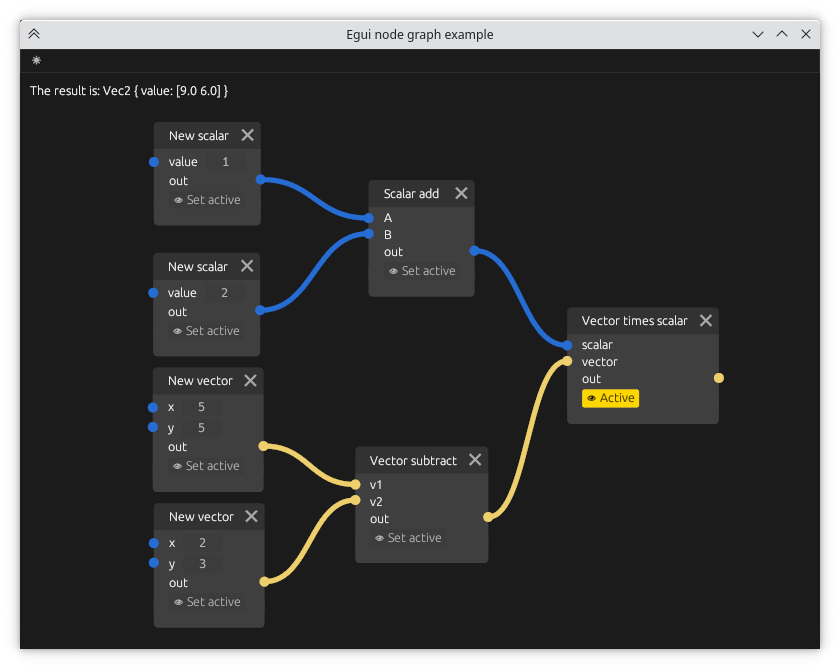
Egui node graph is a featureful, customizable library to create node graph applications using egui. The library takes care of presenting a node graph to your users, and allows customizing many aspects of the interaction, creating the semantics you want for your specific application.
Features and goals
This crate is meant to be a solid base for anyone wanting to expose a node graph interface to their users. Its main design goal is to be completely agnostic to the semantics of the graph, be it game logic, audio production, dialog trees, shader generators... we have you covered!
The purpose of this library is to draw your graphs and handle the common user interaction, like adding new nodes, moving nodes or creating connections. All the additional functionality is provided by the user by means of custom user types implementing several traits.
Usage
To see a node graph in action, simply clone this repository and launch the
example using cargo run. This should open a window with an empty canvas. Right
clicking anywhere on the screen will bring up the node finder menu.
The application code in the example is thoroughly commented and serves as a good introduction to embedding this library in your egui project.
A note on API visibility
Contrary to the general tendency in the Rust ecosytem, this library exposes all
types and fields that may be remotely relevant to a user as public. This is done
with the intent to be as flexible as possible, so no implementation details are
hidden from users who wish to tinker with the internals. Note that this crate
forbids use of unsafe so there is no risk of introducing UB by breaking any of
its invariants.
That being said, for the most typical use cases, you will want to stick to the
customization options this crate provides for you: The generic types in the
GraphEditorState object and their associated traits are the main API, all of
the other types and fields in this crate should be considered an implementation
detail. The example project contains a detailed explanation of all the
customization options and how are users supposed to interact with this crate.
Finally, this does not change the fact that this crate follows semantic versioning, as is usual in the Rust ecosystem. Any change to a public field is still considered breaking.
Use cases
Egui node graph is the library powering the graph user interface of
Blackjack, a 3d procedural modelling
software built in Rust using egui, rend3 and wgpu.
 Are you using this crate for something cool? Add yourself to this section by sending a PR!
Contributing
Contributions are welcome! Before writing a PR, please get in touch by filing an issue 😄